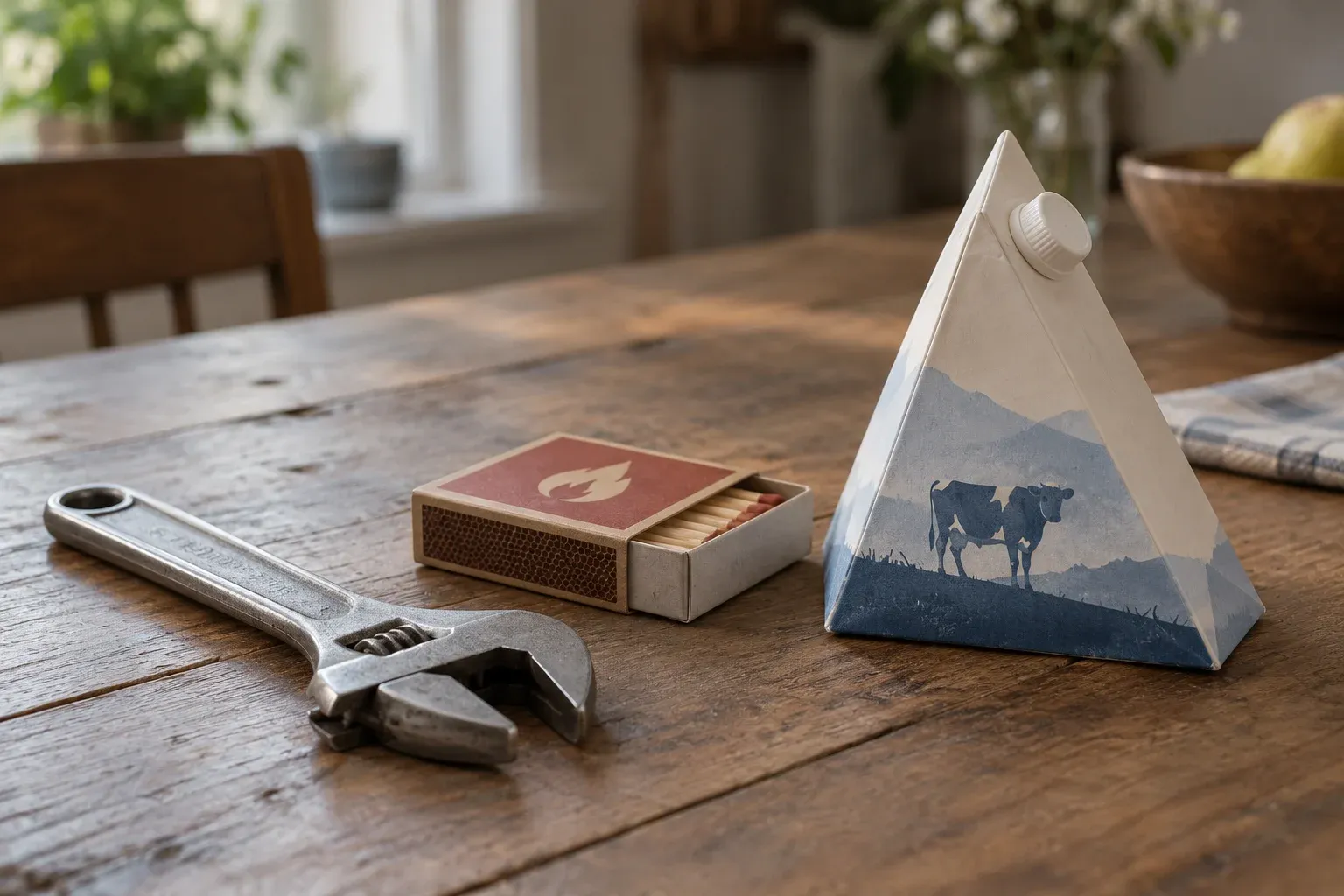
Sweden really did invent a surprising amount of what you use daily, mostly in its 19th- and 20th-century factories. But the popular lists overclaim. Here’s what is clearly Swedish, what is shared, and where to see it.
When you need this
A Swedish friend has just claimed the zipper, and you want to check. You’re planning a rainy day in Stockholm and wondering whether the science museum is worth it. Or you’re driving the E4 past Jönköping and want a short, specific stop. You’ve buckled a seatbelt, opened a milk carton or struck a match on this trip, and you’re curious where they came from.
The clearly Swedish inventions
These are the claims that hold up at the source: a Swedish inventor, working in Sweden, with a date.
| Invention | Who and when | The detail lists skip |
|---|---|---|
| Celsius scale | Anders Celsius, Uppsala, 1742 | His own thermometer had 100 at freezing and 0 at boiling |
| Safety match | Gustaf Erik Pasch, 1844; made commercial by the Lundström brothers in Jönköping | Still called “Swedish matches” |
| Dynamite | Alfred Nobel, invented 1866, patented 1867 | He also invented a blasting cap and held 355 patents |
| Adjustable wrench | J.P. Johansson, Enköping, patent 1892 | The one-jaw screw design; became the Bahco wrench, now made in Spain |
| Self-aligning ball bearing | Sven Wingquist, Gothenburg, 1907 | Founded SKF the same year |
| Absorption refrigerator | Baltzar von Platen and Carl Munters, KTH, 1922 | A silent fridge with no moving parts; Electrolux from 1925 |
| Tetra Pak carton | Erik Wallenberg’s idea, 1944; company launched 1951 | Folded from one sheet of paper into a tetrahedron |
| Implanted pacemaker | Rune Elmqvist and surgeon Åke Senning, 8 October 1958 | Never patented |
| Three-point seatbelt | Nils Bohlin at Volvo, 1959 | Volvo credits it with at least a million lives |
Two more belong on any Swedish list. Gustaf Dalén of AGA won the 1912 Nobel Prize in Physics for automatic lighthouse regulators, including a valve that switched the light off by day. And the electric Advent candlestick in Swedish windows every December was built by Oscar Andersson at Philips in Gothenburg in 1934 and went on sale in 1937. More in Advent in Sweden.
Nobel’s story comes with a twist. He was born in Stockholm in 1833, died in San Remo in 1896, and his dynamite fortune now funds the Nobel Prizes. See the Nobel Prize Museum and Nobel Week.
Shared and disputed credits
This is where most lists go wrong. Each of these has a real Swedish connection, but “Sweden invented it” is not the full story.
| Invention | The Swedish part | The rest of the story |
|---|---|---|
| Zipper | Gideon Sundbäck, who emigrated from Småland to the USA, solved the design in 1913 and patented it in 1914 | Americans Elias Howe (1851) and Whitcomb Judson came first with versions that jammed |
| Bluetooth | Developed at Ericsson’s mobile phone division in the mid-1990s | By Dutch engineer Jaap Haartsen; named after Danish King Harald Bluetooth; standardised with Intel and Nokia from 1996 |
| Ball bearing | Wingquist’s self-aligning design, 1907 | The first ball bearings were made in Germany in the 1800s |
| Adjustable wrench | Johansson’s 1892 one-jaw design | Briton Joseph Stubs took one of the first adjustable-wrench patents in 1840 |
| Dialysis | Nils Alwall in Lund built a machine in the mid-1940s, described as the first used in hospitals | Dutchman Willem Kolff built the first artificial kidney in 1943 |
| Seatbelt | The three-point design | Simpler belts were in use long before |
| Pacemaker | The first implantable one | American Paul Zoll built an earlier external, stationary pacemaker |
The fair phrasing for the zipper is “Swedish-American”. For Bluetooth it’s “developed at a Swedish company”. The Danes, meanwhile, call an adjustable wrench a svensknøgle (“Swedish key”), and Russians call it shvedik, “little Swede”.
Two inventions given to the world
Two of Sweden’s biggest lifesavers were deliberately not locked up.
- The three-point seatbelt. Volvo engineer Nils Bohlin perfected it in 1959, and Volvo made the patent available to the rest of the industry without payment or claims. It’s now in most vehicles, and its use is required by law around the world; the Swedish rules are in driving in Sweden.
- The implanted pacemaker. Rune Elmqvist and Åke Senning never patented it. Their first patient, Arne Larsson, lived to 86 and went through 26 pacemakers.
Swedish companies, not inventions
Some names on “Swedish invention” lists are companies, and one no longer exists.
- Spotify is a streaming service launched in 2008 and headquartered in Stockholm. Its founder, Daniel Ek, is now Executive Chairman. It’s a Swedish success, not an invention.
- Skype was founded in 2003 by Swedish entrepreneur Niklas Zennström and Danish entrepreneur Janus Friis. Its first code was written in Tallinn by three Estonian developers, and Estonia counts it as the start of its tech sector. Microsoft retired Skype on 5 May 2025 and moved users to Teams Free, so it’s history now, not a product.
Where to see Swedish inventions
There isn’t a museum for every invention. These four tell the stories best.
Tekniska museet, Stockholm. The National Museum of Science and Technology is the main stop, at Museivägen 7 on Norra Djurgården. Take bus 69 from Central Station to Museiparken. It’s open every day, children under 7 enter free, and dome shows at Wisdome Stockholm are booked separately. Before you go, skim its Swedish-language “100 innovationer” pages, which cover dynamite, the wrench, the pacemaker, Tetra Pak, the zipper and more.
The Matchstick Museum (Tändsticksmuseet), Jönköping. Housed in a listed wooden factory building from 1848 on the shore of Lake Vättern, it has preserved machines and a matchbox-making activity for children. At its peak, around 2,000 people, a third of the town, worked in the match factory. It’s an easy stop off the E4.
The Nobel Prize Museum, Stockholm. On Stortorget in Gamla stan, it is the place to connect dynamite with the prizes it pays for. Hours change by month.
World of Volvo, Gothenburg. At Lyckholms Torg 1 by Liseberg, it shows part of the old Volvo Museum collection. Don’t head to Arendal: the Volvo Museum there closed in December 2023. Gothenburg is also SKF’s home town. More in Gothenburg’s museums.
For Celsius, Uppsala is his town: his temperature series, begun in 1722, is one of the longest in the world. See Uppsala.
Practical information
| Place | What it covers | Admission | Getting there |
|---|---|---|---|
| Tekniska museet, Stockholm | Science and technology, inventions in context | Paid; under 7 free; reduced 7–18, students, seniors; free with an LMA card | Bus 69 to Museiparken |
| Wisdome Stockholm (inside Tekniska) | Dome and planetarium shows | Booked separately on top of entry | As above |
| Matchstick Museum, Jönköping | The safety match and the match industry | Check the museum’s page | Central Jönköping, by Lake Vättern |
| Nobel Prize Museum, Stockholm | Alfred Nobel and the prizes | Paid; under 18 free | Stortorget 2, Gamla stan |
| World of Volvo, Gothenburg | Volvo history, part of the old museum collection | Check the operator’s page | Lyckholms Torg 1, by Liseberg |
| Tekniska’s “100 innovationer” pages | The invention histories (Swedish) | Free online | tekniskamuseet.se |
FAQ
What are the most famous Swedish inventions?
The best-documented are dynamite (Alfred Nobel, patented 1867), the one-jaw adjustable wrench (J.P. Johansson, 1892), the self-aligning ball bearing (Sven Wingquist, 1907), the three-point seatbelt (Nils Bohlin at Volvo, 1959), the first implanted pacemaker (1958), the Tetra Pak carton (1944) and the safety match (1844). The Celsius scale dates from 1742 in Uppsala.
Did a Swede invent the zipper?
Partly. Earlier versions came from Americans Elias Howe and Whitcomb Judson, but they jammed and sprang open. Gideon Sundbäck, who had emigrated from Småland to the USA, solved the design in 1913 and patented it in 1914, along with a machine to mass-produce it. So the modern zipper is best called a Swedish-American invention, made in the United States.
Is Bluetooth a Swedish invention?
It was developed at Ericsson, the Swedish telecom company, in the mid-1990s, but the engineer credited, Jaap Haartsen, is Dutch. The name honours a Danish king, Harald Bluetooth, and Intel, Ericsson and Nokia standardised it together from 1996. “Developed at a Swedish company” is accurate; “invented by a Swede” is not.
Was Skype Swedish?
Partly. Skype was founded in 2003 by Swedish entrepreneur Niklas Zennström and Danish entrepreneur Janus Friis, and its first code was written in Tallinn by three Estonian developers. Estonia counts it as the start of its tech sector. Microsoft, which owned it, retired Skype on 5 May 2025 and moved users to Teams Free.
Did Volvo really give away the seatbelt patent?
Volvo’s own heritage pages say so. Engineer Nils Bohlin perfected the three-point safety belt in 1959, and Volvo made the patent available to the rest of the industry without payment or claims. Volvo credits the belt with saving at least a million lives. Seatbelts themselves are older; the Swedish contribution is the three-point design.
Where can I see Swedish inventions in Sweden?
Tekniska museet, the National Museum of Science and Technology in Stockholm, is the main stop, open all year by bus 69 from Central Station. Add the Matchstick Museum in Jönköping for the safety match, the Nobel Prize Museum in Gamla stan for Nobel’s legacy, and World of Volvo in Gothenburg for cars.
Did Anders Celsius invent the thermometer?
No. Thermometers already existed; Celsius found none reliable and in 1742 defined a scale of 100 degrees between the freezing and boiling points of water. Oddly, his own thermometer ran the other way, with 100 at freezing and 0 at boiling. The scale was flipped later and is now the international standard.
Related guides
- Nobel Prize in Stockholm — the museum and Nobel Week, where the dynamite fortune ended up
- Swedish design — the other half of “made in Sweden”, and where to buy it
- Gothenburg museums — the city of SKF and Volvo, and what replaced the Volvo Museum
- Advent in Sweden — the electric window candlestick invented in Gothenburg
- The IKEA Museum — Swedish product history you can walk through in Älmhult
Facts verified 2026-10-06. Sources: Tekniska museet, Nobel Foundation, Uppsala University, European Patent Office, Bluetooth SIG, Volvo Group, Microsoft, ERR, Invest in Estonia, Spotify, Destination Jönköping — full register in this topic’s source file. Found something outdated? Tell us and we’ll fix it.