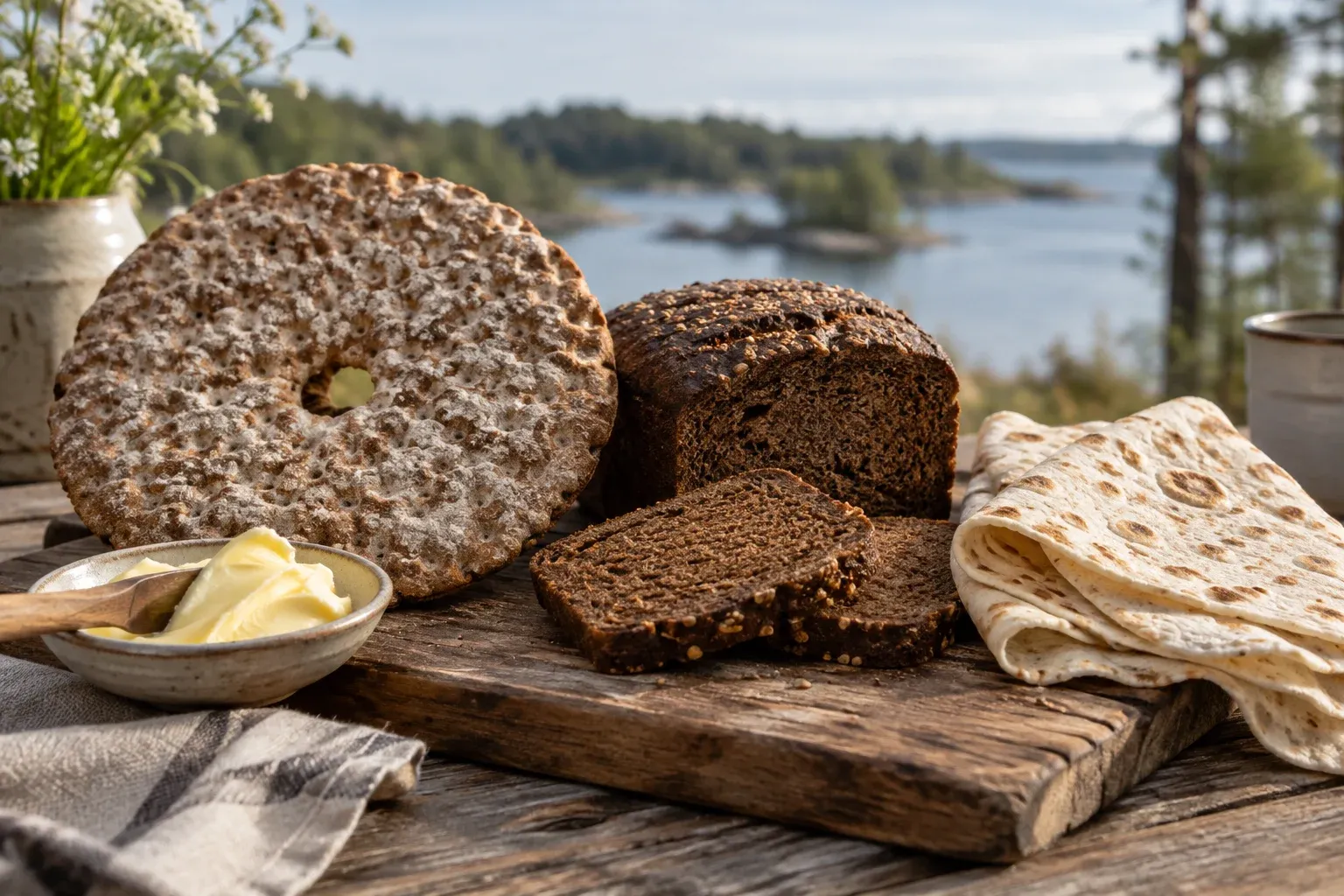
Yes, the sandwich loaf really is sweet. Here is how much sugar is in it according to Sweden’s own food agency, where the habit comes from, and the three label words that get you the bread you actually want.
When you need this
You made a ham-and-cheese sandwich and it tasted faintly of syrup. You are cutting down on sugar, or managing diabetes, and need to read a Swedish bread bag. You want to try the classics — crispbread, tunnbröd, kavring — or you are standing between a bakery counter and a wall of sliced loaves wondering which one is plain.
How sweet is Swedish bread?
Livsmedelsverket, the Swedish Food Agency, runs the national food composition database. Its entries for generic bread types settle the question with numbers rather than impressions:
| Bread type (database entry) | Sugars per 100 g | Of which added (agency estimate) |
|---|---|---|
| Kavring-type dark rye bread | 10.8 g | about 11 g |
| Sweetened rye-blend bread (rågsikt) | 8.0 g | 8 g |
| Soft milk tunnbröd | 8.4 g | 4 g |
| Plain white loaf | 6.0 g | 6 g |
| Hot-dog bun | 6.0 g | 3 g |
| Baguette | 3.6 g | none |
| Unsweetened rye-blend bread | 2.1 g | none |
| Rye crispbread | 1.2–2.7 g | none |
The pattern is clear. The everyday soft loaves — the rye-wheat blend and the white sandwich loaf — carry added sugar, while baguette-style bread, unsweetened loaves and crispbread do not. The Keyhole health symbol caps soft bread at 5 g sugars per 100 g, so a typical sweetened rye-blend loaf would not qualify.
Why it is sweet
The sweetener is usually sirap, Swedish baking syrup, light (ljus) or dark (mörk). It does double duty: it sweetens, and in dark breads it colours. Smaka Sverige, the Swedish Board of Agriculture’s food-heritage site, says kavring “gets its dark colour from dark syrup”, and the EU-protected Upplandskubb is defined by rye, wheat and traditional syrup, with a “sweetish, syrup-like” taste.
The habit has festive roots. Vörtbröd (wort bread, made with syrup, beer wort and bitter orange peel) began as a manor-house bread and became the farm households’ holiday bread. According to Smaka Sverige it was prized for its sweetness, a welcome change from the unsweetened bread of every day. Large bakeries later marketed it nationwide for Christmas and Easter.
Official sources do not give a date when everyday loaves turned sweet, and we won’t invent one. What they show is a country where sweet bread was once the treat — and where much of the ordinary loaf now tastes a little like it.
Knäckebröd: the unsweet half
Swedish bread is not all sweet. Knäckebröd (crispbread) is traditionally made from four things: rye flour, yeast, water and salt. The dough is rolled thin, pricked and baked hot. Rye crispbread goes back to the Middle Ages, and the classic round shape with a hole in the middle comes from drying the breads on a pole near the ceiling.
In the database, rye crispbread has between 1.2 and 2.7 g sugars per 100 g, none of it added, and some kinds are 100% whole grain. Livsmedelsverket points out that one 12-gram slice of 100% whole-grain crispbread gives 12 of the 90 grams of whole grain it recommends a day. It is also the Swedish breakfast default — more on that in our Swedish breakfast guide.
Tunnbröd and the north
Tunnbröd (thin bread) is rolled paper-thin, pricked and baked for 20–45 seconds in a very hot oven. The original northern version was unleavened barley flour, salt and water; today it is made hard and crisp, soft and pliable, or somewhere between. Hard tunnbröd was a storage bread that kept for a long time.
The tradition is strongest in Norrland, northern Svealand and Bohuslän. Soft tunnbröd is most popular from southern Sweden up to Dalarna and in Jämtland; hard tunnbröd is strongest in the rest of Norrland, above all along the Baltic coast. Soft tunnbröd is also the wrap of the kiosk tunnbrödsrulle — see Swedish street food. Note that soft milk tunnbröd is often sweetened, while hard whole-grain tunnbröd is not.
The best-known industrial baker of the north is Polarbröd of Älvsbyn, a five-generation family company that describes itself as Sweden’s third-largest maker of everyday bread. Its round Polarkaka belongs to the family of soft griddle breads (kakbröd) alongside the west coast’s Hönökaka and the Sami gáhkku.
Reading a Swedish bread label
EU labelling law does most of the work for you on prepacked bread:
- Ingredients are listed in descending order of weight. If sirap, socker (sugar) or vört (wort) appears among the first few, the loaf is sweet.
- Look for osötat (unsweetened) on the bag.
- Check the whole-grain figure. If fullkorn (whole grain) is in the name or emphasised on the pack, the amount must be stated — usually as a percentage in the ingredient list.
- Read the sugars line in the nutrition table and compare it with the Keyhole’s 5 g.
- Allergens are in bold: wheat, rye, barley and oats are gluten cereals.
Warning: a dark colour and the word grovt (coarse) do not guarantee whole grain. A loaf can be dark from syrup. Check the percentage, not the colour.
The Keyhole on bread
The green or black Keyhole (Nyckelhålet) is Livsmedelsverket’s voluntary symbol for the healthier choice within a food group. The rules for bread are binding regulation:
| Bread group | Sugars max | Fibre min | Whole grain min | Salt max |
|---|---|---|---|---|
| Soft bread | 5 g | 5 g | 30% | 1.0 g |
| Rye bread | 5 g | 6 g | 35% | 1.2 g |
| Crispbread and rusks | 5 g | 6 g | 50% | 1.3 g |
Amounts are per 100 g; whole grain is calculated on dry matter. Fat is capped at 7 g in all three groups, and Keyhole products may not contain sweeteners, so the sugar cannot simply be swapped for an artificial one. Gluten-free Keyhole bread needs only 10% whole grain (soft) or 15% (crispbread).
Change coming: on 26 January 2026 Livsmedelsverket sent revised Keyhole criteria out for consultation. They raise the fibre and whole-grain requirements for bread, with entry into force planned during 2027 and an 18-month transition. Until then, the limits above apply.
The Keyhole is not an organic or gluten-free label; our food labels guide explains what each mark means.
Bakery or supermarket?
Supermarkets sell packaged sliced bread alongside bread baked in store from frozen dough. Bakeries (bageri) and pastry shops (konditori) sell fresh loaves by the piece, and sourdough (surdeg) is easy to find in city bakeries and many supermarkets — usually the least sweet soft bread on offer, though recipes vary.
Unpackaged bakery bread does not need a printed ingredient list, but the bakery must be able to tell you about allergens, and may do so orally. Ask: staff can usually tell you whether a loaf has syrup too. Prices vary by chain and bakery, so compare the price per kilo — see jämförpris shelf labels.
Regional breads worth trying
| Region | Bread | What it is |
|---|---|---|
| Norrland | Tunnbröd | Thin flatbread, hard or soft |
| Västerbotten | Ljusugnsbröd | Hard rye-and-barley tunnbröd, baked once the oven roof “lightens” with heat |
| Sápmi | Gáhkku | Soft Sami griddle bread, traditionally baked over an open fire |
| Skåne, Halland, Bohuslän | Kavring | Dark rye bread with scalded rye, sourdough and dark syrup |
| Uppland | Upplandskubb | Crustless round loaf of rye, wheat and syrup, cooked in a water bath; EU-protected since 2014 |
| Dalarna | Skedvi Bröd | Round rye crispbread from wood-fired stone ovens; EU-protected |
| Gotland | Gotlandslimpa | Rye loaf that may contain wort and bitter orange |
| Södermanland, Uppland, Östergötland | Vörtbröd | Wort bread with syrup and spices; now nationwide at Christmas and Easter |
Kavring is at its best after maturing a few days, Smaka Sverige notes — try it with pickled herring or cheese. For Christmas breads, see Swedish Christmas traditions. For the sweet bun dough, a separate category from everyday bread, see kanelbullar.
Mistakes to avoid
- Buying sliced “white” or rye-blend bread for savoury sandwiches and finding it sweet. Look for osötat or choose crispbread.
- Reading rågbröd (rye bread) as sugar-free. The sweetened rye blend has 8 g sugars per 100 g.
- Treating colour as fibre. Kavring-style darkness comes from syrup.
- Assuming the Keyhole means organic or gluten-free. It is a nutrition symbol only.
- Expecting crispbread to be gluten-free. Rye, wheat and oats are all gluten cereals — see gluten-free in Sweden.
Practical information
| What | Detail |
|---|---|
| Sugar in sweetened rye-blend bread | 8 g per 100 g (Livsmedelsverket database) |
| Sugar in unsweetened rye-blend bread | 2.1 g per 100 g |
| Sugar in rye crispbread | 1.2–2.7 g per 100 g, none added |
| Keyhole sugar cap, all bread groups | 5 g per 100 g |
| Keyhole whole-grain minimum | 30% soft bread, 35% rye bread, 50% crispbread |
| Keyhole revision | Planned to take effect during 2027, 18-month transition |
| Bread prices | Not published — compare jämförpris per kilo |
| Polarbröd bakery museum, Älvsbyn | Free entry; summer opening — check the company site |
FAQ
Why is Swedish bread so sweet?
Many everyday Swedish loaves are baked with syrup. In Livsmedelsverket’s food database a sweetened rye-blend bread has 8 g sugars per 100 g and a kavring-type dark rye about 11 g, against 2.1 g for the unsweetened version. The habit has festive roots: sweet wort bread was a holiday treat that bakeries later sold nationwide. Crispbread and loaves marked osötat are the unsweetened alternatives.
How can I find unsweetened bread in Sweden?
Look for osötat (unsweetened) on the bag, read the ingredient list from the top — syrup, sugar or wort near the start means a sweet loaf — or choose crispbread, which normally has no added sugar. Keyhole bread is capped at 5 g sugars per 100 g. Sourdough loaves from bakeries are usually the least sweet soft bread, though recipes vary.
Is Swedish crispbread healthy?
It is one of the simplest breads on the shelf: traditionally rye flour, yeast, water and salt, with no added sugar. Livsmedelsverket says crispbread often contains 100% whole grain, so one 12-gram slice gives 12 grams of the 90 grams a day it recommends. Check salt and the whole-grain percentage on the pack, because recipes differ between brands.
What does the Keyhole symbol on bread mean?
The green or black Keyhole is Livsmedelsverket’s voluntary symbol for the healthier choice within a food group. Keyhole soft bread has at most 5 g sugars and 1.0 g salt per 100 g, at least 5 g fibre and at least 30% whole grain; rye bread and crispbread have stricter fibre and whole-grain minimums. New, tougher bread criteria are planned for 2027.
What is tunnbröd?
Thin Swedish flatbread, rolled out, pricked and baked in seconds at high heat. The tradition is strongest in Norrland, northern Svealand and Bohuslän. The original was unleavened barley flour, salt and water; today it comes hard and crisp or soft and pliable. Hard tunnbröd was a storage bread that kept for a long time, and soft tunnbröd is the kind rolled into a kiosk tunnbrödsrulle.
Is Swedish crispbread gluten-free?
No, not ordinary crispbread. It is made from rye, and many kinds also contain wheat or oats; all three are gluten cereals that must be emphasised in the ingredient list. Supermarkets do sell crispbread labelled glutenfri; see our gluten-free guide. If you have coeliac disease, check the label every time, because recipes change.
Related guides
- Swedish breakfast — where crispbread and soft bread actually get eaten.
- Swedish groceries worth trying — crispbread, kaviar and what to take home.
- Gluten-free in Sweden — oats, wheat starch and the crispbread trap.
- Swedish food labels — the Keyhole, KRAV and the bold allergen words.
- Swedish food guide — the whole national kitchen in one page.
Facts verified 2026-10-06. Sources: Livsmedelsverket (food composition database, Keyhole regulation, whole-grain advice), Jordbruksverket’s Smaka Sverige, Isof’s Levande kulturarv, EU Regulation 1169/2011, Polarbröd — full register in this topic’s source file. Found something outdated? Tell us and we’ll fix it.