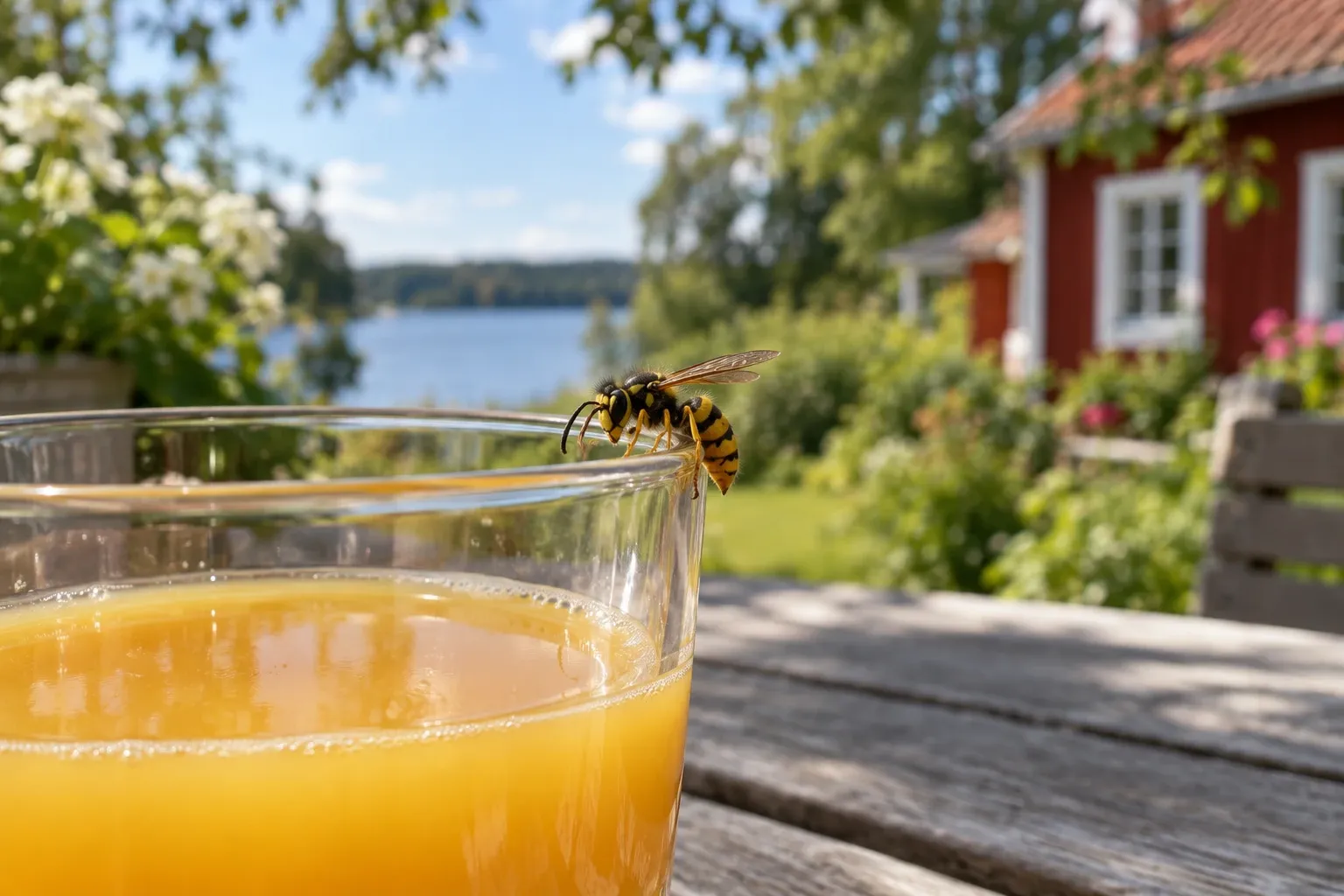
Mosquitoes aren’t the only thing biting in a Swedish summer. Five other insect groups sting or bite people, each in its own season and habitat. This guide covers which one you’ve met, which defense actually works on it, and when a sting stops being a self-care job.
When you need this
You’re eating outdoors in August and wasps have found your juice. Or you’ve been stung and need to decide between a cold compress, the pharmacy, a phone call or 112. Maybe you’re packing for a hike or a cabin week and want to know what bites besides mosquitoes. Or it’s September, you’re picking berries or mushrooms, and small flat flies are crawling through your hair.
It’s also for travelers with a known wasp or bee allergy, and for parents whose child has just picked up a hairy caterpillar.
The six at a glance
| Insect | Swedish | Season | What it does | What works |
|---|---|---|---|---|
| Wasps | geting | Peak late July–August | Stings; can trigger allergy | Calm, covered food, no swatting |
| Bees, bumblebees | bi, humla | Summer | Stings; bee leaves its sting | Scrape the sting out |
| Horseflies | broms | Peak around midsummer | Painful cutting bite | Clothing; repellent barely helps |
| Blackflies | knott | Early summer, near running water | Painful bites in swarms | Wind, open ground, covering clothing |
| Biting midges | svidknott | Late April (south) to July (far north) | Itchy bites | Wind, open ground |
| Deer keds | älgfluga, hjortlusfluga | August–October | Crawls into hair; bites now and then | Light clothing, pick off fast |
Mosquitoes have their own guide: how bad Swedish mosquitoes really are.
Wasps and bees: the only ones that can be dangerous
For almost everyone a sting is painful and nothing more. 1177, Sweden’s national health advice service, says most people stung by insects in Sweden don’t need care at all. Wasps and bees still deserve the most attention, because they’re the only insects here that can set off a life-threatening allergic reaction (anafylaxi, anaphylaxis). Severe reactions are uncommon and mainly affect adults, rarely children. Bumblebees seldom sting and usually cause milder symptoms.
Why August is wasp month. A colony starts in spring from one overwintered queen. By late July and early August it can have up to about a thousand workers hunting sugar for “flight fuel”: ice cream, juice, bins. The workers die off in August and September, and only mated queens survive the winter. Social-wasp numbers also run in a roughly two-year, sometimes three-year cycle, according to SLU’s species center. A getingsommar (a “wasp summer”) just means more wasps than last year.
How to avoid stings, from 1177 and the Swedish Museum of Natural History’s duty biologist:
- Stay calm. Swatting and flapping make wasps defensive.
- Don’t kill a wasp near other people. A killed wasp or bee releases scent signals that attract more.
- Cover sweet food and drinks, and eat outdoors less where you can.
- Never drink from an open can or bottle you can’t see into. A sting in the mouth or throat can swell enough to make breathing difficult, allergy or not.
- Leave windfall fruit alone, cover your head, and don’t walk barefoot.
Not every striped insect is a wasp. Hoverflies (blomflugor) copy the yellow-and-black stripes on flowers and can’t sting.
After a sting: three tiers
| Situation | What to do |
|---|---|
| Pain, redness, swelling at the sting site | Treat it yourself (below) |
| Stung in the mouth; known allergy; face swelling; itchy hives spreading fast over the body; nausea, dizziness or cold sweat; swelling still increasing after a few days | Contact a vårdcentral (health center) or out-of-hours clinic immediately; emergency department if closed |
| Feeling faint or difficulty breathing | Call 112 at once. Use your adrenaline pen first if you have one |
Self-care. Cool the spot with ice wrapped in a cloth, or with cold water. A honeybee often leaves its sting and venom sac in the skin, and they keep pumping venom for a minute or so. Scrape them out sideways with a fingernail or a table knife. Non-prescription hydrocortisone cream, cooling balm or local-anesthetic ointment ease the itch. Antihistamine tablets help, and a plaster stops you scratching the spot open. With young children, ask a doctor before using local-anesthetic ointment under 18 months or hydrocortisone under 2 years. Antihistamine age limits are on the pack, and pharmacists will advise.
Big swelling isn’t allergy. A normal sting swells and reddens more and more, peaking 12–24 hours later. It’s usually gone in a day but can take up to a week. Allergic reactions usually show 10–30 minutes after the sting, as symptoms away from the sting: hives, swollen lips or eyes, nausea, faintness. Many stings at once can mimic allergy. Children, older people and anyone with heart or lung disease are more sensitive. Giftinformationscentralen, the Swedish Poisons Information Centre, also says to see a doctor after a sting in the eye.
Traveling with a sting allergy. Bring your adrenaline auto-injectors from home. In Sweden they’re prescribed by a doctor, so you can’t pick one up off the shelf. The usual kit is two pens plus antihistamine tablets, and Swedish regional guidance says always carry more than one, because adrenaline wears off quickly and you may need a second dose. Don’t spend the first half hour after a sting alone. For using a foreign prescription, see pharmacies in Sweden.
Horseflies: repellent won’t save you
Bromsar (horseflies) breed in damp, boggy ground and hang around wetland edges, lakesides and pasture. Only the females bite. They’re active mostly in sunshine and peak around midsummer, though one group, the rain horseflies, bites in cloudy weather too. Norwegian data for the same family show activity dropping to almost nothing from mid-August.
They find you by smell from a distance and by sight up close. Large, dark, moving shapes attract them most. Their saw-like mouthparts cut the skin, so the bite hurts sharply and can swell red; some people react allergically. A bite hurts enough that you swat, so the fly lands and bites again.
The Norwegian Institute of Public Health puts it bluntly: mosquito repellents and other insect repellents have very little effect on horseflies, and in their peak season only clothing protects. Wear long, light clothing and skip sunny wetland edges at midday.
Knott and svidknott
Knott (blackflies) breed in running water, so they follow rivers and streams, and an early warm spring can bring a mass hatch. They bite rather than pierce, the bites themselves can hurt, and they rarely come alone. Svidknott (biting midges) breed in damp topsoil. They hatch from late April in the south and as late as July north of the Arctic Circle.
Both are scarcer on windy, open, higher ground. That’s the National Veterinary Institute’s advice for grazing animals, and it works just as well for a lunch stop or a tent pitch. Bites usually settle within a few days with the same self-care as mosquito bites. Contact a health center if swelling, redness and pain keep getting worse over several days, or after many bites with heavy swelling and itching.
Deer keds: the autumn hair-crawlers
If small, flat flies land on you in a September forest and crawl into your hair, they’re almost certainly deer keds (älgfluga or hjortlusfluga). These parasites of moose and deer fly from August to October, from mid-July in hot summers, and go inactive below about 5 °C. Once a ked lands on a host it sheds its wings and never flies again. Berry pickers, mushroom hunters and hunters meet them most. They’re common in southern and central Sweden and have been spreading north with milder winters. The main range reaches roughly the latitude of Mora, with scattered finds further north.
They bite people only now and then. Most people’s problem is the crawling, but a bite can itch intensely for 14–20 days. Ordinary repellent gives little protection. A Finnish study found keds prefer black and red clothing to white and mostly land on the upper body, so a light jacket and cap may help. Pick them off immediately, before they reach your hair or get under clothing. They’re too flat and tough to crush against skin, so pinch one between your fingers and flick it away. See also hiking during hunting season, because ked season is hunting season.
Hairy caterpillars
The grass eggar caterpillar (gräsulv), common across most of Sweden, has long hairs linked to small venom glands. Pine and oak processionary moths are rare, in southern Sweden and above all on Gotland. Their microscopic barbed hairs work into skin and mucous membranes. Reactions show within hours and can last up to a week. After contact, take off affected clothing, rings and watches and rinse with plenty of water. Dry with a hairdryer rather than a towel, lift out hairs with tweezers or tape, and use hydrocortisone cream.
Is anything infectious?
Rarely, but “harmless” isn’t quite right either. Many English pages say knott and horseflies carry nothing that matters to people in Sweden. 1177’s current page, updated 1 February 2026, says harpest (tularemia) can be spread by mosquitoes and knott in parts of Sweden. The Public Health Agency lists the bite of an infected mosquito “or other insect” as a route. Norway’s public health institute describes horseflies as possible carriers, with a very low risk to people.
Tularemia starts abruptly with high fever, headache and nausea 2–10 days after exposure. There’s often a sore at the bite and swollen, tender lymph nodes nearby. It’s a bacterial infection that needs a doctor, so call 1177 or seek care if this follows a trip outdoors.
Practical information
| Item | Detail |
|---|---|
| Emergency (faintness, breathing difficulty) | 112 |
| Health advice by phone | 1177 |
| Giftinformationscentralen, public line | 010-456 6700, around the clock |
| Pharmacy basics | Non-prescription hydrocortisone cream and antihistamine tablets; prices vary by product |
| Adrenaline pens | Prescription only; bring two from home |
| Worst months | Svidknott April–July; horseflies around midsummer; wasps late July–August; deer keds August–October |
FAQ
Are there dangerous insects in Sweden?
For most people, no. Sweden’s stinging and biting insects — wasps, bees, horseflies, knott, biting midges and deer keds — usually cause pain, swelling and itching that pass within days. The real exceptions are an allergic reaction to a wasp or bee sting, a sting inside the mouth or throat, and tularemia, a bacterial infection that can follow an insect bite.
What should I do after a wasp sting in Sweden?
Cool the spot with ice in a cloth or cold water, and use non-prescription hydrocortisone cream or antihistamine tablets for itch and swelling. Call 112 at once if you feel faint or struggle to breathe. Contact a health centre immediately if stung in the mouth, if your face swells or hives spread across your body.
Why are there so many wasps in Sweden in August?
Each colony starts in spring from one queen and grows to up to about a thousand workers by late July and early August, and the adults then hunt sugar from ice cream, juice and bins. Numbers also swing in a two-to-three-year cycle, so some summers feel worse. The workers die off in August and September.
Does mosquito repellent work on horseflies?
Barely. The Norwegian Institute of Public Health says mosquito repellents and other insect repellents have very little effect on horseflies, and that in their peak season only clothing protects. Horseflies seek warmth, sun and large dark moving shapes, so long light clothing and avoiding sunny wetland edges at midday work better than any spray.
What are the small flat flies crawling in my hair in autumn?
Almost certainly deer keds (älgfluga or hjortlusfluga), a parasite of moose and deer that flies from August to October, sheds its wings on landing and crawls into hair and under clothing. They bite people only occasionally, though a bite can itch for weeks. Pinch them off quickly; they are too flat and tough to crush.
Can I get sick from knott or horsefly bites in Sweden?
Rarely, but it is possible. 1177 says tularemia (harpest) can be spread by mosquitoes and knott in parts of Sweden, and horseflies are described as possible carriers. See a doctor or call 1177 if a high fever, headache and a sore with swollen glands appear two to ten days after bites.
I have a bee or wasp allergy. What should I bring to Sweden?
Bring your adrenaline auto-injectors from home, since in Sweden they are prescription medicines prescribed by a doctor. 1177 describes the usual kit as two pens plus antihistamine tablets, and Swedish regional guidance says to always carry more than one pen. If stung and reacting, use the pen first, then call 112.
Related guides
- Mosquitoes in Sweden — where and when the other half of the problem is brutal.
- Ticks in Sweden — the bite that carries TBE and Lyme disease.
- 112 and Sweden’s emergency numbers — what happens when you call.
- 1177: Sweden’s medical advice line — the number to ring when a sting is not an emergency.
- Berry picking in Sweden — the autumn trip where you’ll meet deer keds.
Facts verified 2026-10-15. Sources: 1177 Vårdguiden, Giftinformationscentralen, Folkhälsomyndigheten, SVA, SLU Artdatabanken, Jordbruksverket, Norwegian Institute of Public Health (Folkehelseinstituttet), Region Sörmland — full register in this topic’s source file. Found something outdated? Tell us and we’ll fix it.