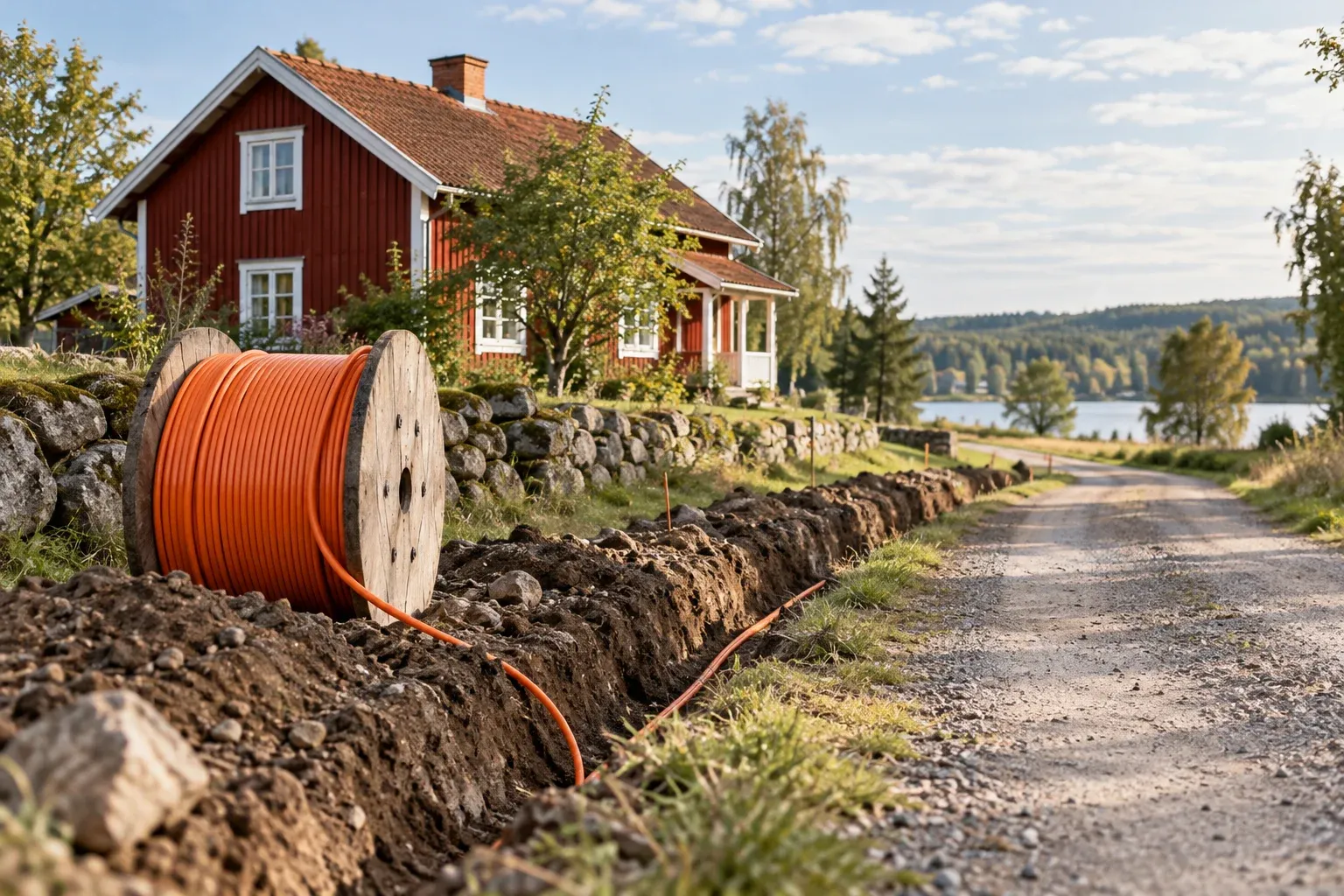
Sweden ran fiber to its farms and forest villages largely through local projects, not one national company. Here is who owns the cable, why you choose a provider rather than a network, what the end of copper means, and how to tell whether a rural cabin will carry your video calls.
When you need this
You’re renting a cabin in the countryside and need to know whether the internet will hold up for work. You’re a remote worker choosing where in Sweden to spend a few months. You own or are buying a country house and the village has a fiber association asking for a decision. Or a letter has arrived saying the old copper line to a property is about to be shut down.
How much of Sweden has fiber
PTS, the Swedish telecom regulator, maps broadband every autumn. Its latest figures, measured on 1 October 2025 and published in May 2026, look like this:
| Measure (households and businesses) | Share |
|---|---|
| Could get fixed broadband of at least 1 Gbit/s, nationally | about 98% |
| The same in glesbygd (sparsely populated areas) | about 88% |
| Fiber actually installed in the building | about 86% |
| Estimated to subscribe to such a connection | about 61% |
That 98% matched the government’s goal for 2025. But read the table carefully: the headline is access, meaning fiber reaches the building or could be connected. It doesn’t mean every house is wired, and it certainly doesn’t mean every house subscribes. In sparsely populated areas roughly one address in eight has no gigabit option at all.
Mobile networks are the fallback. Basic mobile coverage reached 90% of Sweden’s land area in autumn 2025, and coverage with good capacity (at least 50 Mbit/s) reached 81% of populated areas, so the gaps sit exactly where cabins do: forest, mountains and archipelago (see mobile coverage in Sweden’s wilderness).
The government has since set new goals for 2030: connectivity along all public roads and railways, and fast enough connections in all populated areas, which explicitly count holiday homes.
Who built it: stadsnät, byanät and operators
Three kinds of owner put fiber in the ground.
Municipal city networks. A stadsnät (city network) is a local fiber network, and about nine in ten are run by municipal companies. Most municipalities have one; the city-network trade association represents networks in nearly 200 of Sweden’s 290 municipalities. That municipalities own telecom infrastructure at all surprises many visitors, but it fits how much local government runs in Sweden (see how Sweden is governed).
Village networks. A byanät (village network) is a local fiber network that connects the properties of a small area to an operator’s network. It is usually run by the village as an economic association of property owners: a fiberförening or bredbandsförening. Members pay in an insats (contribution), and much of the work was done by the villagers themselves. Around 1,000 such networks existed by 2021, many built with volunteer work and EU rural-development money. Byanätsforum, the associations’ trade body, cites PTS figures showing that 15.6% of people in rural Sweden get broadband through an association-owned network.
Commercial operators built most of the rest, and the state pays for parts that nobody builds on market terms.
| Owner | Typical place | Who you deal with |
|---|---|---|
| Stadsnät | Towns and their surroundings | A service provider chosen from the network’s list |
| Byanät | Villages and farm districts | The association, plus a service provider |
| Commercial operator | Everywhere | The operator or a provider on its network |
A government inquiry (SOU 2025:110) describes village networks as generally not public communications networks, so the associations running them are not operators in the legal sense. It proposes giving them rights, but not an operator’s obligations, when Swedish law is adapted to the EU’s Gigabit Infrastructure Act. As of October 2026 that is a proposal, not law.
Open networks: why you pick a provider, not a cable
Many Swedish networks are öppna nät (open networks). The network owner runs the fiber, and several competing service providers sell broadband over it. You choose a provider from the list for your address, and providers differ in price and speed on the same fiber.
Networks built with state support must be open: they have to give other operators access on fair, non-discriminatory terms, and must be built with spare capacity for at least three access seekers. Other networks are open by choice, so your favorite provider may not be on every list.
Two consequences matter in practice. When something breaks, you call the service provider you pay, not the network owner. And switching provider on the same network must happen with no more than one working day without service.
How the state fills the gaps
Where nobody builds on market terms, PTS awards broadband support under a 2020 ordinance and EU state-aid rules, running separate competitions for Norrland, Svealand and Götaland. The government says it is spending 3.8 billion kr on broadband build-out over 2024–2027 (as of July 2025). The 2026 support call sets clear conditions:
- Speed: supported projects must give access to at least 1 Gbit/s.
- Connection duty: any building in the project must be connected if the owner orders within two years of completion.
- Price: there must be an offer to connect the building alone for 10,000–40,000 kr including VAT, digging on the plot included (checked 2026-10-14). An association member’s insats can be counted against it, and a ROT tax deduction may push the real cost lower.
- Deadline: projects awarded support in 2026 must be finished by 3 December 2029.
Outside supported projects nothing obliges an operator to offer fiber, and the price of a new connection isn’t regulated. If you pay for a connection in instalments, the repayment may run longer than the usual 24-month contract cap.
There is a legal floor, but it’s narrow. You have a right to telephony and functional internet access at a reasonable price at your permanent residence, by whatever technology works. Holiday homes are not covered.
The end of copper in 2026
Telia owns Sweden’s old copper telephone network through its subsidiary Skanova and decides which parts close. Telia says the whole copper network will be decommissioned by the end of 2026, and affected customers are offered fiber or mobile services instead. Municipalities such as Ödeshög list 2026 as the year the local copper comes down.
If you’re reading older guides: guides written before 2025 describe copper being removed area by area with no end date. Telia’s own page now says the entire network is gone by the end of 2026.
What it means for a property you own or rent long-term:
- An old landline, an ADSL modem or an alarm running over the copper line stops working unless it is replaced.
- You don’t have to accept the replacement Telia offers. Any provider serving the area can be used, but check mobile coverage at the house before choosing a mobile solution.
- Sellers use the shutdown to rush people. Affected properties should have been told, and Telia publishes its area lists.
Alarms and remote heating switches have a second problem: the 2G and 3G mobile shutdowns, covered in owning a Swedish cabin.
What it means for cabin renters and remote workers
A building can sit next to fiber and never have been connected, so the region tells you little. The only reliable check is the specific cabin.
| Connection | What to expect | Fits remote work? |
|---|---|---|
| Fiber | Commonly 100–1,000 Mbit/s, stable, no data cap | Yes |
| 4G/5G mobile broadband | Portable, quick to set up; may have data limits, 5G thin outside larger cities | Depends on the signal at the cabin |
| “Wifi” with no details | Could be either | Ask before booking |
Before you book, ask the host: “Fiber or mobile broadband, and what speed?” Then look the address up in PTS’s free Bredbandskartan. Bring a mobile backup, such as a local prepaid SIM in a travel router, for the days the main connection drops (see SIM cards and eSIMs and WiFi in Sweden). Expectations for the rest of the cabin are in what to expect in a Swedish holiday cabin, and the booking side in renting a stuga.
Buying a house rather than renting? Ask whether the property is already a member of the village fiber association and whether its connection fee has been paid. If you’re moving in as a resident, contracts and credit checks are covered in phone contracts and broadband as a new resident.
Practical information
| Item | What to know | Checked |
|---|---|---|
| Gigabit access, national / sparsely populated | About 98% / about 88% (measured 1 October 2025) | 2026-10-14 |
| Connection in a PTS-supported 2026 project | An offer within 10,000–40,000 kr incl. VAT, plot digging included | 2026-10-14 |
| Connection outside supported projects | Not price-regulated; ask several providers | 2026-10-14 |
| Monthly broadband service | Varies by provider and address; compare on the network’s list | 2026-10-14 |
| Telia copper network | Fully decommissioned by the end of 2026 | 2026-10-14 |
| PTS Bredbandskartan | Free address lookup | 2026-10-14 |
FAQ
Does rural Sweden have fiber broadband?
Mostly, yes. PTS found that about 98% of Swedish households and businesses could get 1 Gbit/s fixed broadband in October 2025, and about 88% in sparsely populated areas. Access is not the same as a connection, though: about 86% have fiber in the building, and an estimated 61% subscribe. Check the exact address before you rely on it.
What is a byanät?
A byanät (village network) is a local fiber network built by a broadband association of property owners, usually an economic association, to connect a village to an operator’s network. Around 1,000 exist, many dug with volunteer work and EU rural-development money. Byanätsforum cites PTS figures showing 15.6% of rural residents connect this way.
What is a stadsnät?
A stadsnät (city network) is a local fiber network, in about nine cases out of ten owned by a municipal company. Most municipalities have one, and many run it as an open network where several service providers sell over the same fiber. You pick a provider from the list for your address; the network owner stays in the background.
Will a Swedish holiday cabin have good internet?
It depends on the cabin, not the region. A building can sit next to fiber and never have been connected, and holiday homes have no legal right to broadband. Ask the host whether the cabin has fiber or mobile broadband and what speed. Fiber commonly gives 100 to 1,000 Mbit/s; mobile broadband may have data limits.
Is Sweden shutting down its copper phone network?
Yes. Telia, which owns the copper network through Skanova, says the whole network will be decommissioned by the end of 2026, and affected customers are offered fiber or mobile services instead. You don’t have to accept the replacement offered; any provider serving the area can be used. Check Telia’s area list for a specific property.
Can I choose my internet provider on Swedish fiber?
Usually, on an open network. The network owner lets several competing service providers sell over the same fiber, and you choose from the list for your address. Switching providers must happen with no more than one working day without service. On a closed network, or where the building has a group agreement, the choice may be made for you.
Related guides
- Phone contracts and broadband as a new resident — signing up for home internet once you live here
- Mobile coverage in Sweden’s wilderness — your backup where the fiber ends
- What to expect in a Swedish holiday cabin — wifi, water and linen before you book
- Sweden for digital nomads — the legal side of working remotely from Sweden
- Owning a Swedish cabin — alarms, utilities and winter after the network shutdowns
Facts verified 2026-10-14. Sources: PTS (Post- och telestyrelsen), Sveriges riksdag (Lag 2022:482), Regeringskansliet, Telia, Telekområdgivarna, Byanätsforum, Svenska Stadsnätsföreningen, Hela Sverige ska leva and Ödeshögs kommun — full register in this topic’s source file. Found something outdated? Tell us and we’ll fix it.