Your phone is your map, ticket, wallet and emergency line in Sweden, and in winter it’s also the first thing to fail. Here’s what the cold actually does to a battery, what to do about it, and the 2026 power bank rule for flying in.
When you need this
You’re heading to Lapland, the mountains or a ski resort and will lean on the phone all day. Or you’re out for the northern lights with a camera for hours. Maybe your phone just switched off at 40% on a ski lift, or says “Charging On Hold” back at the cabin. Or you’re packing power banks for the flight and want to know how many you can take.
What cold actually does to a battery
A lithium-ion battery runs on a chemical reaction, and cold slows it down. The ions inside move much more slowly, the battery loses voltage, and it can’t deliver the power the phone needs. So the percentage falls in jumps, the camera refuses to open, and the phone may switch off with charge still left.
Here’s the reassuring part: the charge isn’t gone, it’s hidden. Apple says very cold conditions “might temporarily shorten battery life” and could switch the phone off, and that battery life returns to normal once the device warms up. A phone that “died” at 30% often comes back after a while in an inside pocket. A materials chemist interviewed by SVT, Sweden’s public broadcaster, put it simply: put it in your armpit.
Heat is the real long-term enemy. Apple says very hot conditions can shorten battery life permanently. In winter, the one thing that does lasting harm is charging a battery while it’s below freezing. Consumer lithium-ion cells shouldn’t be charged below 0 °C, because lithium plates onto the anode and permanently degrades both capacity and safety.
How cold Sweden gets compared with your phone
Apple designs iPhone for an ambient temperature of 0 °C to 35 °C, with storage between −20 °C and 45 °C. Samsung gives the same 0–35 °C as the Galaxy’s optimal range and advises against keeping a phone in below-zero winter conditions. Now compare that with SMHI, the Swedish weather service:
| Where | January mean (1991–2020) | What it means for your phone |
|---|---|---|
| Götaland coasts (far south) | +1 to +2 °C | Usually near the bottom of the range; mostly fine |
| Coldest inner Lapland valleys | −15 °C, sometimes below −40 °C | Far below the range; plan for it |
| Sweden’s record | −52.6 °C, Vuoggatjålme, 2 February 1966 | Below even the storage range |
So in the north, almost every winter day outdoors is colder than your phone was built for. The northern mountains add a second problem: coverage there is very limited and often absent, so a flat battery and no signal tend to arrive together. For where the networks reach, see mobile coverage in Sweden’s wilderness.
Keeping devices alive outdoors
The fix is mostly free. Issäkerhetsrådet, the Swedish Ice Safety Council, advises keeping the phone warm, close to your body, and carrying a power bank because batteries run out faster in the cold.
- Charge everything fully indoors the night before: phone, power bank, camera batteries, headlamp.
- Download offline maps and tickets on Wi-Fi before you leave town. Our guide to offline maps and apps lists what to get.
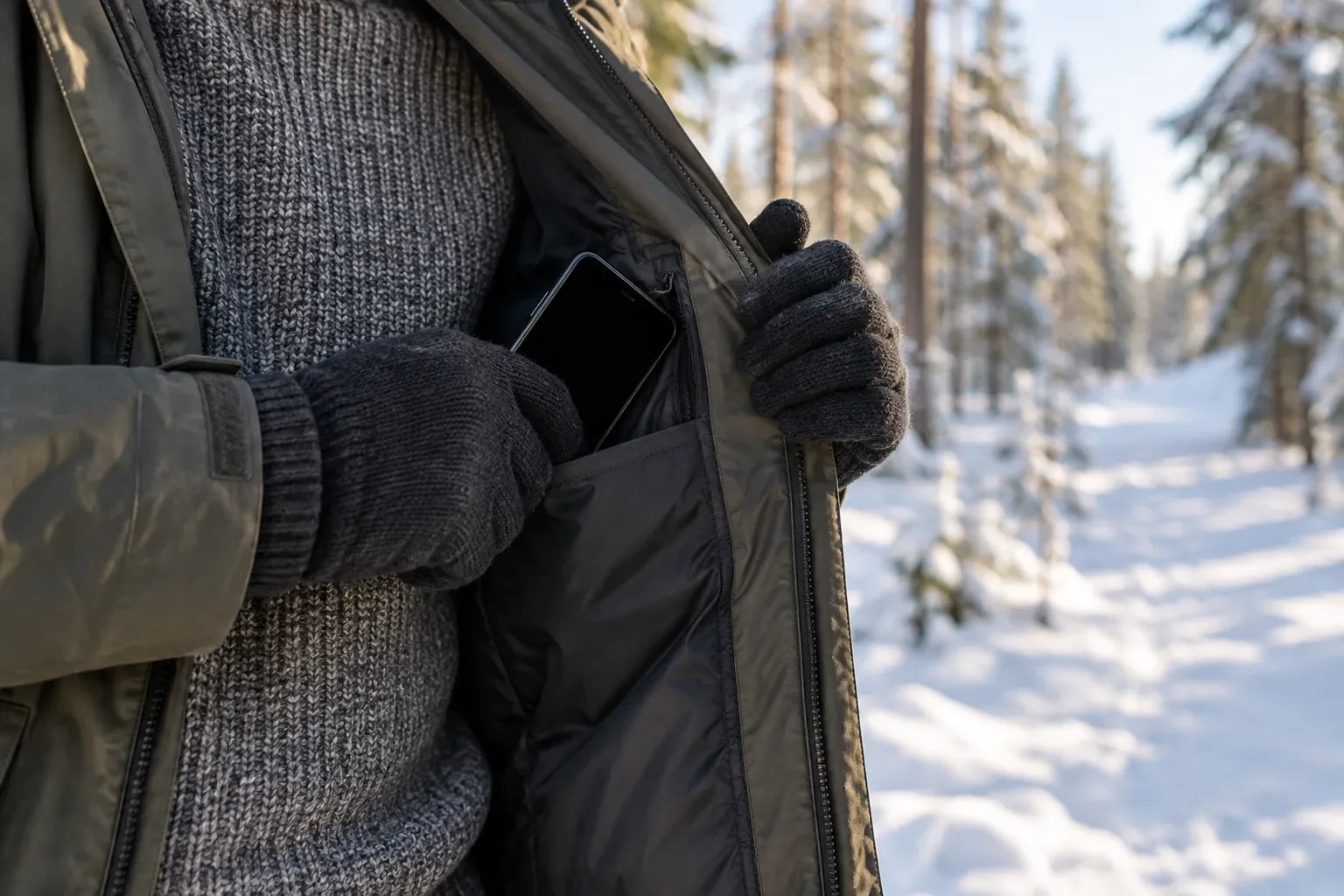
- Carry the phone in an inside pocket, not in an outer jacket pocket or the backpack lid, the coldest spots you carry.
- Keep the power bank warm too. It’s a lithium battery and loses capacity in the cold just like the phone. A cable long enough to charge from pocket to pocket keeps both warm.
- Turn on Low Power Mode or Battery Saver. On iPhone it cuts background activity, dims the screen and sets auto-lock to 30 seconds.
- Use the phone in short bursts. Take it out, do the task, put it back.
- If it dies, warm it before you give up. Armpit or inside pocket, then try again.
A thin liner glove or touchscreen glove saves your fingers. Taking mittens off at −20 °C costs you more than battery; see cold risks: hypothermia and frostbite.
Coming back indoors: charging and condensation
The instinct is to plug everything in the moment you’re through the door. Wait.
- A cold phone may refuse to charge. An iPhone that’s too cold shows “Charging On Hold” and waits until it’s at normal temperature. Samsung also limits charging outside a set temperature range.
- A cold power bank shouldn’t be charged until it has warmed up. The phone protects itself; don’t count on every power bank doing the same.
- Cold devices collect condensation in warm air. Sony’s camera guidance, using a ski slope as its example, is to switch off and wait about an hour, or to seal the device in a plastic bag before going indoors and open it once it’s at room temperature. No phone maker we found publishes condensation advice, but the physics is the same.
- Moisture in the charging port means don’t plug in. Apple says to let a phone dry in moving air, with no external heat source, and not to put it in rice.
Never warm a phone on a radiator, a stove or with a hair dryer. That trades a temporary cold problem for permanent heat damage.
Power banks on the flight: the 2026 rule
This changed in 2026, and most packing advice online hasn’t caught up. Since 27 March 2026, international aviation rules from ICAO allow at most two power banks per passenger, and they may not be recharged during the flight. Transportstyrelsen, the Swedish Transport Agency, applies the rule:
- Two power banks per person, in hand baggage only; never checked in.
- No recharging the power bank on board, and preferably no using it to charge other devices on board either.
- The main limit is 100 Wh per lithium-ion battery; an airline may approve up to 160 Wh.
- Spare batteries, camera batteries included, travel in hand baggage, protected against short circuit.
Airlines can be stricter, so check your carrier. If your power bank only shows mAh, multiply by the voltage and divide by 1,000: a 10,000 mAh bank at 3.7 V is 37 Wh, well under the limit.
Cameras, cars and the 112 backstop
Cameras use the same lithium cells. On an aurora night, keep spare batteries in an inside pocket and swap rather than waiting for a cold one to recover; see our northern lights guide. Bag the camera before you go back in.
In a car, Krisinformation’s winter kit list includes a charged phone. Keep a car charger, but don’t leave the phone in the car overnight: Apple advises against it, and a northern cold snap can push a parked car below even the −20 °C storage limit. More in winter driving in Sweden.
Tickets and payment live on the phone too. At least one regional operator’s terms make the passenger responsible for the device working, so a flat battery doesn’t excuse a missing ticket. Carry a card as backup; see paying by phone in Sweden.
112 is the floor. It’s free and works without a SIM card, but not from a phone that’s off. Police advise a charged phone and a power bank before heading into the forest, plus the 112 app, which shows SOS Alarm your coordinates. Tell someone your plan, so a dead phone isn’t the only way anyone knows where you are. The full system is in 112 and Sweden’s emergency numbers.
Practical information
| Item | Detail |
|---|---|
| Phone operating range (Apple, Samsung) | 0 to 35 °C ambient |
| iPhone storage range | −20 to 45 °C |
| Charging lithium batteries | Not below 0 °C; warm first |
| Condensation wait (camera guidance) | About 1 hour, or seal in a plastic bag |
| Power banks on flights | Max 2 per passenger, cabin only, no recharging on board (since 27 March 2026) |
| Battery size limit on flights | 100 Wh; up to 160 Wh with airline approval |
| Calling 112 | Free, works without a SIM |
| Power bank prices | Vary by capacity and shop; not listed here |
FAQ
Why does my phone die so fast in the cold?
Lithium-ion batteries rely on a chemical reaction that slows in the cold. The ions move more slowly, the battery loses voltage, and the phone cannot draw the power it needs, so the percentage drops and it may switch off. Apple designs iPhone for 0–35 °C. The good news: the lost charge usually returns once the phone warms up.
Will the cold damage my phone permanently?
Usually not. Apple says very cold conditions can temporarily shorten battery life and switch the phone off, and that battery life returns to normal at higher temperatures. Heat is what does lasting damage. The real risk in winter is charging: charging a lithium battery below 0 °C can plate lithium on the anode and degrade it for good.
Can I charge my phone or power bank when it is cold?
Not while it is below freezing. Let it warm to room temperature first. An iPhone that is too cold shows “Charging On Hold” and waits; Samsung also limits charging outside a set temperature range. A power bank left in a cold car or tent should be warmed before you charge it, since sub-freezing charging can permanently damage lithium cells.
How do I keep my phone warm outside in Sweden?
Carry it in an inside pocket close to your body, never in an outer pocket or backpack lid. Keep the power bank and spare camera batteries warm too. Turn on Low Power Mode, use the phone in short bursts and put it straight back. If it switches off, warm it in an armpit or inside pocket before assuming the battery is empty.
How many power banks can I take on a flight to Sweden?
Two per passenger, in hand baggage only. ICAO’s new rule took effect on 27 March 2026, and Transportstyrelsen applies it: power banks may not be checked in or recharged on board, and preferably not used to charge devices during the flight. Each battery’s main limit is 100 Wh. Airlines may be stricter, so check yours.
Is it bad to bring a cold phone straight into a warm room?
It can be. A cold device taken into warm, humid air collects condensation, as camera makers warn. Sony advises switching the device off and waiting about an hour, or sealing it in a plastic bag before going indoors. Do not plug it in if there is moisture in the port, and never dry it with a heater or hair dryer.
What happens if my phone dies and I need help?
A phone that is off cannot call anyone, so prevent it: charge fully, carry a power bank and keep both warm. If the phone revives after warming, call 112; it is free and works without a SIM. The 112 app shares your coordinates. Police advise telling someone where you are going before heading out.
Related guides
- Mobile coverage in Sweden’s wilderness — where your phone will find a network at all.
- Offline maps and apps for a Sweden trip — what to download before the signal goes.
- What to pack for Sweden in winter — the rest of the kit, from layers to ice cleats.
- Cold risks: hypothermia and frostbite — what the cold does to you, not your phone.
- Power cuts at cabins and in storms — when there’s nowhere to charge.
Facts verified 2026-10-15. Sources: Apple, Samsung, Transportstyrelsen, ICAO, SMHI, Polismyndigheten, SOS Alarm, Issäkerhetsrådet, Krisinformation.se, Sony, Battery University — full register in this topic’s source file. Found something outdated? Tell us and we’ll fix it.