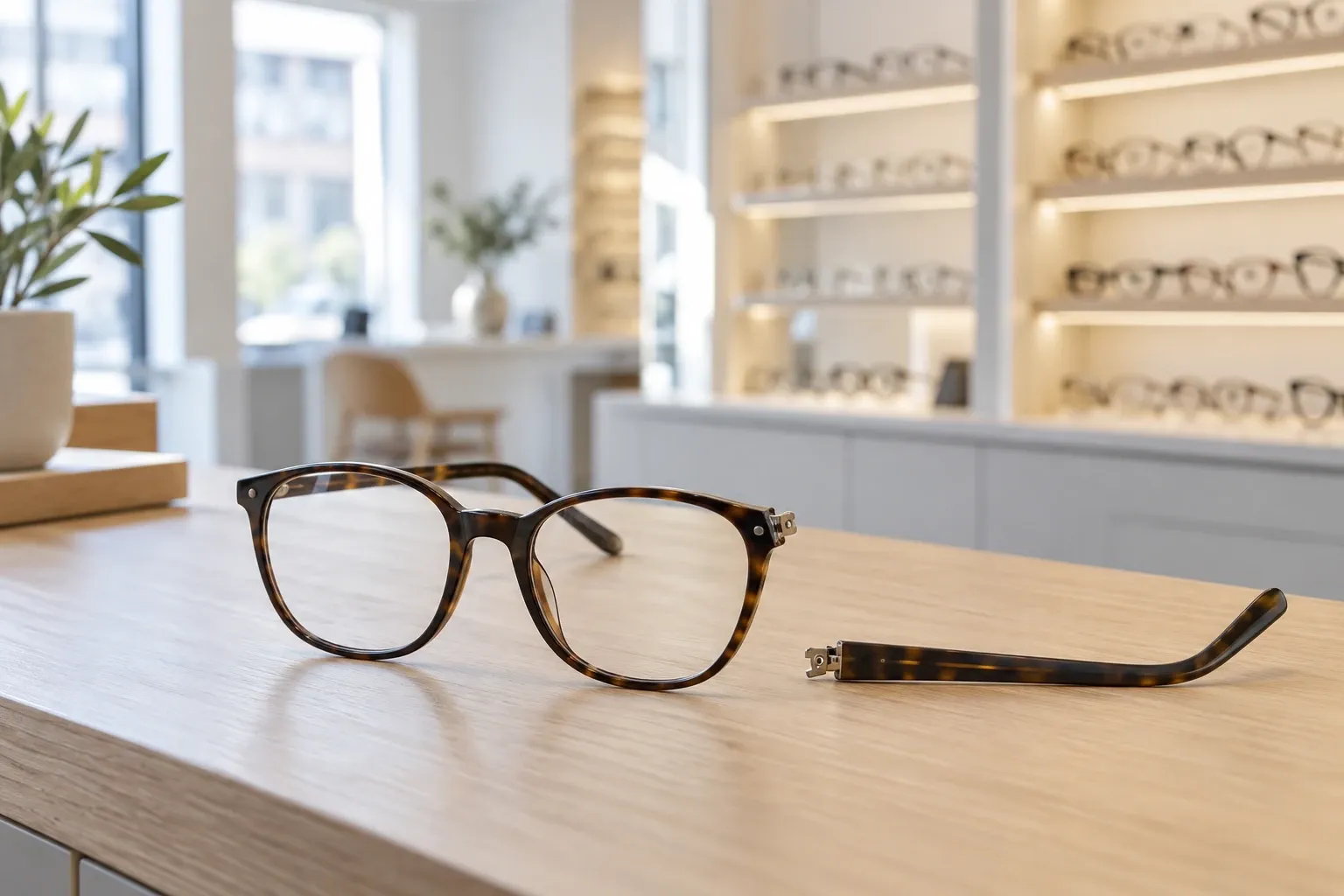
A snapped arm, a lost lens or an empty lens case is a shop problem in Sweden, not a medical one. Here’s where to go, what the rules allow since 2024, who pays, and when a sore eye stops being a shop problem.
When you need this
Your glasses broke on the train, lost a screw or popped a lens. You lost a contact lens in a lake, tore one, or simply ran out a week early. You left the spare pair at home and need glasses to drive. Your eyes went red and gritty after a long day in lenses. Or your child sat on their glasses on day two.
Shop or clinic? Sort it out first
Most eyewear trouble goes to an optician. A few situations don’t, and it’s worth knowing which before you look for a shop.
| Situation | Where to go |
|---|---|
| Chemicals in the eye | Rinse with lukewarm water for at least 15 minutes, call 112 |
| Hit by a sharp object or a fast metal splinter; a shadow in your vision; double vision after an injury | Urgent care with an eye doctor |
| One eye red, painful and suddenly seeing worse | Emergency department |
| Red, sore or gritty eyes while wearing lenses | Take the lenses out; if vision is affected, see an optician or a health-centre doctor |
| Grit that won’t rinse out | Health centre (vårdcentral) |
| Broken frame, lost lens, out of contact lenses | Optician |
With chemicals, speed matters more than anything else: tears aren’t enough to wash out lye, wet cement or drain cleaner. If you can’t tell where you belong, call 1177, Sweden’s healthcare advice line. From a foreign phone the number is +46 771 11 77 00, and a nurse will route you. Don’t take a broken frame to the hospital emergency department; Swedish emergency departments ask people with minor problems to go elsewhere. In bigger cities such as Stockholm there are specialist emergency units for eyes, and 1177 can route you there.
What an optician can do for you
An optiker in Sweden is a licensed health professional, and the title is protected: only someone licensed by Socialstyrelsen (the National Board of Health and Welfare) may use it. In daily life it’s also a high-street shop selling frames, lenses and contact lenses. You need no referral. Walk in or book, and you can get:
- an eye test (synundersökning) and a new prescription (recept)
- new glasses, or a repair of your frame
- contact lenses, including a fitting if you don’t have a current lens prescription
- a referral (remiss) to an eye clinic if something looks wrong; hospital eye clinics commonly take patients on referral from an optician or a health centre
Bring your prescription. A phone photo of your glasses or lens prescription, or the box your lenses came in, can save a test and speeds everything up. Opticians set their own prices and turnaround times, so ask before any work starts.
Contact lenses: what changed
Two things many pages still get wrong.
Anyone may sell contact lenses. Sweden used to reserve lens sales for healthcare staff. When Parliament wrote the Patient Safety Act, it dropped that ban after the Council on Legislation called it outdated. Today the law reserves only fitting: no one but healthcare personnel may professionally fit contact lenses. Buying a box of your usual lenses therefore needs no prescription by law.
Opticians no longer hold a separate lens certificate. Until the end of 2023, Swedish opticians needed a special contact-lens authorisation (kontaktlinsbehörighet) on top of their licence. Since 1 January 2024 that certificate no longer exists. The clinic or shop now decides which of its healthcare staff are competent to fit lenses. If an older guide tells you to look for a “certified contact-lens optician”, it is out of date.
If your eyes are sore, the shop is not the first stop. 1177’s advice for lens wearers is plain:
- Take the lenses out and rest your eyes until the trouble passes.
- Long wear, sleeping in lenses, and dusty, dry or smoky air are the usual causes.
- Lenses raise the risk of a corneal infection (keratit), and around-the-clock lenses raise it most.
- After an eye infection, start again with a new, unused pair.
Children’s glasses: the under-eight rule
This is the one that surprises families. A Swedish optician may make or hand over glasses for a child under eight only on a doctor’s instruction or under a doctor’s direction. A prescription for a young child that is older than six months may only be filled for special reasons. Contact lenses are exempt from the rule.
The regulation doesn’t say whether a doctor’s instruction from abroad counts. So if your child’s glasses break, bring the prescription from home and ask the optician before you choose frames. If that doesn’t work, call 1177 and ask how to reach an eye doctor.
Sweden pays glasses grants (glasögonbidrag) for children, but they are for residents. Stockholm’s grant, for example, requires registration in the county, so a visiting family pays the full price.
Driving without your glasses
Check the back of your driving licence. At point 12, a code in the 01 family, such as 01.06 for glasses or contact lenses, makes the licence conditional on wearing them. Drive without them and you break the licence condition. If you’re driving in Sweden with a code 01 licence, pack a spare pair, and replace a broken one before you get behind the wheel.
Paying and complaining
Opticians are private businesses outside Sweden’s region-funded healthcare. Your EU health card (EHIC) or a UK GHIC gives you care at the same fee as residents in the public system, at health centres and hospitals, but it doesn’t pay an optician. So:
- A broken frame or new glasses: you pay the shop’s price.
- A painful or injured eye seen at a health centre or eye clinic: that is healthcare, and the regional patient fee applies. Visitors insured outside the EU/EEA, Switzerland and the UK pay the full cost.
Keep your receipt. Frames and lenses bought from a business in Sweden come with a three-year right to complain about faults under the Consumer Sales Act; our guide to complaining about faulty goods explains how. A repair to your own glasses is a service under the Consumer Services Act, which requires the work to be done in a professional manner.
Practical information
| Item | What to know |
|---|---|
| Eye test, repair, frames, lenses | Set by each optician; ask before work starts |
| Referral needed for an optician | No |
| Prescription needed to buy contact lenses | No; fitting is reserved to healthcare personnel |
| Glasses for a child under 8 | Doctor’s instruction required; contact lenses exempt |
| Health-centre or eye-clinic fee | Same as residents with EU/EEA, Swiss or UK cover; others pay full cost |
| Children’s glasses grant (Stockholm example) | Up to 500 kr (0–7) and 800 kr (8–19), county residents only (checked 2026-10-15) |
| Advice line | 1177; from a foreign phone +46 771 11 77 00 |
| Emergency | 112 |
FAQ
Can I get new glasses quickly in Sweden without a prescription?
Yes, if an optician tests your eyes first. You need no referral: walk into an optician, have an eye test and order glasses or have your frame repaired. Opticians are private businesses and set their own prices and turnaround times, so ask before work starts. A photo of your prescription from home can save the test. Children under eight are different: they need a doctor’s instruction.
Do I need a prescription to buy contact lenses in Sweden?
No law requires one to buy them. Sweden removed the old ban on anyone other than healthcare staff supplying lenses, so they are sold freely. Fitting is the regulated part: only healthcare personnel may professionally fit contact lenses. If you have no current lens prescription, an optician will fit you; if your eyes are sore, take lenses out first.
Does my EHIC or GHIC pay for glasses or an eye test in Sweden?
No. The EU or UK card gives you care at the same fee as residents in the publicly funded system, at health centres and hospitals. Opticians are private shops outside that system, so you pay their full price. A painful or injured eye is different: that is care, and the patient fee applies at the clinic.
What should I do if my eye hurts while wearing contact lenses?
Take the lenses out and rest your eyes. If your vision is affected, discharge forms or the eye feels gritty, see an optician or a health-centre doctor. A red eye with pain and suddenly worse vision needs urgent care. Call 1177, or +46 771 11 77 00 from a foreign phone, if unsure. After an eye infection, start with a new pair.
Can a Swedish optician make glasses for my young child?
For a child under eight, only on a doctor’s instruction or under a doctor’s direction, and a prescription older than six months needs special reasons. The rule does not say whether a doctor’s instruction from abroad counts, so ask the optician first. Contact lenses are exempt from the rule. Swedish glasses grants for children are for residents, not visitors.
Where do I go with an eye injury in Sweden?
Chemicals in the eye: rinse with lukewarm water for at least 15 minutes and call 112. A cut from a sharp object, a fast metal splinter, a shadow in your vision or double vision after an injury needs urgent care with an eye doctor. Grit that will not rinse out goes to a health centre. When unsure, call 1177.
Related guides
- Getting sick in Sweden — how the care system works for visitors and what it costs.
- 1177, Sweden’s medical advice line — the call to make when you’re not sure where to go.
- Emergency rooms in Sweden — what happens at akuten if an eye injury is serious.
- EHIC and GHIC in Sweden — what your card covers, and what it doesn’t.
- Sun protection in Sweden — protecting your eyes on snow and water, and snow blindness.
Facts verified 2026-10-15. Sources: Sveriges Riksdag (Patientsäkerhetslag 2010:659, prop. 2009/10:210, Lag 2016:35, Konsumenttjänstlag 1985:716), Socialstyrelsen (HSLF-FS 2023:31), 1177, Transportstyrelsen, Försäkringskassan — full register in this topic’s source file. Found something outdated? Tell us and we’ll fix it.