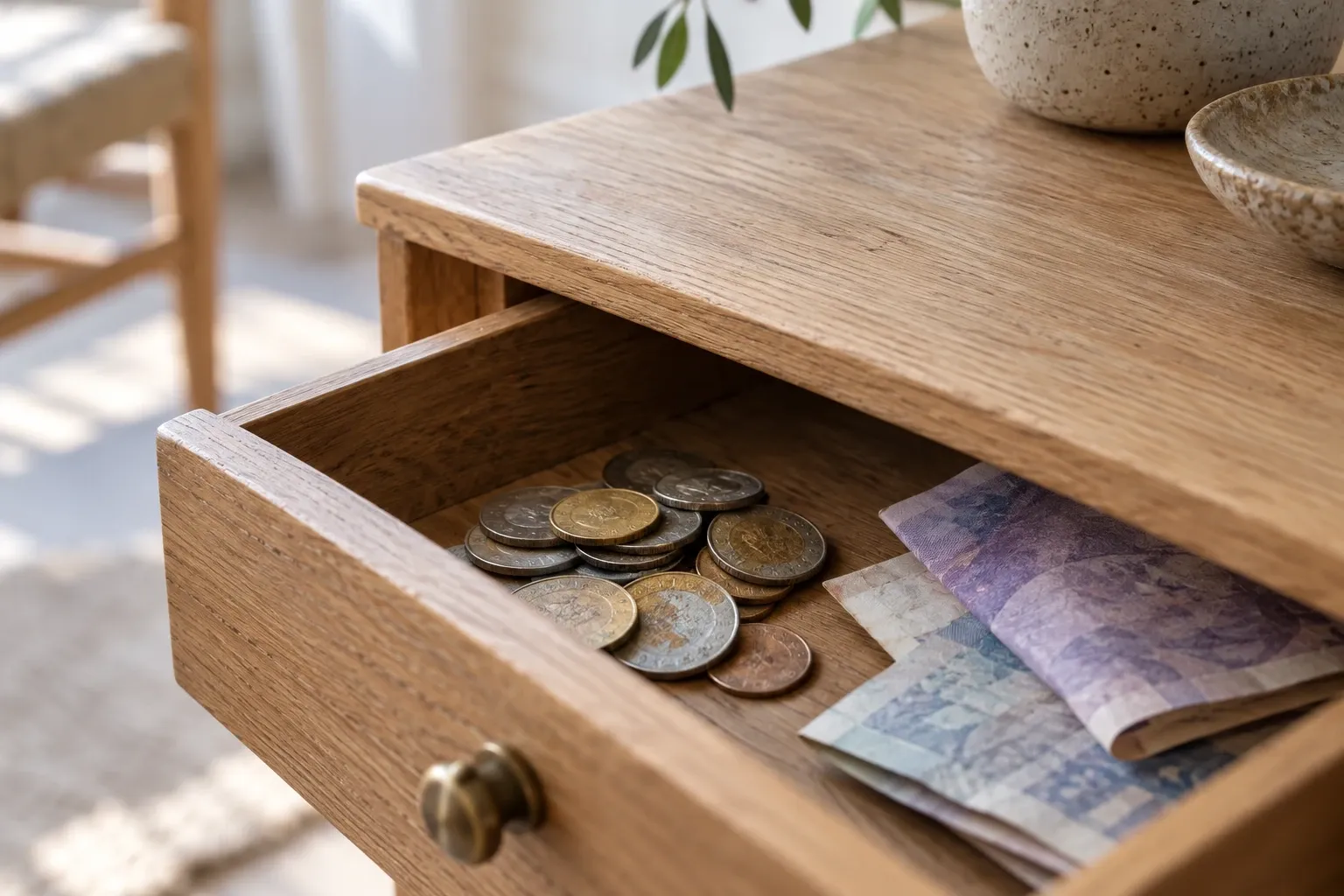
Found Swedish kronor from an old trip? Here’s how to tell old from new in ten seconds, whether your notes are worth sending in, and how to do it from abroad before the Riksbank stops redeeming them.
When you need this
You’ve found an envelope of Swedish notes from a trip before 2017, or a jar of coins. A shop, bank or exchange counter has refused a note you thought was fine. You’ve inherited Swedish cash from a relative. Or you just want to know which notes and coins to accept as change today.
New in October 2026: redemption ends on 30 June 2027
Sweden replaced all its notes and coins in 2015–2017. Since then, the Riksbank, Sweden’s central bank, has been the only place that redeems the old notes. Until recently it would take them however old they were.
That is ending. On 8 October 2026 the Riksbank announced that from 1 July 2027 it will no longer redeem notes that have been invalid for more than ten years. Your application must reach it by 30 June 2027. Every note that is invalid today will be more than ten years past its last valid day by then, so in practice this is the end of the line for all of them. About 3.9 billion kronor in old notes was still unredeemed when the Riksbank made the announcement.
Two more recent changes: the fee rose from 200 to 300 kr on 1 September 2026, and it is charged per granted application. Many guides were written before either change.
One caveat on legal status: the published Riksbank regulation did not yet contain the deadline on 15 October 2026. The date comes from the Riksbank’s own announcement and its redemption pages, which is enough to plan by.
Which notes are invalid
The quickest test is the portrait. Each denomination changed face in the new series.
| Value | Old note (invalid) | Invalid after | Current note (valid) |
|---|---|---|---|
| 20 kr | Selma Lagerlöf | 30 June 2016 | Astrid Lindgren |
| 50 kr | Jenny Lind | 30 June 2016 | Evert Taube |
| 100 kr | Carl von Linné | 30 June 2017 | Greta Garbo |
| 200 kr | none | – | Ingmar Bergman |
| 500 kr | Karl XI | 30 June 2017 | Birgit Nilsson |
| 1,000 kr | Gustav Vasa | 30 June 2016 | Dag Hammarskjöld |
A 200 kr note is always current: the denomination exists only in the new series. The current 100, 200, 500 and 1,000 kr notes also have a vertical security band with three windows. Any older series withdrawn before 2016, including 1, 5, 10 and 10,000 kr notes, is invalid too.
Invalid notes can’t be used to pay, and Swedish banks won’t exchange them. The Riksbank is the only route.
Which coins are invalid
Coins have their own quick test: colour.
| Coin | Old version (invalid after 30 June 2017) | Current version |
|---|---|---|
| 1 kr | Silver-coloured | Copper-coloured |
| 2 kr | Silver-coloured, minted 1876–1971 | Copper-coloured |
| 5 kr | Silver-coloured | Gold-coloured |
| 10 kr | Not replaced | Gold-coloured, in use since 1991 |
So a silver-coloured 1, 2 or 5 kr coin is old. The 10 kr coin was never replaced and is still valid. Every öre coin is long gone; the last one, the 50-öre, went in 2010 (see our guide to cash rounding).
The hard part: invalid coins can’t be redeemed anywhere, not at banks and not at the Riksbank. Banks took the old ones for deposit until 31 August 2017; since then they have had no money value. The Riksbank says they can be treated as scrap metal. If you think a coin is rare, ask a coin dealer.
Who can redeem old notes
Redemption isn’t a right. The Riksbank Act says the bank may redeem cash that is no longer legal tender “if there are special reasons”. Its regulations then set out when it says no. It refuses notes where there is reason to assume that:
- they stem from crime;
- the person sending them is not the rightful owner;
- the sender acquired them after they became invalid, other than by inheritance, a will or the division of an estate;
- they come from a business that took cash for goods or services.
The third rule catches people out. If you kept notes from your own trip in 2015, you qualify. If a friend gave you their leftovers in 2020, or you bought old notes at a flea market, you don’t. Inherited notes are fine, with estate papers for larger sums. Money you found belongs with the police first.
The Riksbank also runs anti-money-laundering checks on every application and must tell the police if it suspects a crime. And it keeps every note it receives, even if it refuses the application.
How to redeem old notes from abroad
- Sort the cash. Separate notes from coins and old designs from current ones. Never send valid notes; the form asks for invalid notes only.
- Add up the old notes. If the total isn’t well above 300 kr, stop here (see below).
- Write down where they came from: when and where you got them, and why they weren’t spent while valid. Attach proof if you can, such as an old bank statement showing the currency purchase or ATM withdrawal.
- Fill in the form. With Swedish BankID you can use the Riksbank’s web form. Without it, print the PDF form for private persons, Ansökan om inlösen av ogiltiga svenska sedlar för privatpersoner.
- Give an account in your own name. A foreign IBAN works, but the Riksbank pays only in Swedish kronor, so check your bank accepts an incoming SEK payment and what it charges.
- Add documents for larger amounts. From 5,000 kr, an account certificate (kontobevis). From 10,000 kr, also a witnessed copy of your passport or ID (bevittnad kopia): someone else signs the copy with their name and phone number.
- Post everything to Sveriges riksbank, Inlösen, 103 37 Stockholm, Sweden. Ordinary, registered or insured post are all accepted. You can’t hand notes in at the Riksbank. Using several envelopes? State the number and total on the form and put your name in each.
- Post early. It must arrive by 30 June 2027; international post takes time.
Handling normally takes three to four weeks, longer if the Riksbank asks for more information. If it grants the application, the value minus 300 kr lands in your account, without a separate notice.
Is it worth it?
The fee decides. The Riksbank deducts 300 kr from each granted application:
| Old notes you hold | You receive |
|---|---|
| One 100 kr note | Nothing |
| Two 500 kr notes (1,000 kr) | 700 kr, before your bank’s charges |
| One 1,000 kr note | 700 kr, before your bank’s charges |
So send one application with everything, never several small ones. Below about 300 kr, the notes are worth more as a souvenir than as a claim. Remember that the Riksbank keeps what it receives either way.
Commemorative money
Not everything unusual is invalid:
- Commemorative coins issued by the Riksbank (minnesmynt) are legal tender, though a shop may refuse them under its own terms. A bank may redeem them, possibly for a fee. The Riksbank redeems damaged ones at face value, free.
- The 2005 commemorative 100 kr note, marking 250 years of the Tumba paper mill, is on the Riksbank’s list of valid notes.
Because many commemorative coins are silver, the “silver means old” test applies only to ordinary 1, 2 and 5 kr coins.
Got valid kronor left over instead? Spend them at a staffed grocery checkout before you fly; since 1 July 2026 grocery stores and pharmacies must accept cash for small payments. Our guide to leftover kronor and currency exchange covers selling notes back.
Practical information
| Item | Detail |
|---|---|
| Old 20, 50, 1,000 kr notes | Invalid after 30 June 2016 |
| Old 100, 500 kr notes | Invalid after 30 June 2017 |
| Old 1, 2, 5 kr coins | Invalid after 30 June 2017; no redemption anywhere |
| Who redeems old notes | Only the Riksbank, by post |
| Deadline | Application must arrive by 30 June 2027 |
| Fee | 300 kr per granted application (200 kr before 1 September 2026) |
| Address | Sveriges riksbank, Inlösen, 103 37 Stockholm, Sweden |
| Extra documents | Account certificate from 5,000 kr; witnessed ID copy from 10,000 kr |
| Payout | In SEK only, to a Swedish or foreign account in your name |
| Handling time | Normally 3–4 weeks |
| Questions | [email protected] |
FAQ
Are old Swedish banknotes still valid?
No. The old 20, 50 and 1,000 kronor notes became invalid after 30 June 2016, and the old 100 and 500 kronor notes after 30 June 2017. Shops and banks will not take them. The Riksbank still redeems them by post for a 300 kr fee, but only for applications that reach it by 30 June 2027.
How do I exchange old Swedish banknotes from abroad?
Post them to the Riksbank with its application form for private persons, explaining where and when you got them and attaching proof such as a bank statement. Address: Sveriges riksbank, Inlösen, 103 37 Stockholm. A foreign IBAN account works, but payment is in Swedish kronor only, minus the 300 kr fee. Handling takes three to four weeks.
Is there a deadline to redeem old Swedish notes?
Yes. On 8 October 2026 the Riksbank announced that from 1 July 2027 it will no longer redeem notes that have been invalid for more than ten years. Your application must reach it by 30 June 2027, so allow time for international post. Guides written before October 2026 do not mention this deadline.
Can I exchange old Swedish coins?
No. The old 1, 2 and 5 kronor coins, invalid after 30 June 2017, and all öre coins cannot be redeemed at banks or at the Riksbank. The Riksbank says they can be treated as scrap metal; a coin dealer can tell you whether one has collector value. The 10 kronor coin was never replaced and is still valid.
How can I tell whether a Swedish note or coin is still valid?
Look at the portrait. Current notes show Astrid Lindgren, Evert Taube, Greta Garbo, Ingmar Bergman, Birgit Nilsson and Dag Hammarskjöld; old ones show Selma Lagerlöf, Jenny Lind, Carl von Linné, Karl XI or Gustav Vasa. For coins, look at the colour: silver-coloured 1, 2 and 5 kronor coins are old, while valid ones are copper or gold-coloured.
Is it worth redeeming just a few old notes?
Only if they add up to clearly more than 300 kronor. The Riksbank deducts a 300 kr fee from each granted application and keeps every note it receives, so one or two old 100 kronor notes return nothing. Put all your old notes into one application rather than several, and keep small amounts as souvenirs.
Can I redeem old Swedish notes someone gave me?
Usually not. The Riksbank refuses notes acquired after they became invalid, unless you got them through inheritance, a will or the division of an estate. Notes bought at a flea market or received as a gift after 2016–2017 do not qualify, and the Riksbank keeps whatever it is sent. Found money should go to the police.
Related guides
- Leftover kronor and currency exchange — what to do with valid notes and coins at the end of a trip.
- Cash rounding and Swedish coins — why there are no öre coins and which coins exist today.
- Paying with cash in Sweden — where cash is still accepted, and where it now must be.
- Leaving Sweden: the departure checklist — leftover cash among the other last-day jobs.
- BankID for tourists — why the Riksbank’s web form needs it, and the paper route without it.
Facts verified 2026-10-15. Sources: Sveriges Riksbank (invalid and valid notes and coins, redemption pages, press release of 8 October 2026, RBFS 2020:1 and RBFS 2026:1, application form), Sveriges riksdag (Lag 2022:1568 om Sveriges riksbank, Lag 2026:769) — full register in this topic’s source file. Found something outdated? Tell us and we’ll fix it.