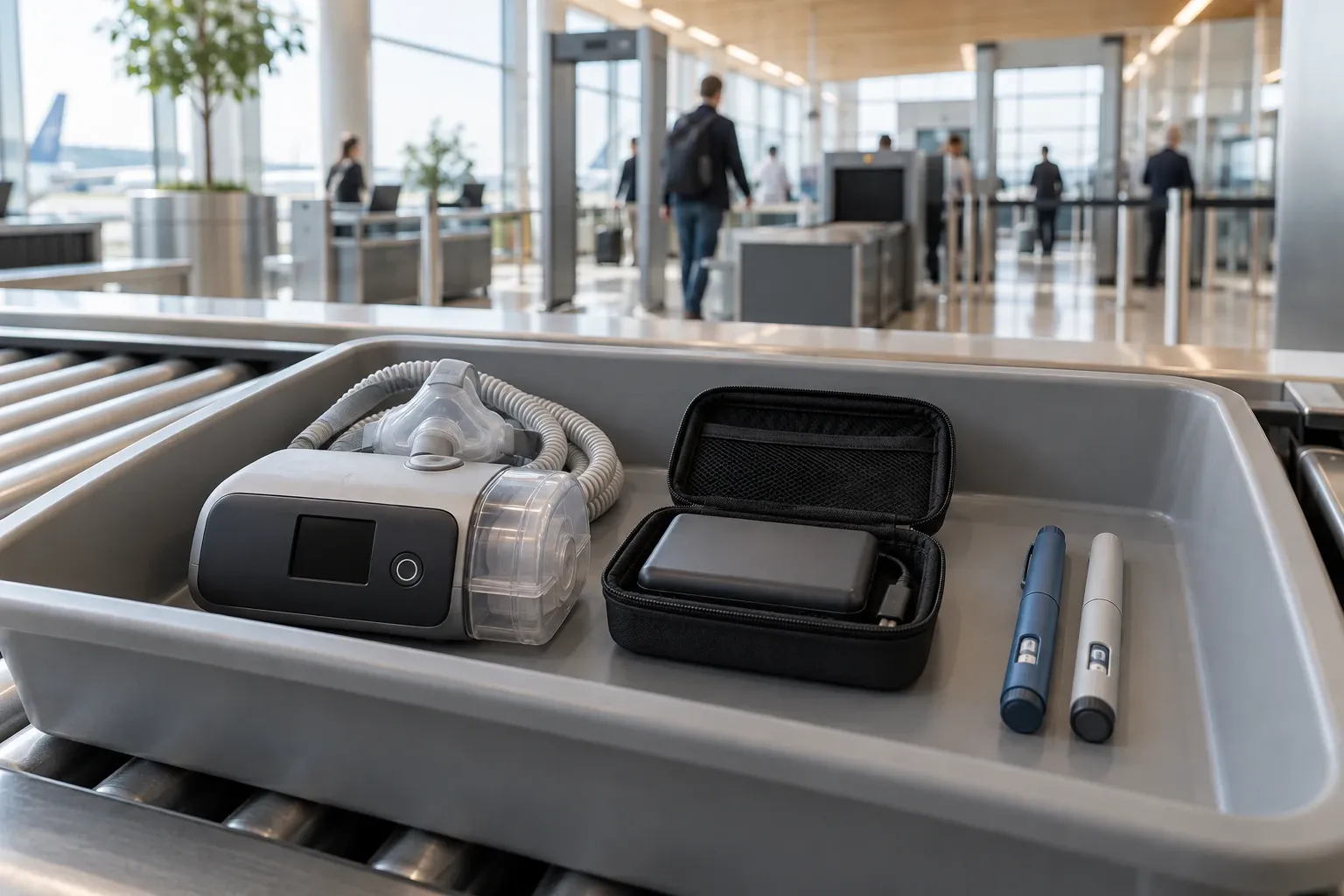
Your CPAP, insulin pump or dialysis schedule doesn’t have to stop you visiting Sweden. Airport security here is generous with medical supplies. The hard parts are battery approvals from your airline and a dialysis slot from a Swedish hospital unit, and both need sorting before you book flights.
When you need this
You’re flying to Sweden with a CPAP or BiPAP and wondering about the battery. You carry insulin, syringes, a pump or a glucose sensor. You use oxygen or a portable concentrator, or you’re on haemodialysis and want a holiday or a family visit here. Or you’re already in Sweden with a box of used needles and no idea where they go.
Who decides what
No single Swedish authority covers all of this. Four players do, and knowing which one to ask saves a lot of phone calls.
| Question | Who decides | What to do |
|---|---|---|
| What can go through security? | EU aviation-security rules, published in Sweden by Transportstyrelsen (the Swedish Transport Agency) | Read the rules below; nothing to book |
| Can this battery or oxygen fly? | International dangerous-goods rules, applied by your airline | Ask the airline at booking and get approval in writing |
| Can I get treatment here? | The Swedish hospital unit; cost depends on where you’re insured | Contact the unit before you book travel |
| Where do used needles go? | Pharmacies and municipalities | Ask any pharmacy (apotek) |
How much medicine you may bring into Sweden, including the narcotic rules, is a separate question. See bringing medicines into Sweden.
Airport security: generous with medical supplies
Transportstyrelsen’s rule is broad. You may carry liquid medicines, prescription or not, and liquid medical supplies in hand luggage without a volume limit. That covers what you need for the journey and your whole stay, plus the cold packs that keep them cool. Syringes for medical use are allowed too.
What you have to do at the checkpoint:
- Take liquid medicines out and show them separately. They may be checked with liquid-screening equipment.
- Original packaging helps but isn’t required at security. Keep the boxes anyway, because the pharmacy label is your easiest proof the medicine is yours.
- Tablets and powders fall outside the liquids rule and can stay in your bag.
- Tell staff about any implant before screening: an artificial joint, other metal implant or internal medical device. Transportstyrelsen doesn’t require a doctor’s certificate for it.
The body scanner is described as an alternative to the walk-through metal detector, and anything it flags is checked by hand. No Swedish source covers how insulin pumps and glucose sensors should be screened. Tell staff before you go through, and follow your device maker’s instructions on scanners and X-ray. The 100 ml rule still applies to your other liquids. Temporary EU restrictions affect only Arlanda Terminal 5 and Sälen.
Batteries and CPAP: the airline’s yes
The battery rules come from the international dangerous-goods rules that every airline applies. Transportstyrelsen and IATA’s passenger table give the same numbers:
| Battery | Rule |
|---|---|
| Lithium-ion up to 100 Wh, lithium-metal up to 2 g | Allowed as the main rule |
| Lithium-ion 100–160 Wh; lithium-metal 2–8 g (medical devices only) | Only with the airline’s approval; two loose spares at most |
| Any spare (loose) battery | Cabin only, terminals protected against short circuit |
| Device in checked baggage | Fully switched off, not in sleep mode |
| Mobility-aid battery, removed | Airline approval; up to 300 Wh |
Read the watt-hour rating on your CPAP’s battery before you book. Then tell the airline about the device, every battery, and whether you want to use the machine in flight, and ask for its approval in writing. Each airline on a connection decides for itself.
One 2026 change worth knowing. Since August 2026, Transportstyrelsen limits power banks to two per person. You may not recharge them on board, and you should preferably not use them to charge other devices on board. A lot of CPAP travel advice still says to run the machine overnight from a power bank. Plan instead around the CPAP’s own approved battery, or in-seat power your airline confirms.
Under EU passenger-rights rules, a traveller with a disability or reduced mobility can take medical equipment and two mobility aids on the flight for free. Give at least 48 hours’ notice. Airlines don’t have to help you take medication in flight, so if you need that, travel with a companion. Some airlines may also ask for a certificate that you’re fit to fly. Booking the assistance itself is covered in booking travel assistance.
Oxygen: approval or nothing
- Gaseous medical oxygen cylinders may fly only with the airline’s approval, at most 5 kg gross per cylinder, and the pilot is told where they are.
- Liquid oxygen systems are forbidden on passenger aircraft.
- Portable oxygen concentrators are battery-powered medical devices, so they follow the battery table above.
Transportstyrelsen’s advice is to tell the airline at booking, because the rules vary between airlines. If you don’t need oxygen for the whole journey, you don’t have to bring your own cylinder into the cabin: aircraft carry oxygen for emergencies. No Swedish authority publishes a route for visitors to get home oxygen here. Ask your home supplier how a concentrator or supply could reach your Swedish address.
Insulin and needles
1177, Sweden’s official health guide, is blunt about flying: keep all insulin in your hand luggage, because insulin in checked baggage freezes in the hold. In Sweden itself:
- Store unopened insulin in a fridge at +2 to +8 °C, away from the freezer element.
- In-use insulin can stay at room temperature for up to a month, out of the light.
- In winter, carry it close to your body, in an inner pocket, so it doesn’t freeze outdoors.
- Brands differ, so the package leaflet wins.
Bringing syringes and needles into Sweden is legal for your own or a family member’s medical use (Lag 2012:595). Carry a prescription list or doctor’s letter, ideally in English, as 1177 recommends.
When you’re done with them, used needles go to a pharmacy. Pharmacies hand out sharps containers for free. Fill one, seal it and hand it back. The system is run by municipalities and pharmacy chains together, so if a pharmacy can’t take them, the municipality can tell you where they go. If supplies run low, see getting a prescription filled as a visitor.
Dialysis in Sweden: book the slot first
Swedish hospitals do take visiting dialysis patients. This is gästdialys (guest dialysis), booked directly with a hospital dialysis unit (dialysmottagning). The catch is in the wording. Units such as Linköping’s take guests i mån av plats, as space allows. Gällivare in the far north explicitly welcomes patients “from the rest of the world”. Karolinska in Stockholm lists separate guest contacts for its units, easiest to reach on weekdays between 09:00 and 14:00. Each unit’s contact is on its page at 1177.se.
Expect paperwork. One Swedish unit’s published checklist asks your home unit to send, at least a week before your first session:
- Recent blood and electrolyte results (no older than a month)
- HIV and hepatitis tests (no older than three months) and MRSA screening
- Treatment protocol, access details, medication list with prescriptions, and a referral
- Your address in Sweden during the stay
What it costs depends on where you’re insured. If you’re insured in the EU, EEA or Switzerland, ongoing treatment of a chronic disease counts as necessary care. You pay the same patient fee as residents of that region, with your EU card. UK insured visitors use the GHIC, and for dialysis the EU–UK agreement requires a prior agreement with the unit. Most visitors insured elsewhere pay the full cost. And if the treatment is the purpose of your trip, it’s planned care, so without prior authorisation from home you pay in full. The card side is explained in EHIC and GHIC in Sweden.
Power in Sweden
Sweden runs on 230 V at 50 Hz, with round-pin Type F sockets that also take two-pin Europlugs. A CPAP or charger marked 100–240 V needs only a plug adapter. A 120 V-only device needs a voltage converter. Homes built from 1994 must have earthed sockets, but older homes and cabins may not. Full detail is in power sockets in Sweden.
The real gap is remote accommodation. STF mountain huts have no electricity at all, so a CPAP night there needs a battery sized for it, or a different bed. For storms at rural cabins, see power cuts at cabins.
Practical information
| Item | Rule or amount (checked 2026-10-15) |
|---|---|
| Liquid medicines, syringes, cold packs at security | No volume limit; show liquids separately |
| Lithium battery, no approval needed | Up to 100 Wh (lithium-metal up to 2 g) |
| Lithium battery with airline approval | 100–160 Wh (lithium-metal 2–8 g, medical only); max 2 spares |
| Spare batteries | Cabin only |
| Power banks | Max 2; no recharging on board |
| Medical oxygen cylinder | Max 5 kg gross, airline approval; liquid oxygen forbidden |
| Assistance notice | At least 48 hours |
| Medical equipment on EU flights (reduced mobility) | Free |
| Guest dialysis documents | At the unit 1 week ahead (one unit’s list) |
| Treatment cost, EU/EEA/Swiss insured | Region’s resident patient fee |
| Treatment cost, most other visitors | Full cost, set by the region |
| Sharps container | Free from pharmacies |
| Mains power | 230 V, 50 Hz, Type F/C |
FAQ
Can I bring my CPAP machine on a flight to Sweden?
Yes. Carry it in the cabin. Its battery decides the rules: up to 100 Wh is the main rule, up to 160 Wh needs airline approval, and spare batteries travel in the cabin only, protected against short circuit. Tell the airline at booking if you want to use the CPAP in flight, and get its approval in writing.
Can I take insulin and needles through security at Swedish airports?
Yes. Liquid medicines, syringes and the cold packs that keep them cool may be carried without a volume limit for your journey and stay. Take liquid medicine out and show it separately at the checkpoint. Tell staff about an insulin pump or sensor before screening. Never pack insulin in checked baggage: it freezes in the hold.
Can I get dialysis while on holiday in Sweden?
Often, but only as space allows. Guest dialysis (gästdialys) is booked directly with a Swedish hospital dialysis unit, which may ask for recent blood tests, screening results and records at least a week ahead. EU, EEA and Swiss insured visitors pay the resident fee; most others pay the full cost. Confirm the slot before booking travel.
Can I fly to Sweden with oxygen?
Gaseous medical oxygen cylinders of up to 5 kg gross may fly with the airline’s approval, and portable oxygen concentrators follow the lithium-battery limits. Liquid oxygen is forbidden on passenger aircraft. Tell the airline at booking, because its rules vary, and check every airline on a connection.
Will my CPAP work with Swedish power sockets?
Almost certainly, with a plug adapter. Sweden uses 230 V at 50 Hz and round-pin Type F sockets that also take two-pin Europlugs. A power supply marked 100–240 V needs nothing more; a 120 V-only device needs a voltage converter. Mountain huts have no electricity at all, so plan a battery there.
Where do I dispose of used needles in Sweden?
At a pharmacy (apotek). Swedish pharmacies hand out free containers for needles and other sharp items; when the container is full you seal it and return it to a pharmacy. Never put loose needles in household waste. If a pharmacy cannot take them, the municipality is responsible and can tell you where they go.
Related guides
- Bringing medicines into Sweden — how much medicine you may bring, and the narcotic-classed exceptions.
- EHIC and GHIC in Sweden — what your card covers for chronic treatment such as dialysis.
- Booking travel assistance — getting airport and train help booked through the right company.
- Getting a prescription filled as a visitor — what to do if insulin or other supplies run out.
- Power sockets in Sweden — adapters, voltage and campsite hook-ups in detail.
Facts verified 2026-10-15. Sources: Transportstyrelsen, IATA Dangerous Goods Regulations (Table 2.3.A), European Commission (Your Europe), Sveriges Riksdag (Lag 2012:595), 1177 Vårdguiden, Karolinska Universitetssjukhuset, Region Västernorrland, Lerums kommun, Elsäkerhetsverket, Svenska kraftnät, Svenska Turistföreningen — full register in this topic’s source file. Found something outdated? Tell us and we’ll fix it.