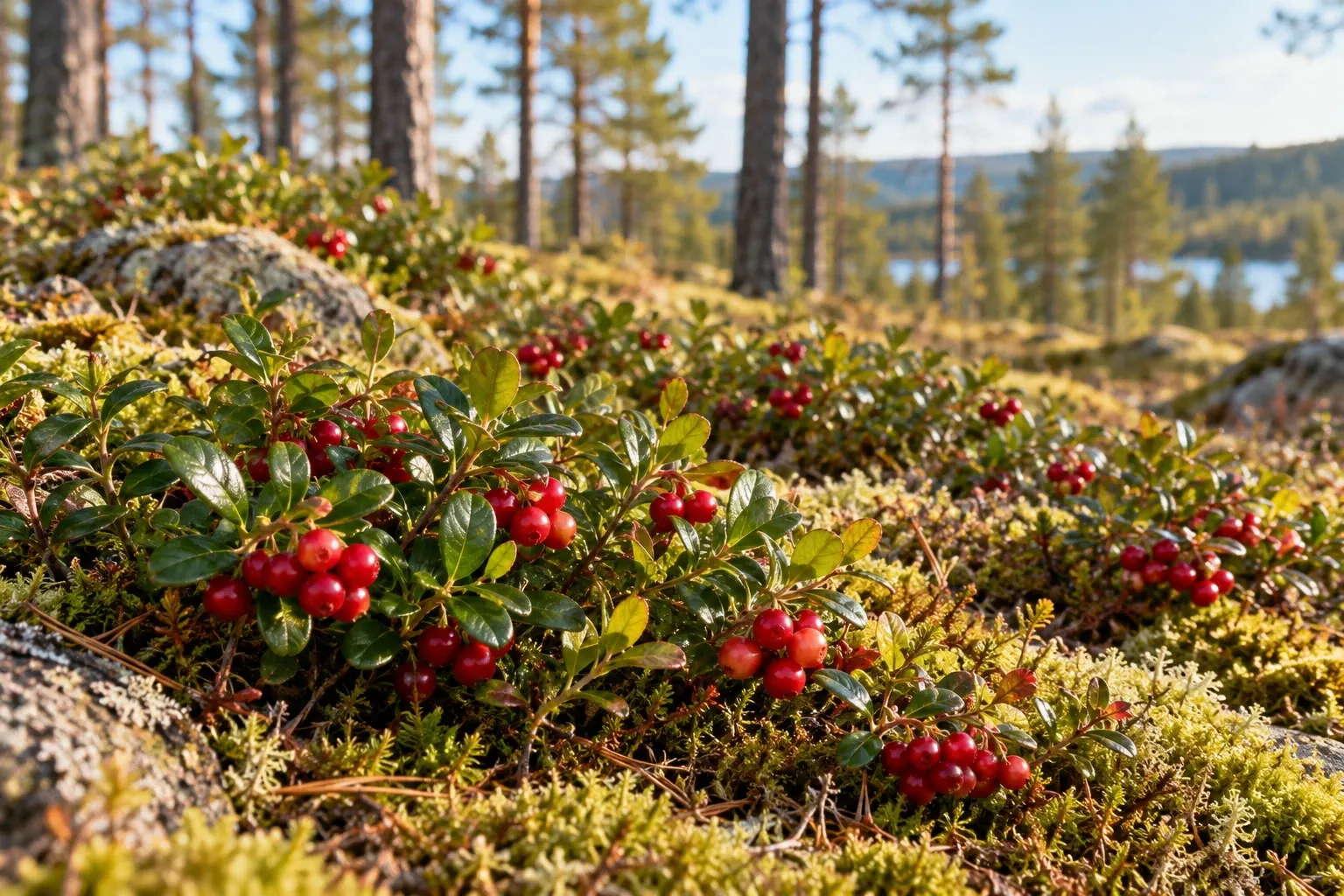
Order meatballs, cabbage rolls or a potato pancake in Sweden and a spoonful of tart red berries comes with it. Here is why it’s there, how to eat it, how to tell a good jar from a poor one, and the one airport rule that catches souvenir hunters.
When you need this
A plate lands in front of you with a red dollop beside the meat and you’re not sure whether it’s dessert, garnish or part of the meal. Or you’re standing at the jam shelf in a Swedish supermarket looking at two kinds of lingonberry jar. Or you’ve walked through an autumn pine forest carpeted with red berries and wondered whether you may pick them. This page covers all three, plus getting a jar home on the plane.
What a lingonberry is
The lingonberry (lingon; Vaccinium vitis-idaea, also called cowberry in English) is a small, red, sharply tart berry on a low evergreen shrub. It grows in huge quantities across almost all of Sweden, on poor, acidic heath and forest floor. The Swedish Board of Agriculture, Jordbruksverket, counts it among the most important Swedish berries. It notes that “many dishes require their lingonberry jam”, and the berry is sometimes called the forest’s red gold.
It is related to the cranberry and tastes similar, but it is smaller. Unlike the cranberry it is still mostly picked wild: four cultivated varieties exist, but most berries come from wild stands.
Why it comes with everything
There are two reasons: taste and history.
Taste. Swedish everyday food is often rich: cream gravy, fried pork, potato, butter. A sweet-sour berry cuts through that. The standard meatball plate, as sweden.se describes it, is meatballs with mashed or boiled potatoes and raw stirred lingonberries. The berries are part of the dish, not decoration. Eat them with the food: a little meat, gravy, potato and lingonberry in each forkful.
History. The lingonberry was the berry that kept. It is firm and contains a natural preservative, benzoic acid, so it stores for a long time without cooking. Before sugar was a household staple, Swedes preserved the berries in jars topped up with plain water, called vattenlingon. Visit Småland notes that in the 19th century lingonberries were eaten with meat, fish, porridge and potatoes. For poor households in Småland, lingonberry mash was the condiment with potatoes. A berry that sat in the cellar all winter became the default side, and the habit outlived the need.
It was big business too. Around 1890 Kronoberg county alone exported about 2,600 tonnes a year, much of it to Germany, where the berries were used among other things to deepen the colour of red wine. Jordbruksverket describes a “lingonberry rush” in the early 1900s, fuelled by German demand and the new railways.
| Why lingonberries | What it means on your plate |
|---|---|
| Sweet-sour taste | Balances cream gravy, pork and potato |
| Natural benzoic acid | Keeps without cooking, so rårörda is possible |
| Grows almost everywhere | Every region has its own pairing |
| Historically stored all winter | Became the default side, year-round |
Rårörda or sylt? Reading the jar
You’ll meet lingonberries in three main forms:
- Rårörda lingon: berries stirred raw with sugar, never cooked. Mostly whole berries, fresher and sharper.
- Lingonsylt: cooked jam. Smoother and sweeter, and it often contains additives.
- Lingondricka / lingonsaft: a lingonberry drink and a cordial.
Rårörda costs noticeably more than jam, because it should be whole berries. According to a TV4 report on a 2025 Testfakta test of seven brands, real rårörda should contain lingonberries and sugar and nothing else. The weakest jars in that test were about half mash, the worst had the most added water, and one contained a preservative that wasn’t needed at all.
The practical rule: turn the jar round and read the ingredients. “Lingon, socker” is the real thing. Water and a thickener mean a cheaper product. Low-sugar jams with sweeteners can contain added preservatives even though the berry keeps fine on its own.
The dishes it belongs to
Meatballs are the famous pairing, but they’re only the start. The berry turns up wherever Swedish food is heavy, and every region has its own pairing.
| Dish | What it is | Where |
|---|---|---|
| Köttbullar | Meatballs with cream gravy and potatoes | Everywhere |
| Kåldolmar | Cabbage rolls, traditionally with gravy, lingonberry jam and potatoes | Everywhere |
| Raggmunk | Potato pancake with fried pork and lingonberries | Everywhere; a Småland and Öland favorite |
| Palt / kams | Boiled barley-flour dumplings with butter and lingonberry jam | Norrland |
| Kroppkakor | Potato dumplings; whether lingonberries belong is disputed on Öland | Småland, Öland |
| Korv å palt å krösamos | Sausage, blood dumplings and lingonberry mash | Småland |
| Suovas | Sámi salted reindeer meat smoked over an open fire, sliced thin | Sápmi |
Cabbage rolls even have their own day: Kåldolmens dag on 30 November, when Helsingborg’s school kitchens describe the traditional serving as gravy, lingonberry jam and potatoes. In Småland, look out for krösa, the southern dialect word for lingonberry. Krösamos is lingonberry mash. Elsewhere you may hear kröser, lingbär, rödbär or tytbär.
For game, moose and reindeer, see game on Swedish menus. For the meatball plate in detail, see Swedish meatballs.
Taking it home
A jar of lingonberries is one of the easiest Swedish food souvenirs: it keeps well and travels well. The catch is airport security. Swedish aviation rules count gels and mixtures of liquid and solids as liquids, with a maximum of 100 ml per container in hand luggage. A normal supermarket jar is much bigger, and security will take it. Pack it in checked baggage, sealed in a plastic bag in case it cracks. The souvenir rules in full, including what you can buy after security, are in Swedish souvenirs.
Picking your own
Lingonberries are wild berries, and under allemansrätten, Sweden’s right of public access, anyone may pick them on most land without asking. Gardens, house plots and cultivated fields are the exceptions. The berry is not a protected species. Berry picking in Sweden has the full rules.
When: Jordbruksverket gives early September to mid-October. Visit Sweden’s foraging calendar says August–September, so in some areas the first berries ripen in late August.
There is plenty to go round. Visit Småland puts a normal-year crop at about 150,000 tonnes with roughly 95% left in the forest. A 2025 question in the Swedish parliament said only 2% of all forest berries were picked in 2024. Both are estimates rather than official statistics. The rules for foreign commercial pickers changed this year: since 1 June 2026, a forest-berry picker can no longer get an ordinary work permit through an employer not established in Sweden; a Swedish-established employer can apply for a seasonal permit instead. Seasonal jobs in Sweden explains the change.
One food-safety note. Stirring self-picked berries raw means they’re uncooked. Folkhälsomyndigheten, the Public Health Agency, rates the fox tapeworm risk from wild berries as very low. But the parasite survives freezing and dies only on boiling. If you want zero risk, cook your own berries into jam.
A note on sensitivity
Livsmedelsverket, the Swedish Food Agency, says lingonberries contain high levels of both benzoic acid and salicylic acid. People who react to acetylsalicylic acid (aspirin) are more often sensitive to benzoic acid. Reactions to benzoates are uncommon, but if you know you react, ask for your dish without lingonberries. It’s an easy request, because they’re served on the side.
Practical information
| Item | Detail |
|---|---|
| Season in the forest | Early September to mid-October (Jordbruksverket); earlier in some areas |
| Picking | Free under allemansrätten; not in gardens, house plots or fields |
| In restaurants | Usually part of the dish as served |
| Rårörda vs sylt | Rårörda costs noticeably more; ingredients should be only lingonberries and sugar |
| Jar in hand luggage | Only 100 ml or less, in the liquids bag; larger jars in checked baggage |
| Sensitivity | High natural benzoic and salicylic acid; ask for the dish without them if you react |
| Cabbage-roll day | Kåldolmens dag, 30 November |
FAQ
Why do Swedes eat lingonberries with meat?
Because the sweet-sour berry balances rich food. Meatballs with cream gravy, cabbage rolls, potato pancakes with pork and boiled dumplings are all heavy, and a spoonful of lingonberries in each bite cuts through them. Historically it was also the berry that kept all winter thanks to its natural benzoic acid, so it was always at hand to serve.
What is the difference between rårörda lingon and lingonsylt?
Rårörda lingon are berries stirred raw with sugar and never cooked; they should contain only lingonberries and sugar. Lingonsylt is jam: heated, smoother, and often with additives. Rårörda costs more because it should be whole berries. In a 2025 test of seven brands, the weakest contained added water and were about half mash.
Are lingonberries the same as cranberries?
No, but they are close relatives with a similar tart taste. Lingonberries are smaller, grow wild on low evergreen shrubs across almost all of Sweden, and are still mostly picked wild; Jordbruksverket lists only four cultivated varieties. In English they are also called cowberries; The Local counts nearly thirty English names in all.
Why don’t lingonberries go bad?
They are firm and contain a natural preservative, benzoic acid, so they keep for a long time. Before sugar was a household staple, Swedes stored them in jars of plain water, called vattenlingon. That is why rårörda lingon need no cooking. The same compound, E 210, is added to many other jams to make them keep.
Can I take lingonberry jam home in my hand luggage?
Only a jar of 100 ml or less, packed in your liquids bag. Swedish aviation rules count gels and mixtures of liquid and solids as liquids, limited to 100 ml per container at security, and jam falls under that. A normal supermarket jar is bigger, so put it in checked baggage, sealed in a plastic bag in case it breaks.
Can I pick lingonberries myself in Sweden?
Yes. Lingonberries are wild berries and free to pick on most land under allemansrätten, without asking the landowner; gardens, house plots and cultivated land are excluded. They ripen from about early September into mid-October, earlier in some areas. If you stir them raw, remember that only cooking removes the very low fox tapeworm risk.
Can people sensitive to aspirin eat lingonberries?
Ask your doctor if you have a known sensitivity. Livsmedelsverket says lingonberries contain high levels of both benzoic acid and salicylic acid, and that people who react to acetylsalicylic acid are more often sensitive to benzoic acid. Reactions to benzoates are uncommon, but a dish served with lingonberries is an easy item to ask for without them.
Related guides
- Swedish meatballs — the plate lingonberries are most famous on, and what locals actually eat.
- Berry picking in Sweden — where, when and how to pick lingonberries yourself.
- Swedish groceries to try — the rest of the jam shelf and what to pack.
- Game on Swedish menus — moose, reindeer and the lingonberry side.
- Cloudberries — Sweden’s other famous berry, from the northern bogs.
Facts verified 2026-10-15. Sources: Jordbruksverket (Smaka Sverige), Livsmedelsverket, Transportstyrelsen, Folkhälsomyndigheten, Migrationsverket, Naturvårdsverket, Sveriges riksdag, Helsingborgs stad, Visit Småland, TV4/Testfakta — full register in this topic’s source file. Found something outdated? Tell us and we’ll fix it.