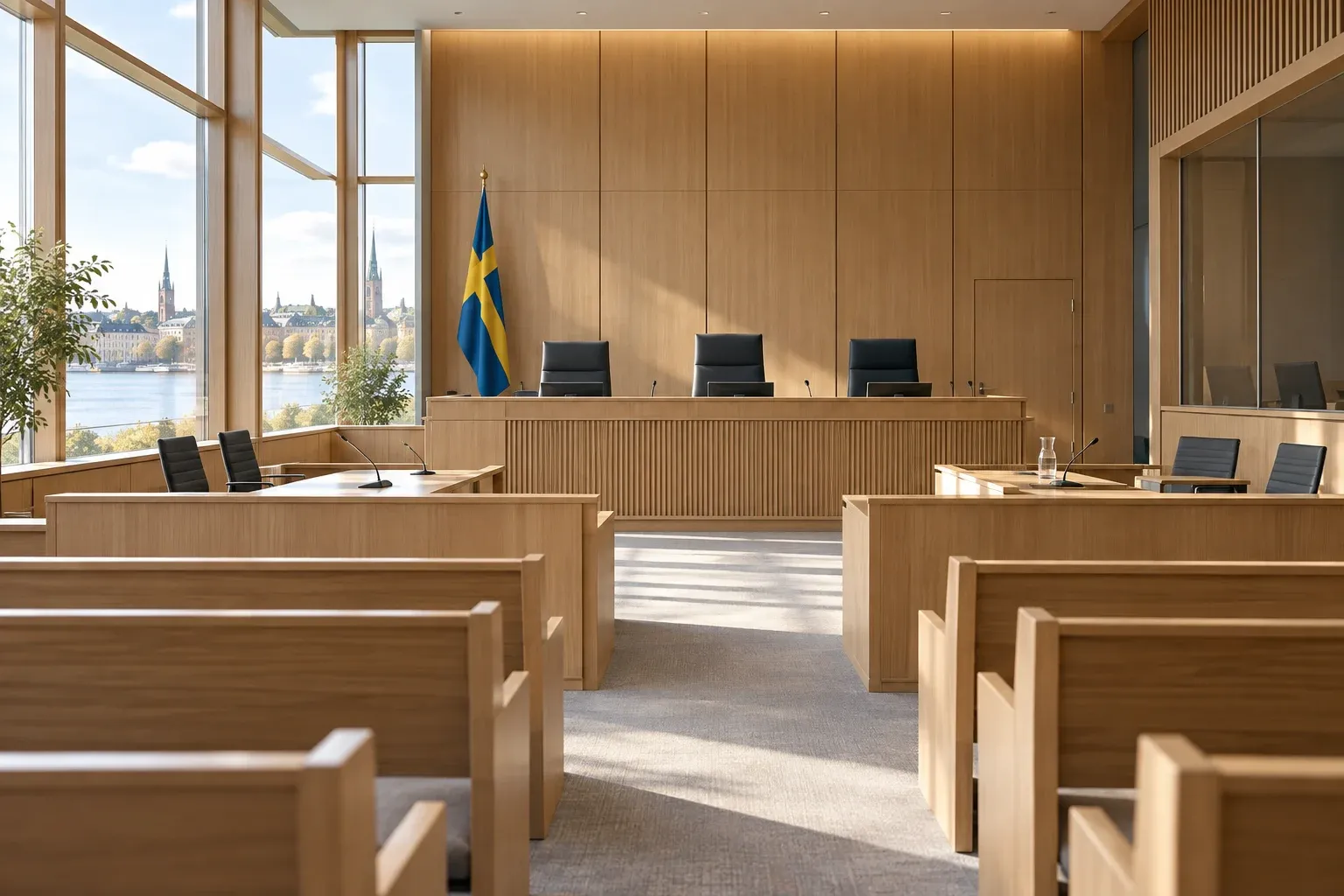
A Swedish criminal trial has no twelve citizens in a box. Ordinary people still decide, but they sit on the bench and vote with the judge. Here is who they are, how they are picked, where the one jury survives, and what it means if you end up in court.
When you need this
- You saw a Swedish trial on the news and wondered who the people beside the judge were
- You have been summoned as a witness to something you saw while travelling
- You are a defendant, for example after a fight, shoplifting or a drink-driving arrest
- You are the victim of a crime and the case is going to trial
- You want to sit in on a public trial during your visit
- You live in Sweden and wonder whether you could become a lay judge
- You read that Sweden “has no juries” and want to know whether that is true
No juries, but lay judges on the bench
Instead of a jury, Sweden puts lay people on the bench. A nämndeman (lay judge; plural nämndemän) sits beside the professional judge, hears the same evidence, deliberates behind closed doors and votes on both guilt and sentence. About 8,500 people serve.
The courts’ own description is blunt: lay judges are judges, not jurors. Each has one vote, exactly like the professional judge. In a standard district court criminal trial that means three of the four votes belong to lay people, so the lay judges can outvote the lawyer in the middle chair.
Who sits in which court
Sweden has two parallel court chains. The general courts — 48 tingsrätter (district courts), six hovrätter (courts of appeal) and Högsta domstolen (the Supreme Court) — try criminal cases and civil disputes. The administrative courts — 12 förvaltningsrätter and four kammarrätter under the Supreme Administrative Court — hear people’s cases against public authorities: tax, social insurance, compulsory care and, in four of them, migration.
| Court and case type | Professional judges | Lay judges |
|---|---|---|
| District court, criminal trial | 1 | 3 (can continue with 2) |
| District court, minor offence where only a fine is warranted | 1 | none |
| District court, fast-track trial held with the detention hearing (max two years’ prison) | 1 | none |
| District court, civil dispute | 1 or 3 | none |
| District court, family case (custody, residence, contact) | yes | yes |
| Court of appeal, criminal case | 3 | 2 |
| Court of appeal, case that can only end in a fine | 3 | none |
| Supreme Court | justices only | none |
| Administrative court | 1 | 3 by default; many decisions by a judge alone |
| Administrative court of appeal | 3 | 2, only where specially prescribed (e.g. compulsory care of young people, addiction care) |
A district court may also add one extra professional judge and one extra lay judge to a heavy case. The Supreme Court has only legally trained justices (justitieråd).
How a lay judge votes
After the hearing, the court withdraws to deliberate in private. If members disagree, they vote. The lay judges speak after the professional judges, each must give reasons, and the opinion backed by more than half of the members wins. If an opinion gets exactly half the votes and it is the milder or least intrusive for the defendant, it wins: a tie goes to the defendant.
Lay judges vote on the sentence as well as the verdict, which is the clearest difference from a jury. Before serving, every judge — lay judges included — swears an oath, promising among other things never to reveal the court’s closed deliberations. Expect them to ask few questions in the courtroom; their real work happens in that room afterwards.
Who becomes a lay judge, and the party question
The legal requirements are short:
- Swedish citizen, of age, not bankrupt and without a guardian (förvaltare)
- registered (folkbokförd) in the court’s municipality, or the county for appeal courts
- not a judge, court employee, prosecutor, police officer, advocate or other professional litigator
- suitable in judgment, independence and respect for the law — the court checks the criminal-record side
There is no upper age limit; people aged 60 or over may decline. EU citizens and other foreign residents cannot serve, however long they have lived in Sweden, because citizenship is required. Read Swedish citizenship for that route.
The unusual part is selection. Municipal councils elect lay judges for district courts and regional councils for courts of appeal and administrative courts, each for four years — the institutions explained in how Sweden is governed. In practice, the local political parties in those councils nominate the candidates. Party membership is not legally required, and leaving a party mid-term is no ground for removal. The law asks councils to aim for a mix of age, sex, ethnic background and occupation; after the 2023 election the average lay judge was 60.6 years old, and 10 percent were born abroad against 23 percent of the population.
Once seated, the job is meant to be non-political: lay judges may not promote political views in court, and a court must dismiss one who proves unsuitable. Still, the link to parties is debated. The European Commission’s 2025 Rule of Law Report repeated its recommendation that Sweden make the appointment system guarantee lay judges’ independence, and recorded “no progress”. No government bill or inquiry on changing the system was found when we checked. The current term ends on 31 December 2027; the next election is in 2027, for 2028–2031.
The one jury: press-freedom cases
Sweden does have one real jury. In criminal cases about a printed publication, a broadcast, a film or other media covered by the free-speech constitution — typically defamation in a newspaper or a broadcast — a nine-member jury first decides whether the publication is criminal. Only the Chancellor of Justice (Justitiekanslern) may prosecute these press offences, and the parties can agree to do without a jury.
| Feature | Press-freedom jury |
|---|---|
| Size | 9 members, drawn from a county list |
| To convict | At least 6 of 9 must find the publication criminal |
| If the jury acquits | The defendant is acquitted; the court is bound |
| If the jury convicts | The court can still acquit or apply a milder provision |
| On appeal | A higher court cannot depart from the jury’s verdict further than the district court did |
| Members | Swedish citizens resident in the county, elected for four years; one group must be current or former lay judges |
Each party may strike a few names before the final jury is drawn by lot, and Stockholm County has a larger pool. These cases are heard by one district court per county. The constitutional background is in Sweden’s press-freedom rules.
If you are a witness
A witness summons is binding. If you do not appear, you can be fined or fetched by the police. You swear to tell the whole truth, and perjury usually leads to prison. Close relatives of a party need not testify, and you may refuse to answer something that would reveal that you or a close relative committed a crime. The crime victim is heard as a party, not a sworn witness. Since 1 January 2025 a court can allow anonymous testimony in exceptional cases, but only the prosecutor or defence can apply.
For a visitor, three things help most:
- Leaving Sweden? Contact the court at once. It can let you take part by video or phone, and the summons says whether that applies to you.
- Costs: you can claim travel, accommodation and lost earnings, and ask for an advance for travel. The party who called you pays, otherwise the state.
- Support: volunteer court supporters (stödjare i domstol, usually from Brottsofferjouren) can meet you before and during the trial, and you may bring a friend.
The prosecutor asks first, then the defence. Say only what you actually remember and are sure of. If you need an interpreter, tell the court; the court must provide one for a suspect or victim who does not master Swedish and may for a witness. How a case starts is covered in reporting a crime as a visitor, and what happens at the scene in how the Swedish police work.
If you are the defendant
You must attend your trial; absence can lead to a fine, police collection, postponement and costs. A case can be decided without you if the likely sentence is no more than a fine or six months’ prison, or if you have absconded. For a serious crime the court appoints a public defence lawyer (offentlig försvarare). The state pays up front, but if you are convicted you may have to repay part or all of it, depending on income. Tell the court early — ideally when you confirm the summons — that you need an interpreter.
Minor offences where only a fine is warranted can be tried by a single judge without lay judges; see laws tourists break in Sweden and paying a fine from Sweden.
Watching a trial
Court hearings are public, and anyone may sit in, including tourists. The court can close parts of a hearing for secrecy, for example when a child under 15 is questioned, and the chair can limit numbers if the room is full. Check with the court which hearings are on that day, arrive early for a possible security check, and expect everything to be in Swedish.
Practical information
| Item | Detail |
|---|---|
| Standard criminal bench, district court | 1 professional judge + 3 lay judges, one vote each |
| Court of appeal, criminal | 3 professional judges + 2 lay judges |
| Press-freedom jury | 9 members; 6 needed to find a publication criminal |
| Lay judges in Sweden | About 8,500 |
| Current lay-judge term | Ends 31 December 2027; next election 2027 for 2028–2031 (checked 2026-10-14) |
| Eligibility | Swedish citizen, registered in the court’s area, of age |
| Watching a trial | Free and open to anyone, subject to secrecy and space |
| Witness costs | Reimbursed by the party who called you, otherwise by the state |
| Public defender | State pays first; repayable on conviction depending on income |
FAQ
Does Sweden have jury trials?
Almost never. Ordinary criminal trials are decided by a professional judge sitting with lay judges, nämndemän, who vote on guilt and sentence. The only jury in Swedish law is a nine-member jury in press-freedom and free-speech cases, such as defamation in a newspaper, where at least six must agree that the publication is criminal before the court can convict.
What is a nämndeman?
A lay judge: an ordinary citizen elected for four years to sit beside professional judges in district courts, courts of appeal and administrative courts. A standard district court criminal trial has one professional judge and three lay judges, each with one vote. About 8,500 people serve. They are not jurors; they deliberate with the judge and decide the sentence too.
Are Swedish lay judges chosen by political parties?
Yes, in practice. Municipal and regional councils elect them, and the local parties in those councils nominate the candidates, although party membership is not legally required. Lay judges must judge independently and may not push political views in court. The European Commission has repeatedly recommended that Sweden make the appointment system better guarantee their independence.
Can a foreigner be a lay judge in Sweden?
No. The law requires Swedish citizenship and registration in the court’s area, so EU citizens and other foreign residents cannot serve, however long they have lived in Sweden. The same applies to the press-freedom jury. Lawyers, police officers, prosecutors and court staff are also excluded. There is no upper age limit, but people over 60 may decline.
Do I have to testify in Sweden as a tourist?
If you are summoned, yes: a witness summons comes with a fine for not appearing, and the police can fetch you. Close relatives of a party are exempt. If you are leaving the country, contact the court quickly; it can let you take part by video or phone, and you can claim travel, accommodation and lost earnings.
Can I watch a trial in Sweden?
Yes. Court hearings are public, and anyone may sit in, including tourists. The court can close parts of a hearing for secrecy, for example when a child under 15 is questioned or sensitive information comes up, and the chair can limit numbers if the room is full. There may be a security check at the entrance, and proceedings are in Swedish.
What happens if I am charged with a crime in Sweden as a visitor?
The trial is held at the district court, usually before one judge and three lay judges. You must attend; a minor case can be decided without you. You are entitled to an interpreter, and for a serious crime the court appoints a public defender, whom you may have to repay if convicted.
Related guides
- How the Swedish police work — questioning, witnesses at the scene and your rights as a suspect
- Reporting a crime as a tourist — the step that can lead to a trial
- How Sweden is governed — the municipal and regional councils that elect lay judges
- Laws tourists break in Sweden — the offences that most often bring visitors to court
- Meddelarskydd and press freedom — the constitution behind the jury exception
Facts verified 2026-10-14. Sources: Sveriges Riksdag (Code of Judicial Procedure, Freedom of the Press Act, Fundamental Law on Freedom of Expression, Administrative Courts Act), Sveriges Domstolar and Domstolsverket, European Commission — full register in this topic’s source file. Found something outdated? Tell us and we’ll fix it.