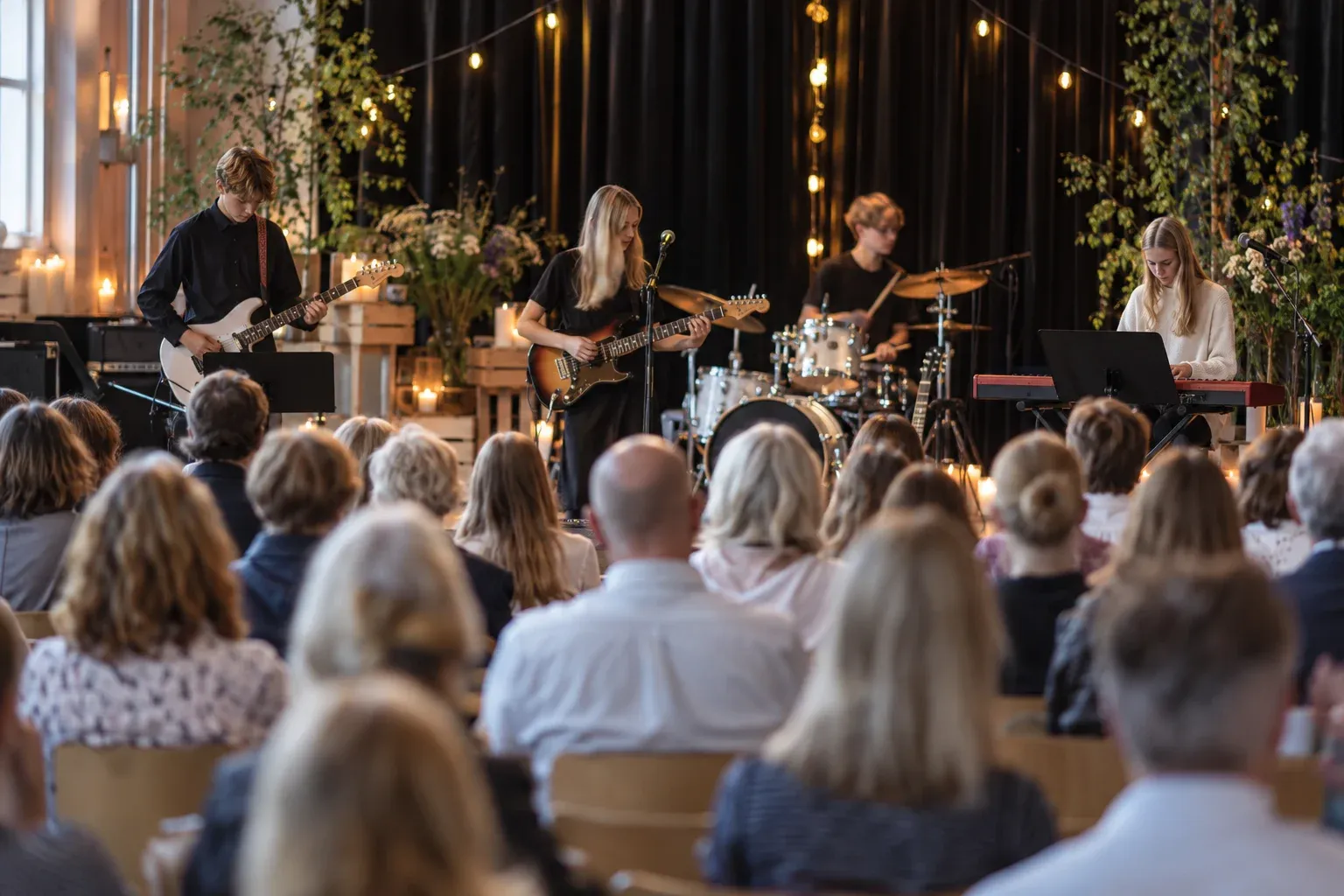
Ask a Swede why a country of ten million keeps writing global hits and you’ll usually hear two words: kulturskolan and replokal (rehearsal room). This guide explains both, what the export figures actually measure, and how your kids can join in or you can catch a concert.
When you need this
You’ve read that Sweden is a “pop superpower” and want to know what’s behind it. Or you’re moving here with children and wonder whether they can learn an instrument after school. Maybe your teenager plays in a band, or you’ve seen a poster for a vårkonsert (spring concert) and wonder who is on stage.
What a kulturskola is
A kulturskola (culture school; the older name is musikskola, music school) is a voluntary after-school program run by the municipality. Children and teenagers learn an instrument, singing, dance, theater, art or film. In 2024 one existed in 287 of Sweden’s 290 municipalities, nearly always run by the municipality itself, according to the Swedish Arts Council (Kulturrådet).
No law requires it. The government’s 2018 strategy says it is important that the kulturskola “remains municipal and voluntary”, and it chose not to regulate it by statute. The state supports it instead through a national center at Kulturrådet, development grants and money for teacher training.
The schools grew out of municipal music schools in the 1940s, as the welfare state was being built. The bill describes two aims: to gather children around music, and to give every child meaningful leisure time whatever their parents earned. Music still dominates:
| Kulturskola in 2024 | Figure |
|---|---|
| Municipalities with a kulturskola | 287 of 290 |
| Children aged 6–19 in term courses | about 190,000 (about 11% of the age group) |
| Music’s share of all participation | almost 70% |
| Individual instrument or singing lessons | 35% of all participation |
| Municipalities with a waiting list | almost three in four |
| Municipalities with a fully free kulturskola | 13% |
Fees and queues
The kulturskola is cheap, but usually not free. In Kulturrådet’s 2024 survey, the most common term fee averaged 703 kr, with municipalities ranging from 100 to 1,720 kr. Kulturrådet’s other measure, fee income divided by participants, gives an average of 1,366 kr a year, falling in real terms since 2015. Only 13% of municipalities said their kulturskola was fully free.
Each municipality sets its own rules. Sibling discounts, income-based waivers and extra charges for instrument hire (instrumenthyra), holiday courses or camps are common. Stockholm, for example, takes ages 6–22, charges a different rate for pupils from other municipalities, and lets the third and later siblings take part free.
Expect a queue. Almost three quarters of municipalities had a waiting list at the start of the 2024 autumn term. Two thirds of the children in those queues weren’t taking any course yet.
Rehearsal rooms and the study associations
The other half of the story is the studieförbund (study associations): state-funded adult-education bodies that rent rehearsal rooms to bands, help them record demos and book their first gigs. Music is by far their largest cultural subject. According to the Swedish Agency for Cultural Policy Analysis, it made up 49% of cultural study circles and 80% of cultural programs (public events) in 2024. For how study associations fit into Swedish club life, see Swedish club life and the study associations.
This network has shrunk sharply. Most English articles about the “Swedish music miracle” haven’t caught up:
| Change, as reported by Studieförbunden | Figure |
|---|---|
| State grant cut announced in the 2024 budget | 500 million kr over 2024–2026, about a third of the annual grant |
| Rehearsal rooms closed in 2024–2025 | at least 200 |
| Music gigs, 2023 → 2025 | 33,535 → 25,548 (−24%) |
| Municipalities where study associations closed premises | four in ten |
| Study associations that shut down entirely | two of ten |
So if a band listing points to a room that has since closed, the cuts are the likely reason. Studiefrämjandet still runs a stage for unsigned bands at Sweden Rock Festival, which it has done for about 20 years. It’s one example of how the associations connect new bands to festival stages.
What the export numbers really say
You’ll often read that Sweden is “the third-largest music exporter in the world”. We found no current primary source for that ranking. The measured claim comes from Stim, the Swedish songwriters’ copyright society:
- Swedish music by Stim’s members is exported at 2.8 times the value of imports.
- 54% of Stim’s 2025 rights revenue came from abroad.
- Sweden is one of four net exporters of music in the world. In 2021 Stim said one of three, so older articles quote that.
- A 2025 report commissioned by Stim called Sweden the EU’s only net exporter of music.
Those figures measure songwriting royalties, not all music business. The best-known example is Max Martin (born Martin Sandberg, 1971). He attended Swedish public music education, apprenticed at the Cheiron studio, and had 21 US Billboard Hot 100 number ones by February 2016, according to the Polar Music Prize. Streaming has a Swedish chapter too: Spotify launched in 2008 and is run by Spotify AB from Stockholm.
Does the music school explain the hits?
Probably in part, but nobody has proven it. Cheap, widespread music lessons, plus rehearsal rooms where teenagers can form bands, make a convincing story. It’s the sector’s own explanation, and it fits Max Martin’s biography. But we found no study that proves the causal link, and the kulturskola reaches about one in nine children, not all of them.
Kulturrådet’s own register analysis adds a caveat: children of highly educated parents are over-represented, while foreign-born and newly arrived children are under-represented. “Music for everyone” is the goal, not quite the reality.
For newcomer families
There is no national application. Search “kulturskolan” plus your municipality’s name and use its own application page. Apply as soon as you have an address, because queues are normal. If the course you want has a queue, ask about the alternatives:
- Open activities (drop-in, open houses): 77% of municipalities run them.
- Targeted courses: 12% of responding municipalities ran activities for newly arrived children, and 57% for children with disabilities.
- Advanced courses (fördjupningskurs): 65% of municipalities offer them, mostly in music.
- In school: 65% of municipalities send kulturskola teachers into compulsory schools, free as part of the school day.
The kulturskola follows school terms: autumn from August, spring from January. It is separate from school itself; for that, see how Swedish schools work for newcomer children.
Concerts visitors can attend
Kulturskola concerts and shows are public, and many are free. Stockholm’s calendar, for example, lists a free guitar evening at the City Museum. End-of-term concerts in May–June and before Christmas are typical, but every school sets its own dates and ticketing, so check the local calendar. For bigger stages, Swedish pop lives on TV in Melodifestivalen and Eurovision and live at Swedish summer festivals.
Practical information
| Item | What to know |
|---|---|
| Kulturskola term fee | National average 703 kr in 2024 (range 100–1,720 kr); your municipality sets its own |
| Fully free kulturskola | 13% of municipalities in 2024 |
| Instrument hire | Often charged separately |
| Application | Through your municipality; no national system |
| Waiting lists | Almost three in four municipalities |
| Concerts | Public; many free; dates set locally |
| Rehearsal rooms | Through local study associations; at least 200 closed in 2024–2025 |
| Next national statistics | Kulturrådet now collects every second year; next collection 2027 |
FAQ
What is a kulturskola in Sweden?
A kulturskola is a voluntary after-school music and arts school run by the municipality. Children and teenagers learn an instrument, singing, dance, theater, art or film, usually for a term fee. In 2024, 287 of Sweden’s 290 municipalities had one, and music made up almost 70% of all participation. It is not part of compulsory school.
Is the Swedish kulturskola free?
Usually not, but it is cheap. In 2024 the most common term fee averaged 703 kr nationally, ranging from 100 to 1,720 kr, and 13% of municipalities ran a fully free kulturskola. Sibling discounts, income-based waivers and extra charges for instrument hire are common. Your municipality’s website lists its own fees.
Why does Sweden produce so many pop hits?
The usual Swedish answer is cheap, widespread music teaching through the kulturskola, plus study-association rehearsal rooms where bands start. Max Martin attended public music education. It is a plausible explanation that the sector itself promotes, not a proven cause. What is measured is that Swedish songwriting earns far more abroad than foreign music earns in Sweden.
Is Sweden really the third-largest music exporter in the world?
No current primary source supports that ranking. The measured claim, from the copyright society Stim, is that Swedish music by its members is exported at 2.8 times the value of imports and that Sweden is one of four net music exporters. A 2025 report commissioned by Stim called Sweden the EU’s only net exporter.
Can my child join a kulturskola if we just moved to Sweden?
Usually yes, once you live in the municipality. Each municipality runs its own application, often online, and almost three quarters had waiting lists in 2024, so apply early. Some charge a different rate for pupils from other municipalities. Many also run open activities and targeted courses, including for newly arrived children.
Can visitors attend kulturskola concerts?
Yes. Kulturskola concerts and shows are public, and many are free; Stockholm’s calendar, for example, lists a free guitar evening at the city museum. Look up the local kulturskola’s calendar. End-of-term concerts in late spring and before Christmas are the most common, but dates and ticketing are set by each school.
Related guides
- How Swedish schools work for newcomer children — the school day the kulturskola sits beside
- Swedish club life and the study associations — where adult music circles and bands fit in
- ABBA The Museum — the group that started the export story
- Melodifestivalen and Eurovision — Swedish pop’s biggest TV stage
- Sommar i P1 — the radio show built on hosts’ own music choices
Facts verified 2026-10-06. Sources: Kulturrådet, the Government (prop. 2017/18:164), Myndigheten för kulturanalys, Studieförbunden, Stim, Polar Music Prize, Spotify, Stockholms stad — full register in this topic’s source file. Fees and admission rules are set by each municipality; check locally. Found something outdated? Tell us and we’ll fix it.