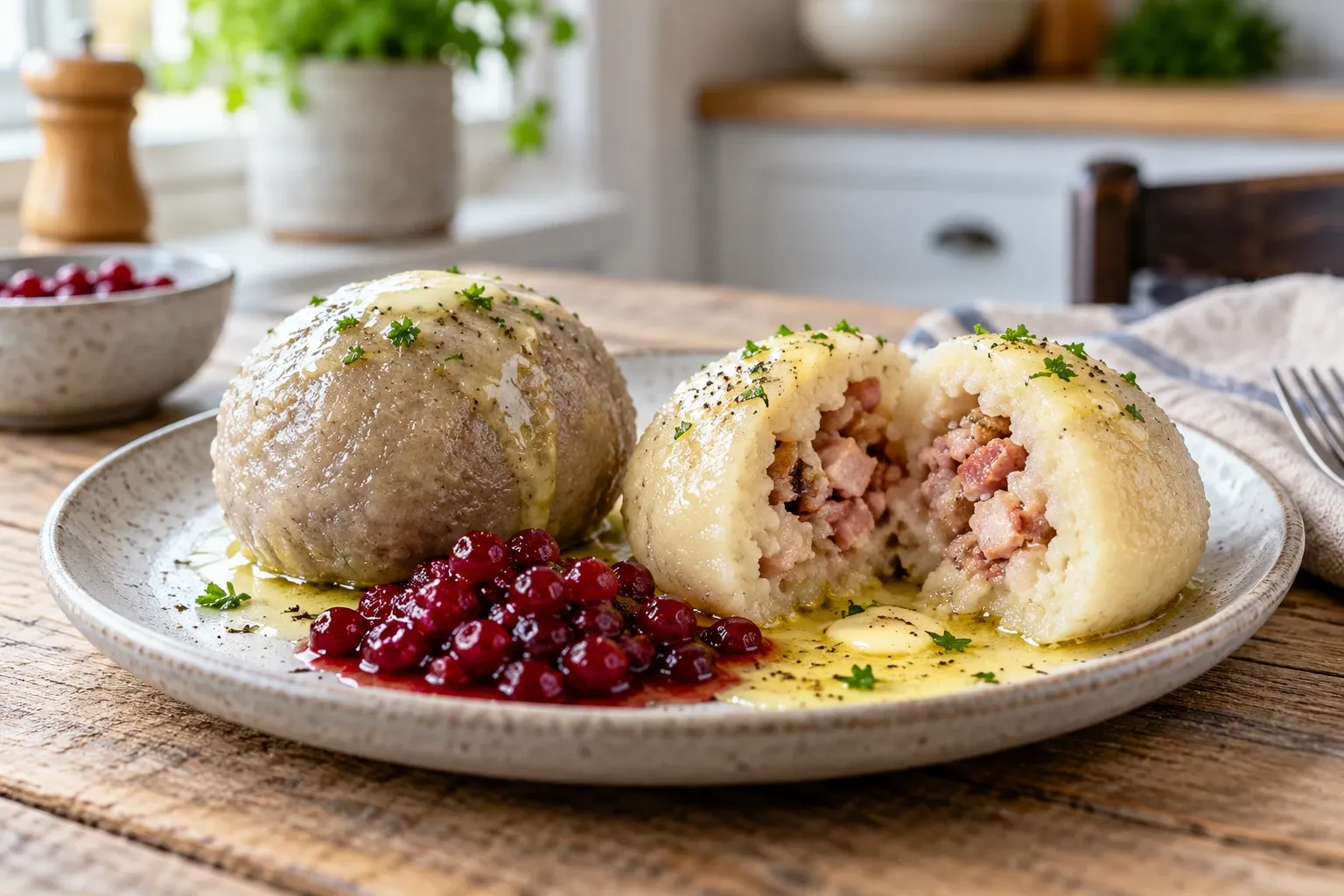
Swedish everyday food is mostly the same from Malmö to Kiruna. Dumplings are the exception. Here is what kroppkakor and palt are, how the grey and pale kinds differ, what to eat them with, what is in them, and where to find them.
When you need this
- You see kroppkakor or palt on a lunch board and want to know what arrives
- You are driving through Öland, Småland, Blekinge or Gotland and want the local dish
- You are heading north to Piteå, Luleå or the Norrbotten coast
- You need to know whether the dish contains pork or gluten
- You bought a vacuum pack in a supermarket and wonder how to heat it
- You heard “grey” and “white” kroppkakor and want the difference
What Swedish dumplings are
Most of the dishes Swedes call husmanskost (everyday home cooking) — meatballs, pea soup, fried herring — are eaten all over the country. The meal historian at SLU, the Swedish University of Agricultural Sciences, names only two real regional exceptions: grain sausages, and the variants of palt and kroppkakor. That makes dumplings one of the few things worth eating because of where you are.
Both families are boiled balls of grated potato and flour with a filling, usually diced salted or smoked pork and onion. They belong to opposite ends of the country, though, and they are made differently.
| Kroppkakor | Palt (pitepalt) | |
|---|---|---|
| Home region | Öland, Småland, Blekinge, Gotland (also listed: Östergötland) | Norrland, with Piteå as its capital |
| Potato | Raw (grey) or boiled (pale), depending on region | Raw grated potato |
| Flour | Wheat | Wheat and barley |
| Filling | Fried diced pork, onion, pepper or allspice | Diced salted pork |
| Size | A little smaller than palt | A little smaller than a tennis ball |
Neither name is protected. Kroppkakor, palt and kams are all absent from the Swedish Board of Agriculture’s list of protected EU food names, last updated on 25 June 2026, so anyone may use the names for any recipe.
Kroppkakor: grey or pale
Kroppkakor (singular kroppkaka) are the dumplings of south-east Sweden. A traveler to Öland called them “a very tasty dish” as early as 1775. Back then they were made from barley and wheat flour; potato replaced the barley from the mid-1800s.
The single biggest difference is the potato. Smaka Sverige, the Board of Agriculture’s food-heritage site, splits them into two kinds: grova (coarse) kroppkakor made with raw grated potato, which turn grey, and fina (fine) ones made with boiled potato, which stay pale.
| Region | Style |
|---|---|
| Öland | Grey: mostly raw grated potato with some boiled; the coarse kind is the most common in Öland homes |
| Blekinge | Gråa (grey) kroppkakor of almost only raw potato; western and central Blekinge use more boiled potato |
| Småland | Pale: made with boiled potato |
| Gotland | White: almost only boiled potato, traditionally with a white sauce |
The classic filling is fried diced pork with chopped onion and white pepper or allspice. Historically Öland also filled them with eel or herring, and poor households made unfilled ones called blinningar.
If you are in the south-east for more than a day, try one of each color. A grey Öland or Blekinge kroppkaka and a pale Småland or Gotland one feel like two different dishes.
Palt: the northern cousin
Boiled lumps of grain have been eaten in Sweden since prehistoric times; the oldest finds of blood palt come from Iron Age graves in Halland. Palt was once eaten across the whole country, but in the 1800s it faded in the south — except as kroppkakor — while Norrland kept it. Potato and wheat flour only entered the recipes in the 1800s.
Today the palt you are most likely to meet is pitepalt, from Piteå in Norrbotten. It is raw grated potato mixed with wheat and barley flour and salt, rolled around diced salted pork into a ball a little smaller than a tennis ball. It simmers for up to an hour and is normally done when it floats. Smaka Sverige explains the Piteå connection by young men from Piteå who worked their way around the country around 1900 with palt in their packs. A palt academy was founded in Piteå in 1995.
Palt has relatives of its own:
- Kams is the southern-Norrland name; the switch is said to fall somewhere between Umeå and Örnsköldsvik. In Ångermanland and Medelpad kams is often made without potato.
- Blodpalt has blood mixed into the dough and turns dark. In Tornedalen it is made with reindeer blood and dropped into the pot by the spoonful, so the dumplings are irregular. It comes with fried pork.
- Leverpalt has liver in the dough.
- Flatpalt is flat and unfilled; in Jämtland the pair is fetkams (filled) and flatkams (unfilled).
Pitepalt may also be filled with minced meat, liver or fish. Across the border, Norway’s raspeball (called komle on the west coast) is a cousin of the same idea.
How to eat them
The classic plate is simple: melted butter and lingonberries, often with cream poured over. With palt, a glass of cold milk is the traditional drink.
Not everyone wants the lingonberries. Some people feel they drown the dumpling’s flavor, and the traditional Öland serving is melted butter and cream. On Gotland a white sauce is traditional.
Expect something dense. A grey kroppkaka or a pitepalt is nothing like light Italian gnocchi; one or two make a meal.
Leftovers are half the point. Reheat them in water, or slice or dice them and fry them in butter the next day.
Pork, blood and gluten
The standard dish suits fewer diets than its potato base suggests.
- Pork: the classic filling is salted or smoked pork, so the default dumpling is not vegetarian, halal or kosher. Blood palt contains blood, leverpalt liver.
- Gluten: the dough is bound with wheat flour, and palt also with barley, so it is not gluten-free.
- Meatless versions: unfilled kinds exist, such as blinningar and flatpalt, but there is no telling how common they are on menus.
Ask the kitchen. Restaurants must be able to tell you what a dish contains, and Livsmedelsverket, the Swedish Food Agency, accepts that allergen information for food served on the premises is given by word of mouth.
Where to find them
The honest answer is: in the region. Outside the south-east and Norrland, kroppkakor and palt are rarely on menus, so do not save them for Stockholm or Gothenburg.
In their home regions, look in three places:
- Weekday lunch boards. The lunch restaurants are where Swedish everyday food lives on; see our guide to dagens lunch.
- Local kitchens that specialize in them, especially in Småland and on Öland in summer, when visitors are most numerous.
- Takeaway and supermarkets. Buying kroppkakor to take home or for a picnic is normal, some producers sell them freshly made, and chilled packs are easy to heat in a rental cabin’s kitchen.
Seasons matter only a little. Neither dish belongs to a holiday. Summer potatoes have less starch than winter ones, which changes the texture. Smaka Sverige gives 13 July as Paltens dag (Palt Day), though we found no second source for the date.
Practical information
| What | Detail |
|---|---|
| Kroppkakor regions | Öland, Småland, Blekinge, Gotland; also listed for Östergötland |
| Palt regions | Norrland; pitepalt in Norrbotten, kams in southern Norrland |
| Grey vs pale | Raw grated potato (grey) vs boiled potato (pale) |
| Usual filling | Salted or smoked pork, often with onion |
| Contains | Wheat flour (gluten); palt also barley |
| Served with | Melted butter, lingonberries, often cream; milk to drink with palt |
| Protected EU name? | No — not on Jordbruksverket’s list of 25 June 2026 |
| Lunch and pack prices | Vary by restaurant, producer and shop — not published here |
FAQ
What are kroppkakor?
Kroppkakor are Swedish potato dumplings from Öland, Småland, Blekinge and Gotland: balls of grated potato and flour filled with fried diced pork and onion, seasoned with pepper or allspice, then boiled. They are eaten with melted butter, lingonberries and often cream. Grey ones use raw potato, pale ones boiled potato. The dish has been recorded on Öland since 1775.
What is the difference between kroppkakor and palt?
They are related regional dumplings from opposite ends of Sweden. Kroppkakor belong to the south-east and can be made from raw or boiled potato; pitepalt belongs to Norrbotten and is made from raw potato with wheat and barley flour. Kroppkakor are usually a little smaller and spiced with allspice. Both have a salted-pork filling and come with butter and lingonberries.
What is pitepalt?
Pitepalt is the palt of Piteå in Norrbotten: raw grated potato mixed with wheat and barley flour and salt, rolled around diced salted pork into a ball a little smaller than a tennis ball, then simmered for up to an hour until it floats. It is served with butter and lingonberries, traditionally with a glass of cold milk.
Why are some kroppkakor grey?
Because they are made with raw grated potato, which greys as it cooks. Smaka Sverige calls these grova (coarse) kroppkakor and says they are the kind most common in Öland homes; Blekinge’s gråa kroppkakor are almost all raw potato. Småland and Gotland versions use boiled potato and stay pale. The taste and texture differ, so try both.
What do you eat with kroppkakor?
Melted butter and lingonberries are the classic pair, often with cream poured over. Some people skip the lingonberries because they overpower the dumpling, and the traditional Öland serving is butter and cream. On Gotland a white sauce is traditional. Leftovers are good sliced and fried in butter. A glass of milk is the traditional drink with palt.
Are kroppkakor gluten-free or vegetarian?
Not usually. The dough is bound with wheat flour, and palt also with barley, so the standard dish contains gluten. The classic filling is salted or smoked pork, and blood palt contains blood. Unfilled versions exist, such as Öland’s blinningar and northern flatpalt, but ask the kitchen: restaurants must be able to tell you what a dish contains.
Where can I eat kroppkakor in Sweden?
In their home regions: Öland, Småland, Blekinge and Gotland for kroppkakor, and Norrbotten and the rest of Norrland for palt. Look on weekday lunch boards and at local kitchens that specialize in them, or buy them freshly made or chilled to take away. Elsewhere in Sweden they are rarely on menus, so do not count on finding them in Stockholm or Gothenburg.
Related guides
- Swedish food: the complete visitor’s guide — the national map these dumplings sit on.
- Dagens lunch — the weekday lunch boards where regional dishes actually appear.
- Öland travel guide — the island of the grey kroppkaka.
- Småland travel guide — the pale, boiled-potato kind, plus ostkaka.
- Gluten-free in Sweden — because the dough is wheat-based.
Facts verified 2026-10-15. Sources: Jordbruksverket (Smaka Sverige), SLU, Livsmedelsverket, Visit Småland — full register in this topic’s source file. Found something outdated? Tell us and we’ll fix it.