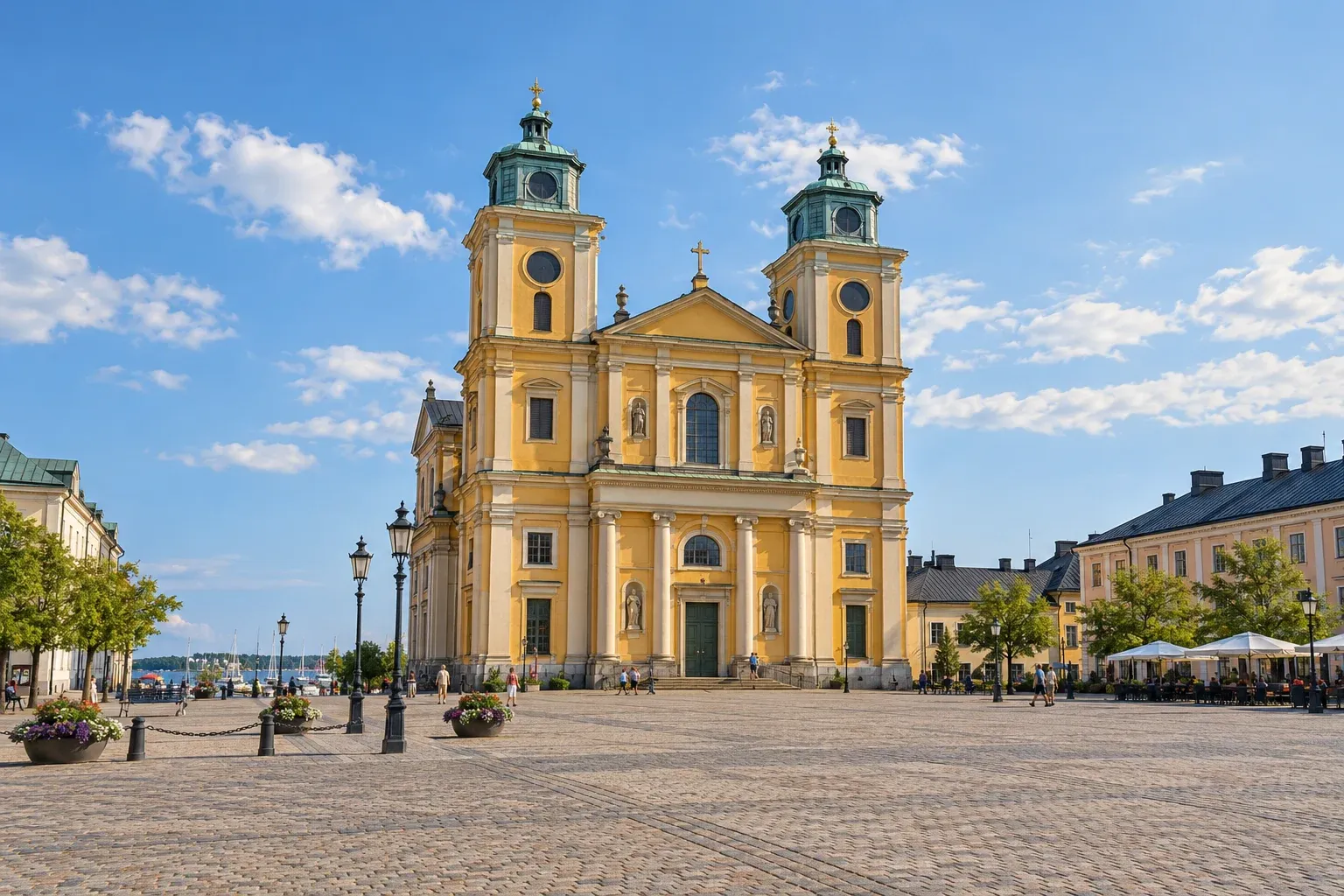
Karlskrona is a working naval base that happens to be a World Heritage town. That shapes your visit: some sights need a booking and a passport number, some boat routes ban cameras, and the islands run to a summer timetable.
When you need this
You are planning a day or a weekend in Karlskrona, perhaps as a stop on a south-east Sweden road trip or straight off the ferry from Poland. You want to know which parts of the World Heritage site you can actually walk into, whether the naval museum costs anything, how to get out to the forts and islands, and what the military setting means for your camera.
What the World Heritage listing covers
Karlskrona was founded in 1680, when Karl XI granted the town its privileges on the island of Trossö. The site was picked for its narrow, deep, easily defended channel with room for a large sheltered harbor. UNESCO inscribed Örlogsstaden Karlskrona (“the Naval Port of Karlskrona”) on 3 December 1998 as Sweden’s ninth World Heritage site, calling it the best-preserved and most complete of Europe’s surviving naval bases. The base is still in military use.
The listing is a whole system, not one building, and not all of it is open:
| Part | What it includes | Can you go in? |
|---|---|---|
| The town on Trossö | Grid plan, Stortorget with Fredrikskyrkan and Trefaldighetskyrkan, Amiralitetskyrkan | Yes; public streets and churches |
| Örlogsvarvet and örlogshamnen | The naval shipyard and harbor, Polhem’s dry dock | Active naval area; guided tours of the old yard cancelled until further notice |
| Stumholmen | Former naval supply island, public since 1993; Marinmuseum | Yes |
| Fortifications | Kungsholms fort, Drottningskärs kastell and smaller forts | Kungsholm by booked tour only; Drottningskär in season |
| Omlandet | Surrounding estates and supply sites | Varies by site |
Stortorget, the highest point of the grid plan, has two churches: Fredrikskyrkan, by Nicodemus Tessin the Younger and inaugurated in 1744, and Trefaldighetskyrkan, the “German church”. A short walk away, Amiralitetskyrkan is Karlskrona’s first church, a wooden building inaugurated in 1685 as a temporary church for about 4,000 people. Outside stands Rosenbom, a poor box carved as an 18th-century sailor. In summer 2026 Amiralitetskyrkan opened 15 June–9 August, Monday–Friday 10:00–18:00. It has no planned autumn hours and does not open in winter without staff, so contact the parish office first.
One tour you will still see advertised is gone. Visit Karlskrona says guided tours of the old naval shipyard are cancelled until further notice “due to the current security situation in Europe”.
Marinmuseum
Marinmuseum, the naval museum, sits on Stumholmen. It is not free for adults, whatever older guides say: free adult admission at Swedish state museums ended with the 2023 budget. The free options are:
- Under 18: always free.
- Everyone on Wednesdays from October to April, when the museum also stays open until 19:00.
- Companions of paying visitors.
| Period (2026) | Hours |
|---|---|
| October–April | Tuesday–Sunday 10:00–16:00, Wednesday to 19:00 |
| May and September | Daily 10:00–16:00 |
| June–August | Daily 10:00–17:00; boat houses and museum vessels 11:00–16:00 |
Adult tickets cost more in June–August. The museum is closed on 23–25 and 31 December and 1 January, and opens on some school-holiday Mondays, including 26 October and 21 and 28 December 2026.
Kungsholms fort and Drottningskär
Kungsholms fort has guarded the inlet to Karlskrona with Drottningskär for more than 300 years. Its island is still a military protected object, so you can go only on a guided tour booked through Karlskrona Tourist Center at Amiralitetstorget 27:
- Book by 15:00 two working days before the tour, in person, by phone or by email. A weekend tour therefore has to be booked by Thursday afternoon.
- Give your full name, nationality and passport number if you are not Scandinavian. Scandinavians give their personal number instead.
- Bring valid ID. Everyone over 18 must carry the document registered at booking.
- Go to Fisktorget, where all tours leave. They last three to four hours. No pets.
In 2026 tours ran on May weekends, two June weekends, daily from 22 June to 16 August, and on further dates in August and September. The fort is not fully accessible, so mention any mobility need when booking.
Drottningskärs kastell, the citadel on Aspö, is the open counterpart. In 2026 it opened daily 09:45–17:00 from 30 May to 31 August and on weekends into September, free under 18. Get there on Aspöleden, the free road ferry run by Trafikverket: about 25 minutes, all year. See our guide to Sweden’s road ferries.
The archipelago boats
Blekingetrafiken, the county transport authority, runs two kinds of boat, and the difference matters outside summer:
| Boat type | From | When | Ticket |
|---|---|---|---|
| Summer lines to Kastellet, Nättraby and Stenshamn, plus hop-on hop-off | Fisktorget | May to end of September | Bought on board, Swish or bank card |
| Commuter boats to Hasslö, Sturkö, Trummenäs | Handelshamnen | Weekdays, all year | Ordinary tickets in the Blekingetrafiken app |
| Line to Inlängan, Stenshamn, Ungskär, Långören | Yttre Park | All year | App, or tap a bank card on board |
Children aged 7–19 get 40% off the summer boats, and two children under 7 ride free with a paying adult. Bikes go on departures marked with a bike symbol, if the crew agrees. M/F Axel takes three wheelchairs and M/F Wittus one, with no accessible toilets; book ahead.
The Fisktorget–Kastellet line is called the världsarvsturen (“World Heritage tour”). It passes powder houses, the shipyard, the forts and the working naval base, which is exactly why it also carries a photography ban. The 2026 summer season is over: every Fisktorget line now says it returns in summer 2027.
Cameras and drones near the base
A skyddsobjekt (protected site or object) can carry a ban on making images, descriptions or measurements “of or within” it. It can also ban entry, drones, bathing, diving, anchoring and fishing. Military sites, water areas important to defense, and military ships and vehicles can all be protected.
- The sign marks the ban, not a fence line. Photographing a signed site from a public quay or a passing boat can still be olovlig avbildning av skyddsobjekt (unlawful image-making), which carries a fine or up to a year in prison. Carelessness is enough.
- Guards may ask your name, date of birth and address, search you and your vehicle, and remove you.
- Blekingetrafiken warns that parts of its archipelago routes pass protected objects where photography is not allowed.
The safe default is simple: no photos when a sign or the crew says so, and no drone near the base. Our photography rules guide covers the law in full.
Getting there
By train. Öresundståg runs Karlskrona–Karlshamn–Kristianstad–Malmö–Copenhagen; see our Öresundståg guide. Krösatåg runs the Kust till kust branch from Karlskrona to Emmaboda, about 56 km in about 38 minutes, connecting towards Kalmar and Växjö. You may see “Kustpilen” in old guides: that service disappeared in 2005, when the coast line closed for electrification and Öresundståg replaced it.
Rail works in autumn 2026. On 16–18 October, buses replace evening Öresundståg trains between Sölvesborg and Kristianstad. Alvesta’s last 2026 weekend closure is 21–22 November, when Krösatåg Karlskrona–Emmaboda runs to changed times.
By bus. Since 2 March 2026, long-distance lines 500 (to Kalmar) and 600, taxis and the airport bus leave from Kungsplan, not the station forecourt. The works last until about winter 2028.
By plane. Ronneby Airport has direct flights to Stockholm. Blekingetrafiken buses serve the airport, and a private airport bus timed to the flights runs to Karlskrona, taking card, Swish or cash.
By car. Kalmar is about 89 km away on the E22, about 1 h 15 min of pure driving. Our southern Sweden road trip gives Karlskrona a full day, and Kalmar is the next stop up the coast.
The ferry to Gdynia
Stena Line sails Karlskrona–Gdynia in about 10 h 30 min, day or night, with up to three sailings a day. The terminal is on Verkö, Verkövägen 101, about 10 km from the center. Bus line 6 ends at the terminal, about 30 minutes from town. Carry a passport or national ID card: Sweden’s temporary internal border control runs to 11 November 2026 and may be extended. Our ferry guide for Poland and the Baltics compares all routes.
When to go
| Period | What to expect |
|---|---|
| Late May–August | Drottningskär open daily; Kungsholm tours (daily 22 June–16 August in 2026); all summer boats; Marinmuseum daily |
| September | Boats to end of month; Drottningskär weekends; some Kungsholm dates |
| October–April | Marinmuseum free on Wednesdays; commuter boats and Aspö road ferry only |
| 16–18 Oct, 21–22 Nov 2026 | Rail works |
Mistakes to avoid
- Assuming Marinmuseum is free for adults.
- Turning up at Fisktorget for a Kungsholm tour without a booking or ID.
- Photographing the naval harbor from the boat where the crew has announced a ban.
- Planning a Fisktorget island hop in October.
- Waiting for long-distance buses in front of the station instead of at Kungsplan.
- Searching for “Kustpilen” trains.
- Booking a shipyard walk an old guide recommends.
Practical information
| Item | Detail | Checked |
|---|---|---|
| Marinmuseum | Adults pay (more in June–August); under 18 free; all free on Wednesdays October–April | 2026-10-01 |
| Kungsholms fort tour | Paid; adult, youth 7–19 and child rates; book via Karlskrona Tourist Center | 2026-10-01 |
| Drottningskärs kastell | Adults pay; under 18 free | 2026-10-01 |
| Aspöleden road ferry | Free; about 25 minutes | 2026-10-01 |
| Summer boats | Paid on board, Swish or card; 40% off ages 7–19 | 2026-10-01 |
| Commuter boats | Ordinary Blekingetrafiken fares in the app | 2026-10-01 |
| Churches | No entrance fee stated by the parishes | 2026-10-01 |
| Gdynia ferry | Varies by date and cabin; book with Stena Line | 2026-10-01 |
Prices change by season and year, so they are not repeated here: check the museum, Visit Karlskrona and the boat timetables on the day.
FAQ
Is Marinmuseum in Karlskrona free?
Not for adults, except on Wednesdays from October to April, when entry is free for everyone and the museum stays open until 19:00. Children and teenagers up to 18 always enter free. Free admission at Swedish state museums ended for adults with the 2023 budget, so older guides calling Marinmuseum free are out of date. Adult prices are higher in June–August.
Can you visit Kungsholms fort?
Yes, but only on a guided tour booked through Karlskrona Tourist Center, because the island is a military protected object. Book by 15:00 two working days ahead, giving your full name, nationality and passport number. Everyone over 18 must carry the registered ID. Tours leave from Fisktorget, last three to four hours, and ran daily from 22 June to 16 August in 2026.
What does Karlskrona’s World Heritage site include?
The whole naval system, not one building: the planned town on Trossö with Stortorget and its churches, the naval shipyard and harbor, the fortifications including Kungsholms fort and Drottningskär, Stumholmen, and estates in the surrounding countryside. UNESCO inscribed it on 3 December 1998 as the best-preserved and most complete of Europe’s surviving naval bases, which is still in use.
Can I take photos of the naval base in Karlskrona?
Not where a protected-object ban applies. Under the Protection Act, a signed military site, water area, ship or vehicle can carry a ban on making images of it, even from outside, and breaking it can mean a fine or up to a year in prison. Blekingetrafiken warns that parts of the archipelago boat routes pass such areas. When a sign or the crew says no photos, put the camera away.
How do I get to Karlskrona?
By train, bus, plane or car. Öresundståg runs direct from Copenhagen and Malmö via Kristianstad, and Krösatåg connects at Emmaboda towards Kalmar and Växjö. Ronneby Airport has direct flights to Stockholm and buses to Karlskrona. Kalmar is about 89 km away on the E22. During station works, long-distance buses leave from Kungsplan, not the station forecourt.
Do the archipelago boats run outside summer?
Partly. The summer lines from Fisktorget, including the World Heritage route past the forts, run from May to the end of September and return in summer 2027. Weekday commuter boats from Handelshamnen to Hasslö, Sturkö and Trummenäs, and a line from Yttre Park to the eastern islands, run all year with ordinary app tickets. Drottningskär is reachable year-round by the free Aspö road ferry.
How do I get to the ferry to Gdynia?
Stena Line’s terminal is on Verkö, about 10 km from the center at Verkövägen 101. Local bus line 6 ends at the terminal and takes about 30 minutes. The crossing to Gdynia takes about ten and a half hours, with up to three sailings a day. Carry a passport or national ID card: Sweden’s temporary internal border control runs to 11 November 2026.
Related guides
- UNESCO World Heritage sites in Sweden: where Karlskrona fits among the country’s listed sites.
- Ferries from Poland and the Baltics: Gdynia–Karlskrona compared with every other route.
- Photography rules in Sweden: protected sites, people and posting, in full.
- Southern Sweden road trip: Karlskrona as one day on a driving loop.
- Kalmar: the castle city 89 km up the E22.
Facts verified 2026-10-01. Sources: Länsstyrelsen Blekinge, Karlskrona kommun and Visit Karlskrona, Svenska kyrkan, Marinmuseum, Trafikverket, Blekingetrafiken, Öresundståg, Swedavia, Stena Line, Regeringen, Sveriges Riksdag (Skyddslag 2010:305) and Försvarsmakten — full register in this topic’s source file. Seasons and opening hours are 2026 figures. Found something outdated? Tell us and we’ll fix it.