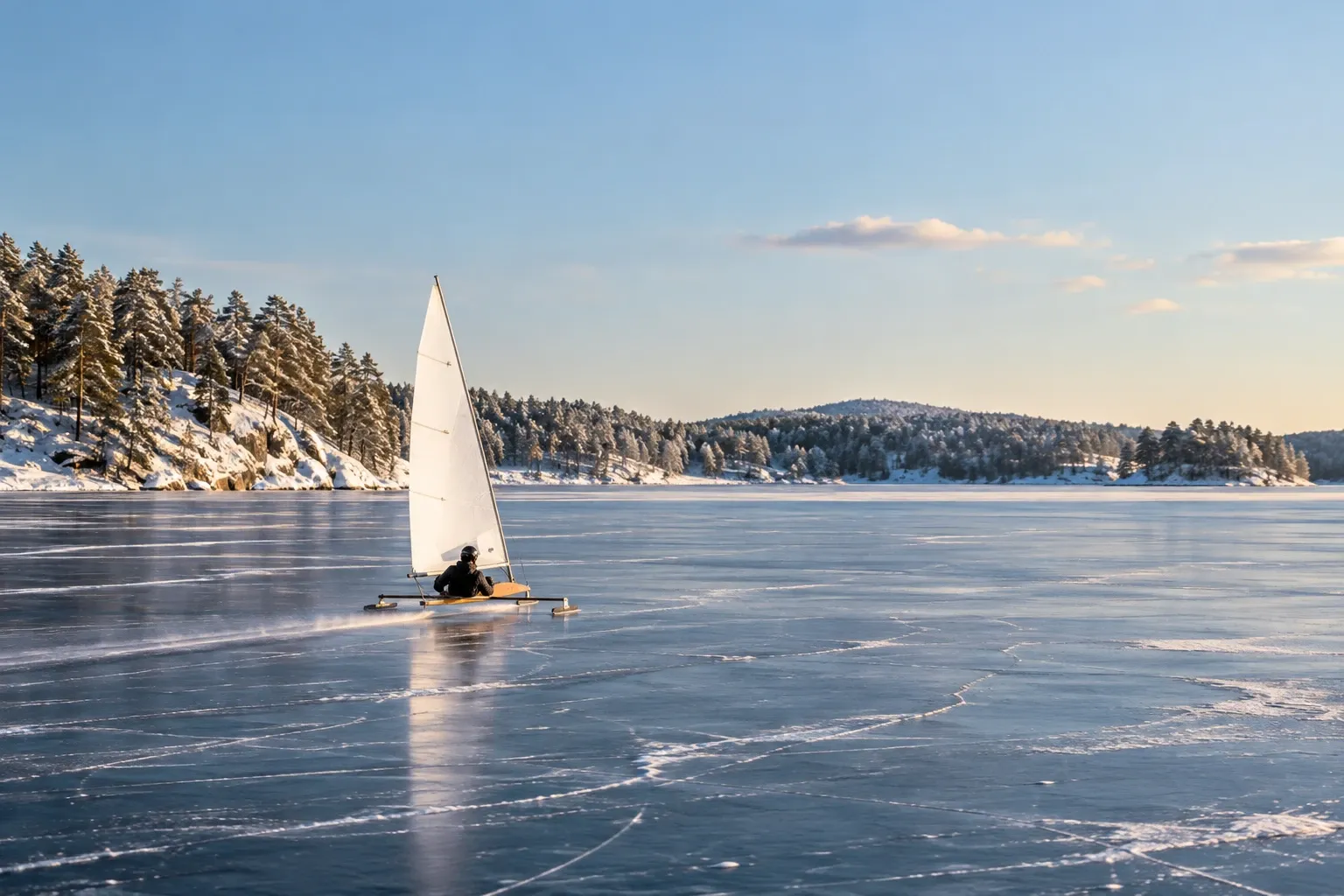
Ice sailing is one of Sweden’s oldest organised sports and one of its fastest. This guide explains how it is organised, which form suits you, what kit the sport requires, and how a visitor can actually get onto the ice.
When you need this
You are in Sweden between December and April and have seen iceboats or kites tearing across a frozen lake. Maybe you kitesurf, windsurf or sail in summer and want the winter version. Or you already skate on natural ice and wonder about adding a sail. Either way, you need to know whether you need a permit, a course or insurance, and whether a guided session or your own kite makes more sense.
What ice sailing is: one word, six ways to do it
Swedes use issegling (ice sailing) for every way of crossing frozen lakes and sea bays with wind alone. The sport has been organised for over a century. Stockholm’s first skate-sailing and ice-yacht clubs both date from 1901, and the national federation, today Svenska Isseglarförbundet, joined the Swedish Sports Confederation in 1906. The federation recognises ten classes. These are the ones a newcomer meets:
| Form | What it is | Good to know |
|---|---|---|
| DN iceboat (isjakt) | One-person boat on three runners (medar) | The world’s most popular class; recorded above 140 km/h |
| Ice Optimist | Small iceboat for ages 8–15 | The junior entry class |
| Wing | Hand-held sail on skates, no fixed link to the skates | The federation calls it very easy to handle; renamed from Kitewing in 2022 |
| Draksegel | Rigid five-sided hand-held sail on skates | Despite the name (“kite sail”), not a kite |
| Winter windsurf | Windsurf rig on an ice or snow board with runners | For windsurfers |
| Kite | Kite on lines, on skis, snowboard or skates | Works on packed snow as well as ice |
That draksegel trap matters if you search in Swedish. A kite on lines is simply called kite; the draksegel is the oldest skate-sailing class, with roots in the late 1800s.
How fast, and why it matters
The federation and the Swedish Sports Confederation’s facility guide put typical speeds at 60 to more than 130 km/h. Swedish ice kiters have passed 100 km/h on both skates and skis. That speed changes the ordinary ice rules.
Issäkerhetsrådet, the Swedish ice-safety council, puts it plainly: the faster you go, the further onto weak ice you get before it breaks, and the harder the rescue. Kite skiers face a second problem. Skis carry you far out onto weak ice, and the council warns it is almost impossible to climb out of a hole with skis on, because many bindings cannot be released in the water. Its advice is to ski only on ice you are sure of, near the shore.
The other big risk is each other. A Stockholm ice-yacht club names collisions between sailors as the sport’s greatest danger. That is why sailors lay out a course and follow right-of-way rules — for iceboats, the NIA rules, adapted by each class.
How a visitor can actually try it
Here is the honest part that sales pages skip. Swedish clubs are not tour providers. The federation’s try-outs are offered to clubs, mainly for juniors coming from summer sailing. A long-established Stockholm club runs open try-outs between December and April, but says they are for people who want to take up the sport — someone looking for a one-off thrill gets a polite but firm no.
| You are… | Realistic route |
|---|---|
| On a short winter trip | A commercial guided ice-sailing session or a kite course |
| A kitesurfer who has never flown a kite on snow | A kite course; the federation recommends one for anyone who has never kited |
| An experienced sailor staying a season | Contact a club through the federation’s club map; clubs lend boats and equipment |
| A Nordic skater | Ask a club about the wing, the easiest sail to handle |
If you go to a club try-out, the federation’s list asks for basic sailing skills, the ability to get round a course unaided, warm clothes, your own ski helmet and goggles, thick mittens, shoe spikes and, for skate sailing, your own skates.
The two legal limits
There is no licence, permit or registration to get: we found none for sailing or kiting on natural ice. Being on the ice rests on allemansrätten, the right of public access, and the Environmental Code’s duty to show consideration for nature and other people applies out there too. See our guide to allemansrätten, Sweden’s right of public access.
Two binding limits remain:
- Nature reserves can ban kites. Reserve regulations can restrict how people move inside a reserve. The Utteros reserve near Varberg, for example, bans kitesurfing and kite flying outright. Check the regulations of any protected area before you launch.
- Do not scare reindeer. Frightening or harassing reindeer where herding is allowed is a fineable offence under the Reindeer Husbandry Act, even through negligence. A fast kite on a mountain lake can do exactly that. Read why reindeer are not wild animals before kiting in the north.
Insurance is the practical third limit. The federation’s group cover only applies to club and class activities, and it warns that unorganised solo sailing can leave you with inadequate cover. It advises both accident and third-party liability insurance. Its safety page also says sailing outside organised events falls under Terrängtrafikkungörelsen, a terrain-traffic ordinance. That ordinance was repealed in 2003, so don’t rely on that line. Your ordinary personal liability remains, which is why the insurance advice still matters.
Thick ice is not enough
In February 2026 the DN World and European Championships began on a bay near Norrköping. The ice was thick and snow-free. But the race committee found many deep cracks, one sailor broke his rudder on one, and the whole event moved to Poland. If world-class sailors walk away from thick ice, a visitor should not second-guess them.
Issäkerhetsrådet’s general rule is that clear core ice (kärnis) should be at least 10 cm thick before anyone goes on it. It publishes no separate figure for iceboats or kites. The sailors’ answer is reconnaissance: all ice is checked for thickness and quality before sailing, and sailing stays inside the checked area. The other ice hazards apply at speed:
- Sea ice is always weaker than lake ice. It gives no clear sound as it thins, and boats, waves and wind can break it up.
- Ship and ferry channels (isrännor) are broken through sea ice at short notice.
- Spring ice can lose its strength in 15–20 minutes as the sun rises, first near shore.
- Snow hides weak spots — a kite skier on snow-covered ice cannot read it.
- Weak spots cluster at inlets, outlets, straits, shallows, points, reeds, bridges, jetties and sewage outlets.
For the full picture, read our guide to ice safety on frozen lakes. The federation’s own map of launch points is no help here: it says it is not a map of current conditions.
The kit
The federation describes a helmet, shoe spikes (broddar) and ice claws (isdubbar) as mandatory safety equipment for every ice sailor. Its try-out list adds ski goggles and thick mittens. On top of that comes the standard Swedish ice kit: an ice pole, a throw line, flotation and a phone packed waterproof so you can call 112. Never go out alone, and tell someone your plan.
Dress for wind chill. SMHI’s model shows −10 °C feeling like −14 °C in only 2 m/s of wind, and at sailing speed you make your own wind. See what to pack for a Swedish winter and hypothermia and frostbite basics.
Where people sail
Sailors need hard, snow-free ice and wind, so clubs watch many lakes and often pick a venue only days ahead. They follow ice reports through Skridskonätet (via a member club) and a free public social-media group the federation links to. For the sea and the biggest lakes, SMHI’s ice chart gives the big picture, though SMHI says you must still judge the ice where you are.
| Area | What to know |
|---|---|
| Stockholm | Stora Värtan, a sea bay, is the classic iceboat meeting place; Ullnasjön and Fysingen are inland club ices; hand-held sailors also use Ältasjön, Drevviken, Mälaren and the inner archipelago |
| Mälaren and Västerås | Västerås’s bays are a recognised venue; Västerås hosted the WISSA world championship in February 2026 |
| Dalarna | Orsasjön at Orsa has repeatedly hosted world and European championships |
| Uppsala and Gävleborg | Ekoln and Storsjön (Sandviken) |
| Mountains | Visit Sweden lists snow kiting in Funäsfjällen; kites can use packed snow; reindeer graze here |
If a championship is on during your visit, it is worth watching from the shore.
Practical information
| Item | Detail |
|---|---|
| Licence or permit | None found for sailing or kiting on natural ice |
| Fee to use public lake ice | None found |
| Mandatory kit (federation) | Helmet, shoe spikes, ice claws |
| Minimum core ice for people | 10 cm (Issäkerhetsrådet); no iceboat or kite figure |
| Club iceboat rental (one Stockholm club, members only) | 100 kr per hour, at most two 4-hour sessions (checked October 2026) |
| Guided session or kite course | Set by each operator |
| Liability cover at international iceboat regattas | Often up to €500,000 or more required |
| Club try-out season | December–April (one Stockholm club) |
| Emergency | 112 |
FAQ
Do you need a licence or permit for ice sailing in Sweden?
No licence, permit or registration was found for sailing or kiting on natural ice; it rests on allemansrätten, the right of public access. Two legal limits remain: nature-reserve regulations can ban kites, and scaring reindeer is a fineable offence. The federation strongly advises your own accident and liability insurance outside club events.
How fast do iceboats and ice kites go?
Very fast. Sweden’s ice sailing federation puts typical speeds at 60 to more than 130 km/h, and a DN iceboat has been recorded above 140 km/h. Swedish ice kiters have passed 100 km/h on both skates and skis. Speed is why the sport requires a helmet and why it sails only on ice that has been checked first.
Can tourists try ice sailing in Sweden?
Yes, but usually through a commercial guided session rather than a club. Clubs and the national federation run try-outs mainly for people who want to take up the sport, often juniors, and one Stockholm club says it turns away one-off thrill-seekers. Experienced sailors staying a season can contact a club, which may lend boats and equipment.
Where can you go snowkiting or kite skiing in Sweden?
On large frozen lakes and open snowfields wherever the ice and wind allow. Kites, unlike iceboats, can run on packed snow as well as clear ice. Visit Sweden lists snow kiting among Funäsfjällen’s winter activities. In the mountains, keep clear of reindeer and check any nature reserve’s regulations, since some ban kites.
How thick does the ice need to be for ice sailing?
Issäkerhetsrådet, the Swedish ice-safety council, says clear core ice should be at least 10 cm thick before anyone goes on it; it publishes no separate figure for iceboats or kites. Thickness is not enough: in 2026 a world championship left a Swedish bay because of deep cracks in thick ice. Sailors reconnoitre the ice first.
What safety gear do you need for ice sailing or ice kiting?
The federation lists a helmet, shoe spikes and ice claws as mandatory for every ice sailor; ski goggles and thick mittens are also on its try-out list. Add the standard ice kit — ice pole, throw line, flotation and a phone packed waterproof — and never go alone. Beginners on a kite should take a course first.
Is ice sailing dangerous?
It carries real risks, mostly collisions and weak ice. A Stockholm club names collisions as the biggest risk, which is why sailors use a laid-out course and right-of-way rules. Speed carries you far onto weak ice before it breaks, and skis make climbing out of a hole almost impossible. Organised, on reconnoitred ice, the federation calls the risks low.
Related guides
- Nordic skating on natural ice — the skating skills and kit a wing sailor builds on.
- Ice safety on frozen lakes — weak spots, thickness and what to do if someone goes through.
- Hypothermia and frostbite basics — wind chill at speed is the cold risk here.
- Surfing and kitesurfing in Sweden — the summer version, and where reserves ban kites.
- 112 and Sweden’s emergency numbers — the call to make if it goes wrong.
Facts verified 2026-10-15. Sources: Issäkerhetsrådet, Svenska Isseglarförbundet, Riksidrottsförbundet, Länsstyrelsen Hallands län, Sveriges riksdag (Miljöbalken, Rennäringslagen), Visit Sweden, SMHI — full register in this topic’s source file. Found something outdated? Tell us and we’ll fix it.