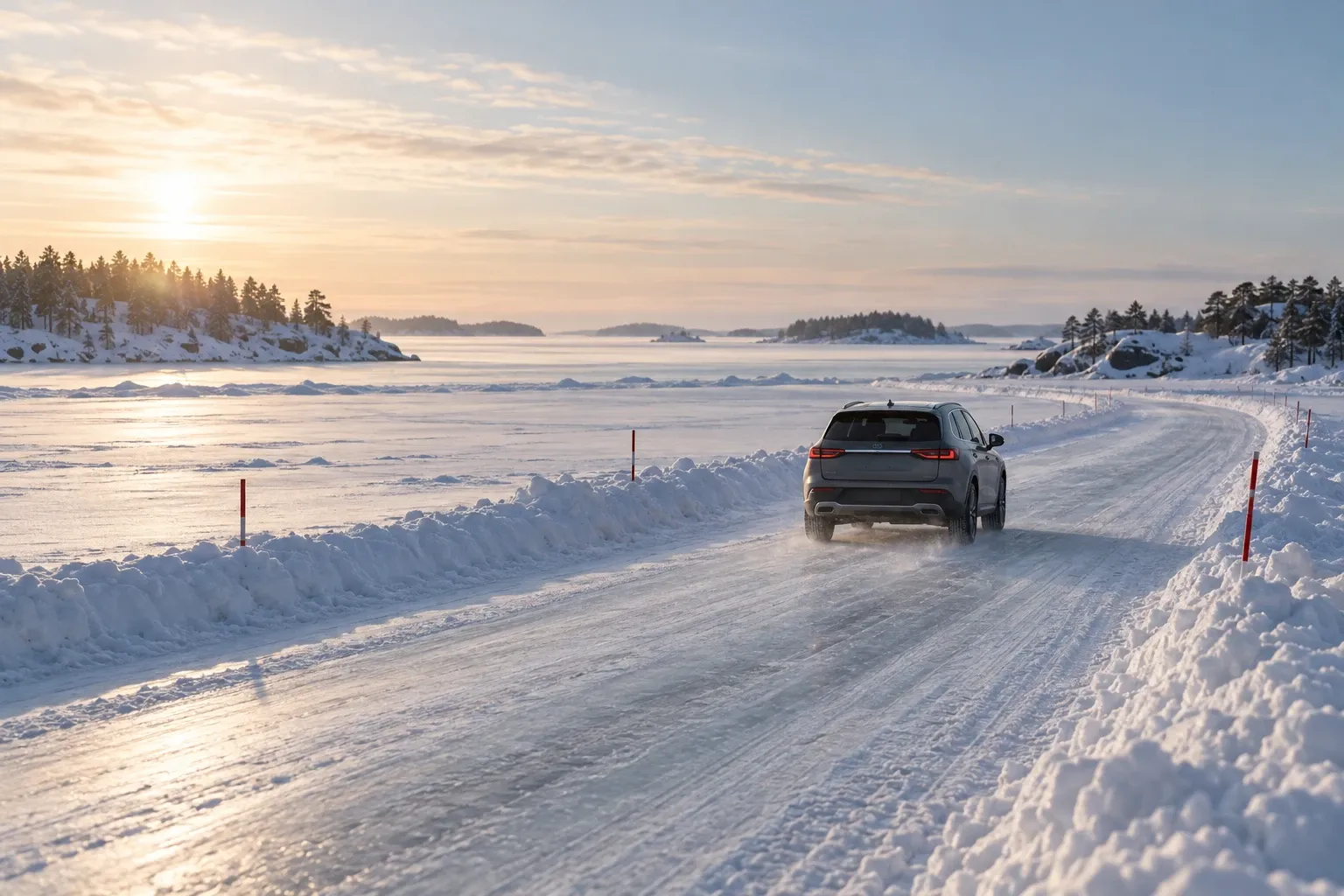
In northern Sweden, some winter roads run straight across a frozen lake or the sea. Driving one is easy if you follow five rules. The real decision is a different one: is this a measured ice road, or just ice?
When you need this
Your sat-nav sends you across a lake or a ferry crossing in January. You want to drive out to the islands of the Luleå archipelago in February. A ferry route you planned on shows an ice road instead. Or you’re standing at a lake shore with a rental car and wondering whether everyone else’s tyre tracks mean it’s fine.
Ice road or just ice?
Sweden has two kinds of frozen surface you might drive on, and the law and the risk are completely different.
| Official ice road (isväg) | Any other ice | |
|---|---|---|
| Who checks the ice | The operator, regularly | Nobody |
| Opens when | The ice bears at least 2 tonnes | Never “opens” |
| Speed | At most 30 km/h | At most 70 km/h by law, and slow enough to stop |
| Marking | Ploughed, reflector posts | None |
| If a vehicle goes through | Call 112 | Call 112; the driver pays the rescue costs |
An official ice road is ploughed, marked and measured. Trafikverket’s ferry operation, Färjerederiet, runs up to seven of them. In winter, when the climate allows, they replace or supplement some of the yellow road ferries. Staff check the ice quality round the clock, drill cores and analyse them. Once the ice is thick enough, they measure it about every 25 metres. If it can’t be shown to bear two tonnes, the road doesn’t open. Municipalities run others: Luleå runs four across the sea ice of its archipelago, and they must also take at least 2 tonnes.
Everything else is, legally, terrain. Swedish traffic law defines a road (väg) as a road, street or other route generally used for motor traffic, and terrain (terräng) as anything that is not a road. On terrain ice, no one has measured anything.
Where the ice roads are
Mostly in the north, and only in winters cold enough to build them. Which roads exist changes, so treat this as examples rather than a list.
| Area | Ice roads | Run by |
|---|---|---|
| Luleå archipelago, Norrbotten (sea ice) | Sandön (0.7 km), Sandön–Junkön (8.5 km), Hindersöstallarna (Lövskär)–Hindersön (8 km), Hindersöstallarna–Storbrändön (7.5 km) | Luleå municipality |
| Kalixälven river, Överkalix | Röduppleden, county road 836, replacing a 250 m ferry | Trafikverket |
| Storsjön, Jämtland | Isön–Norderön, Vällviken–Sunne, Håkansta–Norderön, replacing the Isöleden and Håkanstaleden ferries (2022 report) | Trafikverket’s ferry operation |
Don’t trust older lists. Some reference texts still describe a continuous 16 km Luleå ice road out to Långön, or an ice road to Vinön on Lake Hjälmaren as Sweden’s southernmost. Luleå’s current page lists four roads, the longest 8.5 km, and we found no recent report of a Vinön ice road. In the south, ice tends to be thinner and more often clear than the snow-covered northern ice.
Opening dates depend on the ice, not the calendar. Luleå’s roads usually open at the end of January or the beginning of February. A river crossing can freeze much sooner: Trafikverket replaced the Röduppleden ferry with an ice road on 24 November 2025. At sea, SMHI says the whole Bothnian Bay first froze on 29 January 2026, and the sea was ice-free on 10 May, about two weeks earlier than normal. Luleå’s roads were all listed as closed by its status update of 19 March 2026.
Checking that a road is open
Check every time, because a road that was open yesterday can be closed today.
- State ice roads: open Trafikverket’s Trafikinformation Vägfärja map, zoom to the ferry route and click the blue ice-road symbol. It shows whether the ferry has been replaced and how heavy a vehicle the road takes. The Trafikinfo Färjerederiet app has the same traffic information.
- Not every ice road is on that map. It shows only state ice roads that replace a ferry. Trafikverket itself names Sunne–Vällviken as one that isn’t on it.
- Municipal ice roads: check the municipality’s own page. Luleå posts a status line for each road (öppen, open, or stängd, closed).
Luleå closes its roads in heavy snowfall, thick fog, lots of meltwater, or when above-zero days leave the snow too soft. A closed ice road is not ice you may cross at your own risk. Take the ferry or the long way round.
The rules on the ice
Trafikverket and Luleå publish the same core rules, and they’re signed on the ice:
| Rule | Trafikverket’s ice roads | Luleå’s ice roads |
|---|---|---|
| Speed | At most 30 km/h | At most 30 km/h |
| Distance to the vehicle ahead | At least 50 m | At least 50 m |
| Overtaking | Banned | Not stated |
| Stopping and parking | Banned | Parking banned |
| Weight | Per road, shown on the map | Load-class sign, 2–4 tonnes |
The weight limit is the gross weight of the vehicle, or of the whole combination if you tow a caravan or trailer. Luleå signs a load class (bärighetsklass) of 2 to 4 tonnes on its roads. Ice roads can take more than two tonnes: in 2022 one on Revsundsjön in Jämtland took vehicles up to 4 tonnes, while the Storsjön roads took 2 and heavier traffic stayed on the ferry.
Break the rules and everyone loses. Trafikverket warns that speeding or overweight vehicles can crack the ice, and the road is then closed. On Storsjön, one road once closed the day after it opened.
A few more things to expect on the ice:
- No snow banks. Luleå’s roads are marked only by reflector posts (reflexpinnar) on both sides. Leave the line and you’re on ice nobody measured.
- Bumps and cracks. Natural sea ice isn’t flat, and the ramps on and off the ice can be uneven. Drive onto it slowly.
- Ploughs driving the wrong way. Road crews may drive against the traffic while clearing snow. Give way and follow their instructions.
Driving on a frozen lake off the ice roads
Is it legal? Generally, yes. The Off-Road Driving Act (terrängkörningslagen) bans driving on bare ground and on snow-covered young forest and farmland, and frozen water isn’t on that list. But a municipality or an authority can restrict terrain driving in a given area, and water-protection areas and nature reserves can forbid it.
The traffic rules still apply, because the traffic regulation covers terrain too:
- 70 km/h at most for motor vehicles where nothing lower is set, and never faster than lets you stop within what you can see.
- Give way to pedestrians. Municipalities add that skiers, skaters and walkers have priority on the ice.
- Don’t disturb people or animals needlessly with your route or speed.
- The right-hand rule applies, and your driving licence rules apply on ice as on land.
Being legal doesn’t make it safe. There’s no official Swedish figure for how thick ice must be for a car. The ice safety council’s 10 cm of clear core ice (kärnis) is for people walking, skating and fishing. It warns that new, spring, snow-covered and sea ice can be weak, and that speed carries you further out onto weak ice before it breaks. SMHI’s ice chart is a general analysis, not a clearance; it tells you to judge the ice where you are.
The costs fall on you. Two municipalities warn that if a vehicle goes through lake ice, the driver pays for the rescue work, may pay to clean up any fuel leak, and can be guilty of an environmental crime. Speed past a skater who falls and gets hurt, and you can be convicted of careless driving (vårdslöshet i trafik).
If something goes wrong
If a vehicle goes through or anyone is in danger, call 112. It’s free and works without a SIM card. We found no Swedish official guidance on how to get out of a car in the water, so we don’t give a procedure here.
With a rental car, ask the company before you drive onto any ice, and get the answer in writing if the trip depends on it. We couldn’t verify rental terms across companies. Some insurers don’t cover terrain driving at all. For what rental cover usually includes, see our guide to rental car insurance in Sweden.
Practical information
| Item | Detail |
|---|---|
| Speed on an ice road | 30 km/h |
| Distance between vehicles | 50 m minimum |
| Opening threshold | Bears at least 2 tonnes (Trafikverket and Luleå) |
| Weight limit | Per road; Luleå signs 2–4 tonnes |
| Fee for state and Luleå ice roads | None stated by either operator (checked 2026-10-15) |
| Ferries the state ice roads replace | Free, except Ekeröleden and Visingsöleden (checked 2026-10-15) |
| Status, state roads | Trafikinformation Vägfärja map; Trafikinfo Färjerederiet app |
| Status, Luleå | Luleå municipality’s ice-road page |
| Usual Luleå opening | End of January or early February |
| Speed off ice roads (terrain) | 70 km/h at most, by law |
| Vehicle through lake ice | Rescue costs and any clean-up charged to the driver; no amount stated |
| Emergency | 112 |
FAQ
Is it legal to drive a car on a frozen lake in Sweden?
Generally yes. The Off-Road Driving Act bans terrain driving on bare ground and on snow-covered young forest and farmland, and frozen water is not on that list. Water-protection areas and nature reserves can still ban it, the traffic rules apply with a 70 km/h ceiling, and walkers and skaters have priority. Nobody checks the ice for you.
How thick does ice need to be to drive a car on it?
There is no official Swedish figure for cars. Issäkerhetsrådet’s 10 cm of clear core ice is guidance for people walking, skating and fishing, not for vehicles. Official ice roads are different: they open only when the ice can bear at least two tonnes, measured about every 25 metres, and each road shows its own weight limit.
What is the speed limit on a Swedish ice road?
Thirty kilometres per hour on both Trafikverket’s and Luleå’s ice roads. Keep at least 50 metres to the vehicle ahead, never overtake, and do not stop or park on the ice. Driving too fast or too heavy can crack the ice, and the road is then closed for everyone, sometimes the day after it opened.
How do I know if an ice road is open?
For a state ice road, open Trafikverket’s Trafikinformation Vägfärja map, zoom to the ferry route and click the blue ice-road symbol; the Trafikinfo Färjerederiet app has the same traffic information. For municipal roads, such as Luleå’s archipelago roads, check the municipality’s status page. If it says closed, it is closed.
Where are the ice roads in Sweden?
Mainly in the north. Trafikverket runs up to seven, replacing ferries such as Röduppleden in Överkalix, and on Storsjön in Jämtland ice roads have replaced the Isöleden and Håkanstaleden ferries in cold winters. Luleå runs four across the sea ice to its archipelago islands. Which roads open changes every winter.
Do ice roads cost anything to use?
Neither Trafikverket’s ice-road page nor Luleå’s ice-road page mentions any charge, and the state road ferries they replace are free apart from two routes near Stockholm and Gränna. The costs come if something goes wrong off the marked road: municipalities warn that a driver whose vehicle goes through lake ice pays for the rescue work and can be charged for cleaning up leaks.
Can I drive a rental car on an ice road?
Ask the rental company before you do. Whether ice roads are allowed is a question for your own rental contract, and this guide could not verify the terms across companies. Municipalities also warn that some insurers do not cover terrain driving, which includes driving on lake ice outside a road. Get the answer in writing if the trip depends on it.
Related guides
- Ice safety in Sweden — walking and skating on ice, and what to do if you fall through.
- Sweden’s free yellow road ferries — the crossings the ice roads replace, and how to board them.
- Winter driving in Sweden — tyres, kit, convoys and darkness on the way to the ice.
- Luleå travel guide — the archipelago the ice roads lead to, and the city’s ice track.
- Checking road conditions in Sweden — Trafikverket’s traffic information for the rest of the drive.
Facts verified 2026-10-15. Sources: Trafikverket, Luleå kommun, Sveriges Riksdag (trafikförordningen 1998:1276, förordning 2001:651, terrängkörningslagen 1975:1313), Ludvika kommun, Borås Stad, Issäkerhetsrådet, SMHI, SOS Alarm, NSD, SVT — full register in this topic’s source file. Found something outdated? Tell us and we’ll fix it.