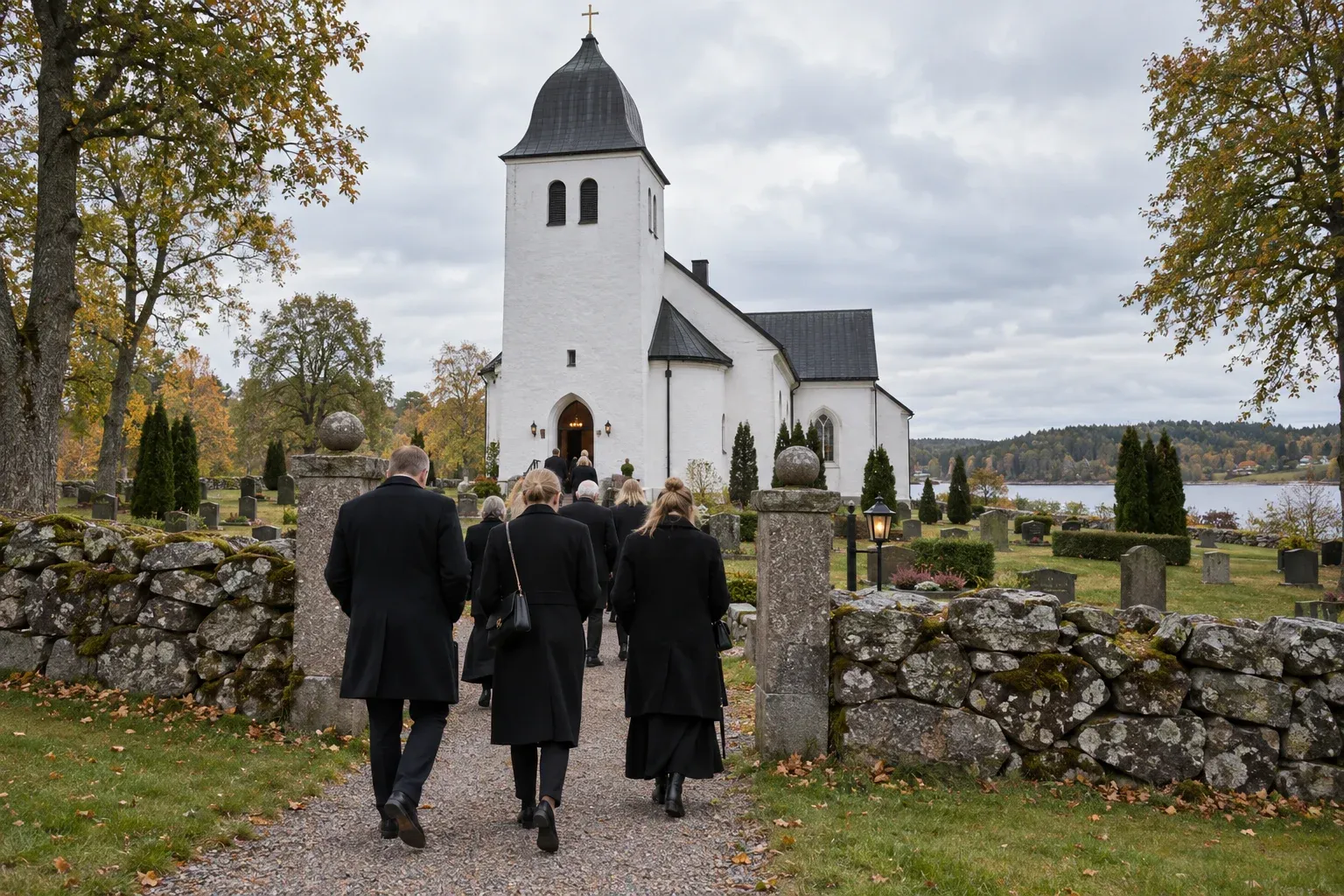
Almost everything you need to know as a guest is written in one place: the death notice. Here is how to read it, what happens on the day, and the few legal rules behind Swedish funerals.
When you need this
A Swedish colleague, neighbor, friend or in-law has died and you have seen the notice or been told the date. You are unsure whether you may go, what to wear or whether to bring flowers. Maybe the notice says ljus klädsel or minnesgåva and you have no idea what is expected. Or you are a newcomer who has spotted begravningsavgift, the burial fee, on your tax statement.
Start with the death notice
The family publishes a dödsannons (death notice) in a newspaper, on social media or on a funeral director’s memorial web page. It is the guest’s instruction sheet. Read all of it:
| What the notice says | What it means for you |
|---|---|
| Time and place | Church, chapel or other venue; be seated ten minutes early |
| “Begravningen sker i kretsen av de närmast anhöriga” | Family only — don’t go unless the family asks you |
| Ljus klädsel | Wear light, calm colors |
| Valfri klädsel | Dark or light, in muted colors |
| No dress code stated | Wear dark, discreet clothes |
| A named fund or charity | A minnesgåva (memorial gift) instead of flowers is welcome |
| Registration for the minnesstund | Sign up by the deadline via the memorial page or the funeral director |
May I go if I wasn’t personally invited?
Usually yes. Church of Sweden funerals are open to all — the church’s own guidance says no one can be stopped from attending, and that people tend to be too cautious because they don’t want to intrude. Families often want people to come. A public notice works as the invitation.
The exception is the family-only wording above. Legally the church can’t turn you away, but going anyway intrudes on people in grief. If you’re unsure, ask the family or the funeral director.
Most funerals still follow Church of Sweden order: 63.3% of everyone who died in 2025 had one. The church holds funerals for non-members too, as long as that doesn’t go against the dead person’s wishes. The funeral industry estimates that about one in ten funerals is borgerlig (civil), led by an officiant, a relative or a friend, in a chapel, outdoors or any venue.
What to wear
Dark and discreet is the default. Traditionally that means:
- Men: dark suit, white shirt, black tie. A white tie is traditionally worn by the closest mourners.
- Women: a dark dress, skirt or smart trousers with a blouse, often with navy or gray.
- Children: clothes they feel smart in; they don’t need to be in black and white.
The notice can change all of this. Ljus klädsel is a deliberate wish to celebrate a life — wear beige, light gray, light blue or similar calm tones, not black. Funeral directors say many families now choose it. No one enforces any of it, but dressing against an explicit wish is the most visible mistake a guest can make.
Flowers or a memorial gift
Most guests bring a handblomma — one or two simple flowers or a single rose — to lay at the coffin or urn at the end, when everyone files past (defilering). Larger arrangements, wreaths or hearts are ordered to the venue in advance and carry a ribbon with a short greeting on one end and the senders’ names on the other. The family’s coffin flowers set the color, and guests often match them.
If the notice names a charity or fund, give a minnesgåva instead of an arrangement. The gift goes in the dead person’s name. If you can’t attend, a memorial gift or condolence flowers sent to the family’s home show you care.
On the day
- Arrive early. Be seated at least ten minutes before the start.
- Leave the front rows for the closest family. Often family sits on one side, friends on the other.
- Phone off, no photos during the ceremony. The coffin, urn and flowers may be photographed before or after if the family is fine with it.
- Follow the room. A church funeral has a largely fixed order with at least two hymns. Everyone stands for the committal, when the priest lays earth on the coffin three times or makes the sign of the cross over it.
- Lay your flower when guests file past at the end.
- Ask the funeral director. If a funeral home is involved, its representative is usually at the church early and can answer guests’ questions.
Children are welcome. A Church of Sweden priest describes involving children directly in the ceremony, and nothing in the order shuts them out. Some ceremonies are also streamed on the memorial page for people who live far away.
The minnesstund
After the funeral comes the minnesstund, a memorial gathering with coffee and cake or a meal, short speeches about the person, and time to talk. It is by invitation: the family decides who comes — usually everyone at the ceremony, sometimes only the closest. Register by the deadline in the notice, through the memorial page or by phone, and mention any allergies or special diets. Turning up unregistered can leave the hosts short.
The rules behind it
Swedish funerals run on the Burial Act, Begravningslag (1990:1144). The parts that touch guests and families:
| Rule | What it says |
|---|---|
| Time limit | Cremation or burial as soon as possible, and no later than one month after the death. Skatteverket can grant a delay for special reasons |
| Certificate | No burial or cremation before Skatteverket’s certificate |
| Wishes | The dead person’s wishes on cremation and burial should be followed as far as possible |
| Ashes | Must be buried within one year of cremation |
| Where | Bodies and ashes only in a burial ground, unless a county board allows something else |
| No one to arrange it | The municipality steps in — for someone never registered in Sweden, such as a tourist, the municipality where the death happened |
This is a 2012 change: the limit used to be two months. Older guides that still say two months are out of date. Because of the one-month rule, invitations often come at short notice.
Funerals are largely paid through the system. Everyone registered in Sweden with taxable income pays the burial fee, member of a church or not. It covers a grave for 25 years, burial, cremation, transport, a room for the body and a ceremony room without religious symbols. A Church of Sweden service is free for members; the estate pays for the coffin, the notice, flowers, the minnesstund and the headstone. Our Church of Sweden guide explains the fees and how they appear on your taxes.
In Stockholm and Tranås the municipality, not the church, runs burials and cemeteries. Everywhere else the local Church of Sweden parish is the burial authority for everyone, members or not.
Graves, ashes and minneslundar
Cremation dominates: 86.0% of the 92,212 people who died in Sweden in 2025 were cremated. That makes two burial forms common that surprise many visitors:
| Form | How it works |
|---|---|
| Minneslund (memorial grove) | Shared, anonymous area. Staff bury the ashes without the family present and with no name. Cut flowers — and candles in season — go only on the shared decorating spot, never on grass, stones or walls |
| Askgravlund (shared ash grove) | Like a minneslund, but names are listed on a common memorial and relatives may attend |
| Scattering ashes | Allowed outside a cemetery only with a permit from a county board (länsstyrelsen), given if the place is suitable and the handling respectful. Applying is free |
Scattering over water is by far the most common choice: in 2025 county boards received 4,008 applications and granted 3,533, of which 2,974 were over water. Dividing ashes needs a permit too, and is allowed only for exceptional reasons when part is to be buried abroad. Ashes may also be taken out of Sweden. Each cemetery sets its own decorating rules; Stockholm’s, for example, allow candles at the shared spot from 1 October to 31 March. If you visit in early November, see our All Saints’ Day guide for the candle-lit cemeteries.
Permits are handled by a few county boards, each covering a group of counties, and a 2026 government bill proposes regrouping them from 2027. Start from the Länsstyrelsen page for the place concerned.
Practical information
| Item | Detail |
|---|---|
| Attending as a guest | Free; flowers or a memorial gift are voluntary |
| Church of Sweden service for a member | No charge (covered by the church fee) |
| Burial fee, 2026 | 0.292% of taxable earned income; Stockholm 0.07%, Tranås 0.285% |
| Covered by the burial fee | Grave for 25 years, burial, cremation, transport, room for the body, non-religious ceremony room |
| Paid by the estate | Coffin, urn, notice, flowers, minnesstund food, headstone, funeral director |
| Permit to scatter ashes | From a county board; free to apply |
| Legal time limit | Burial or cremation within one month of death; ashes buried within a year |
FAQ
Can I go to a Swedish funeral if I wasn’t personally invited?
Usually yes. Church of Sweden funerals are open to all, and families often want people to come — the public death notice works as the invitation. The exception is a notice saying the funeral takes place “in the circle of the closest family” (i kretsen av de närmast anhöriga); then stay away or ask the family first. The coffee afterwards needs registration.
What should I wear to a funeral in Sweden?
Dark, discreet clothes unless the death notice says otherwise: traditionally a dark suit with a white shirt and black tie, or a dark dress, skirt or smart trousers. If the notice asks for ljus klädsel, wear light, calm colors such as beige or light gray. “Valfri klädsel” means either. Children can wear anything they feel smart in.
Should I bring flowers to a Swedish funeral?
Most guests bring one or two simple flowers or a rose to lay at the coffin or urn when everyone walks past it at the end. Larger arrangements are ordered to the venue in advance, with a ribbon. But if the notice asks for a memorial gift (minnesgåva) to a named charity, give that instead of flowers.
What is a minnesstund?
The memorial gathering after the funeral, where guests share coffee and cake or a meal, talk and give short speeches about the person. The family decides who is invited — usually everyone at the ceremony, sometimes only the closest — and the notice or memorial page says how to register. Register in time and mention allergies.
How soon after a death is the funeral in Sweden?
The law requires the body to be cremated or buried as soon as possible and no later than one month after the death. Skatteverket can grant a delay for special reasons. Since 2012 this has been one month; older sources saying two months are out of date. Ashes must then be buried within a year.
Can you scatter ashes anywhere in Sweden?
No. Ashes may be scattered outside a cemetery only with a permit from a county administrative board, granted if the place is suitable and the handling respectful; applying is free. Scattering over water is most common: of 3,533 permits granted in 2025, 2,974 were over water. Otherwise ashes go in a grave or a memorial grove.
What is a minneslund?
A memorial grove: a shared, anonymous burial area for ashes. Staff bury the ashes without the family present and without any name marker, and there is no grave to look after. Visitors leave cut flowers, and candles in season, only at the shared decorating spot. A variant, the askgravlund, lists the names on a common memorial.
Related guides
- Church of Sweden — membership, the church fee and the burial fee rates
- All Saints’ Day in Sweden — when Swedes light candles on graves
- Swedish etiquette — the unwritten rules of everyday life
- Why Swedes pay high taxes — where the burial fee fits
- Swedish fika — the coffee ritual behind the minnesstund
Facts verified 2026-10-06. Sources: Begravningslag (1990:1144) and Begravningsförordning (1990:1147), Svenska kyrkan, Länsstyrelsen, Skatteverket, City of Stockholm, SKKF and Fonus — full register in this topic’s source file. Found something outdated? Tell us and we’ll fix it.