A visitor meets a Swedish forest fire at one of three moments. You see the fire, an alert reaches you, or someone tells you to leave. Each moment has a clear instruction and a Swedish law behind it. Here is what to do at each.
When you need this
Maybe you can see smoke above the trees and nobody seems to be doing anything. Maybe your phone has just shown an alert with the word skogsbrand (forest fire). Or a rescue crew has closed the road to your cabin, smoke is drifting over town while your child has asthma, or the trail you planned runs through forest that burned earlier in the year.
This page covers the fire itself. For whether you may light a fire today, see fire bans in Sweden. For how Sweden’s alert system works in general, see Sweden’s emergency alerts.
You see a fire: call 112, then warn people
Call 112 straight away. Say it is a forest fire, where you are and what you can see, and be ready for questions. The SOS Alarm 112 app can send your exact position during the call.
Then warn people nearby: hikers on the trail, the campers at the next lake, the cabin down the road. This isn’t only good manners. Under the Act on Protection Against Accidents, anyone who discovers a fire that endangers people must warn them and call for help if possible. Failing to do so, deliberately or through carelessness, is punishable by fines.
Krisinformation.se, the government’s crisis-information service, describes one way to fight a small fire, but only if it feels safe. Beat burning material in towards the fire with a bundle of small spruce branches (a ruska), wet if you can, and press it down to smother the flames. Clear away twigs and branches around the fire. If it is already too big, move away and leave it to the rescue service.
Don’t assume someone else has called. And don’t walk or drive towards the fire to get a better look.
How the warning reaches you
When people need to act, the authorities issue a VMA, Viktigt meddelande till allmänheten (important public announcement). It goes out on several channels at once:
| Channel | What to know as a visitor |
|---|---|
| Sveriges Radio P4 and TV | The main channel; the car radio works when the mobile network doesn’t |
| SE-Alert on your phone | Cell-broadcast alert, live since 1 July 2026; needs an updated smartphone, no app |
| Text message | Sent to phones in the affected area |
| 112 app and Krisinformation.se | Location-based alerts; the 112 app is in Swedish only |
| Outdoor sirens | Only in truly serious incidents, and rarely audible deep in the forest |
Two cautions. VMA information is primarily broadcast in Swedish, so act on the instruction first and translate afterwards. And no official source says how SE-Alert shows up on a foreign-registered phone, so don’t rely on one channel. If the alert tells you to go indoors, close windows, doors and ventilation, and listen to P4.
Evacuation: who decides and what the law says
Krisinformation and the Swedish Civil Defence and Resilience Agency (MCF, formerly MSB) now use the word utrymning for evacuation. Older guides and news reports say evakuering. Both mean you are being moved out because of a danger to life and health.
At fires the rescue service usually decides; the police can also order an evacuation where public order or security is at stake. The legal power sits with the incident commander (räddningsledare). If danger to life, health, property or the environment can’t reasonably be prevented any other way, the commander may cordon off or evacuate an area.
That makes an evacuation order binding, not advisory:
- The order applies at once, even if someone appeals it.
- Deliberately obstructing it, or ignoring it without a valid excuse, is an offence punishable by fines. Petty cases are not punished.
- You may leave earlier on your own initiative, but MCF says you must still follow the authorities’ instructions.
Take with you what you would need to be away for a while: passport or ID, medicines and prescriptions, phone and charger (a car charger too), warm clothes, something to eat and drink, bank cards and cash. Bring your European Health Insurance Card if you have one, and a paper list of important phone numbers. Leave by the route you are given.
A surprise for most visitors: the duty to assist. Swedish law obliges everyone who turns 18 to 65 during the calendar year to help the rescue service when needed and when the incident commander asks. The help is limited to what your knowledge, health and strength allow. The statute says var och en (everyone) and doesn’t limit the duty to residents. Refusing without a valid reason is punishable by fines.
Cordons, roads and trails
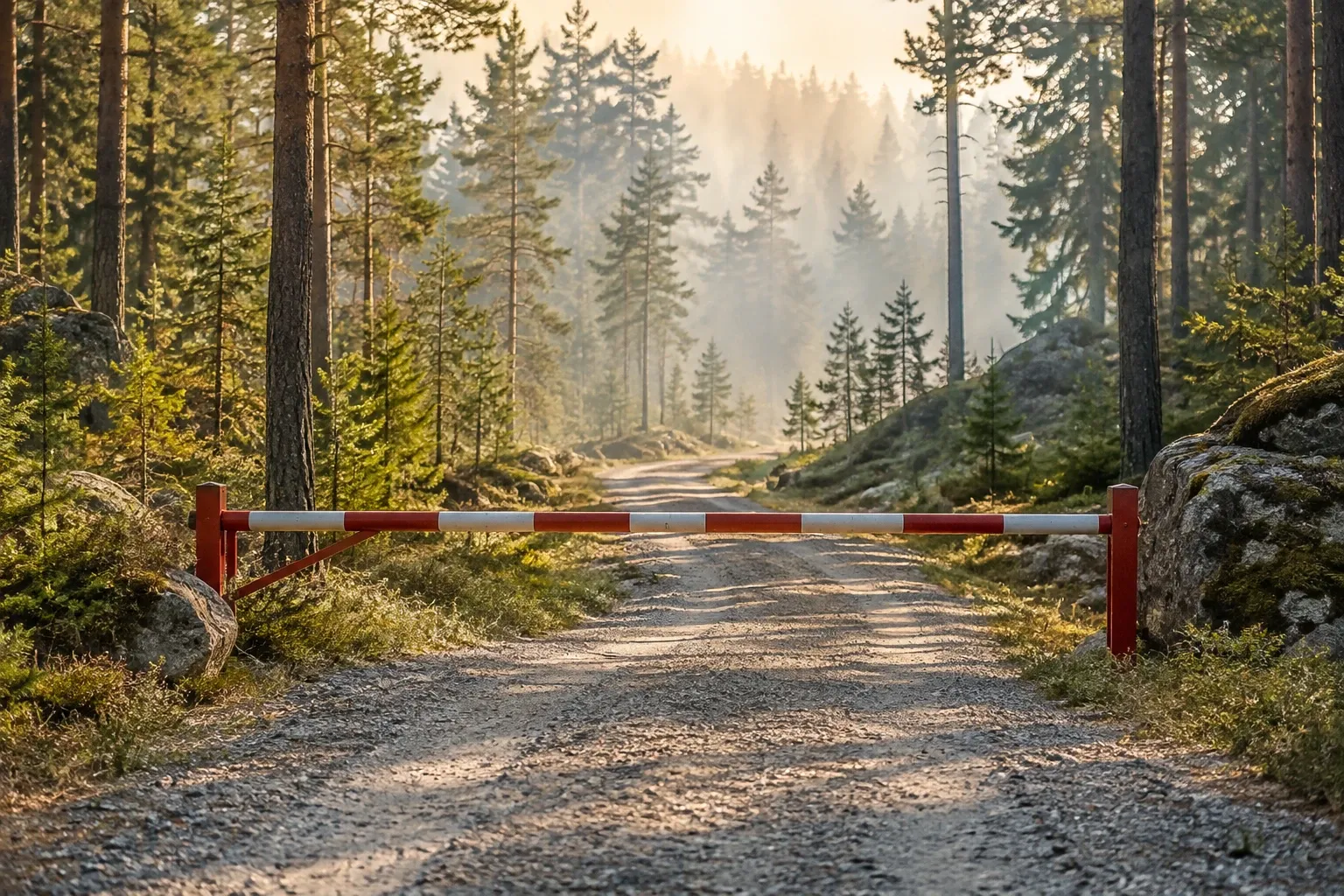
The most likely way a forest fire touches your trip is a closed road or trail. A cordon (avspärrat område) keeps people out of danger and keeps access routes free for fire engines. Treat it as an order, because legally it is one. Turn round, find another route, and never drive around a roadblock because the smoke looks far away.
Keep your drone on the ground. Transportstyrelsen, the Swedish Transport Agency, can set up temporary flight restriction areas. These are published as AIP SUP or NOTAM notices, which the LFV drone map doesn’t show. From the map alone you can’t easily tell whether you would be flying illegally over a rescue operation.
Smoke and your health
According to 1177, Sweden’s public health-care advice service, wildfire smoke usually causes temporary irritation. Soot can irritate the airways, but the risk of lasting harm is small. Smoke from burning vegetation is less harmful than smoke from burning plastic, though breathing smoke is never good.
| Who | What 1177 advises |
|---|---|
| Anyone with difficulty breathing, or who inhaled a lot of smoke | Call 112 at once, adult or child |
| Asthma, COPD or allergies (including children with asthma) | Take medicines as prescribed and stay indoors |
| Heart disease | Take medicines as prescribed; chest pain or breathlessness can occur |
| Babies under one | Keep them out of the smoke; stay indoors with windows closed |
| Pregnant | An unborn child is not harmed by the smoke |
| Symptoms that don’t pass | Health centre or out-of-hours clinic; call 1177 for advice |
Sealing a room against smoke won’t use up the air; a home is never fully airtight, though it can get hot. Food exposed to smoke is fine; rinse fruit and vegetables as usual. For help as a visitor, see healthcare for tourists in Sweden.
In a cabin or at a campsite
Krisinformation’s advice for property owners applies to you as a cabin guest when a fire approaches. Close windows, shutters, doors and roof hatches, retract awnings and move flammable things away from the walls. Wet the ground around the building and keep it damp, which takes less water than putting out a fire. Then get ready for a possible evacuation.
At a campsite or in the wild, follow the rescue service’s instructions; where you would be standing is covered in wild camping in Sweden. After a fire, cabins on a private well should have the water tested before you drink it. Don’t drink water that smells or tastes clearly odd.
After the fire: the hazard people forget
A burnt forest isn’t safe just because the flames are out. Krisinformation warns that it can take several months before the area is completely safe:
- Trees with damaged roots can fall in a light breeze.
- Embers hidden in the ground can flare up into a new fire.
- Embers can burn out hollows under the surface, and you can step into one and be badly burned.
Stay out until the area is officially reopened, and choose another trail.
How big Swedish fires get
Sweden has 3,000–4,000 forest and land fires a year, usually between May and July. About nine in ten are started by people, often with a badly put-out campfire or a fire lit in the wrong place. The season is getting longer and starting earlier, most of all in the south.
The summer of 2018 was exceptional. Fires burned about 25,000 hectares, nearly ten times the average for the 2000s, and rescue services made about 7,000 operations in terrain. Even then, about a hundred people in total were evacuated from their homes. Krisinformation states that Sweden has not yet had to evacuate large residential areas. Swedish evacuations are local and short, but when one comes, it is binding.
Practical information
| Item | Detail |
|---|---|
| Emergency (fire, breathing difficulty) | 112 |
| Information during a major incident | 113 13; +46 77 33 113 13 from a foreign phone; ordinary call rate |
| Health advice | 1177 |
| Radio | Sveriges Radio P4, the local channel |
| Phone alerts | SE-Alert since 1 July 2026, free, no registration |
| Apps | SOS Alarm 112 app (Swedish only); Brandrisk Ute from MCF, fire risk on a 1–6 scale; both free |
| Ignoring a cordon or evacuation | Fines (böter), set case by case |
| Fire season | Usually May–July, starting earlier |
FAQ
What should I do if I see a forest fire in Sweden?
Call 112 at once and say it is a forest fire, where you are and what you can see; the 112 app can send your position. Warn anyone nearby, which Swedish law expects of everyone who discovers a fire. Only if it feels safe, try to stop a small fire spreading with a bundle of spruce branches; otherwise move away.
How will I know if I have to evacuate?
The authorities announce it through a VMA, an important public announcement, on Sveriges Radio P4, TV, text messages, the 112 app, Krisinformation.se and, since July 2026, SE-Alert on mobile phones. Outdoor sirens sound only in truly serious incidents. The message is primarily in Swedish, so act on its instructions first and look for a translation afterwards.
Who can order an evacuation in Sweden, and do I have to obey?
At fires the rescue service usually decides; the police can also order one. The incident commander may legally cordon off or evacuate an area when there is no other way to protect life, health, property or the environment. The order applies even if appealed, and deliberately obstructing it or ignoring it without a valid excuse is punishable by fines.
Is forest fire smoke dangerous?
For most healthy people it causes temporary irritation, and 1177 says the risk of lasting harm is small, although breathing smoke is never good. People with asthma, COPD or allergies should take their medicines as prescribed and stay indoors, and babies under one should be kept out of the smoke. Call 112 if anyone has difficulty breathing.
Can I be made to help fight a forest fire as a tourist?
In principle, yes. Swedish law obliges everyone who turns 18 to 65 during the calendar year to assist the rescue service when needed, at the incident commander’s request, as far as their knowledge, health and strength allow. The statute does not limit this to residents. Refusing without a valid reason is punishable by fines.
Where can I get information about a forest fire in English?
Krisinformation.se has English pages on forest fires and evacuation, though its source pages are in Swedish. For questions during a major incident, call the information number 113 13, or +46 77 33 113 13 from a foreign phone. Do not call 112 for information; keep it free for people who need help.
Is it safe to hike in a burnt forest after the fire?
Not right away. Krisinformation warns that it can take several months before a burnt area is completely safe. Trees with damaged roots can fall in a light breeze, and embers hidden in the ground can flare up or burn out hollows that you can step into and be badly burned. Keep out until the area reopens.
Related guides
- Sweden’s emergency alerts: VMA and the 112 app — the four siren signals and how SE-Alert works.
- 112 and Sweden’s emergency numbers — what to say on the call, and the other numbers.
- Fire bans in Sweden — how to check whether you may light anything today.
- Campfires and fire bans — how to put a fire out so it doesn’t become this page.
- Travel insurance for Sweden — what to check if a fire disrupts your trip.
Facts verified 2026-10-15. Sources: Krisinformation.se, Myndigheten för civilt försvar, Sveriges Riksdag (Lag 2003:778 om skydd mot olyckor), 1177 Vårdguiden, SOS Alarm, SMHI, SOU 2019:7, Transportstyrelsen, Polismyndigheten — full register in this topic’s source file. We never publish current fire or evacuation status; check the official channels. Found something outdated? Tell us and we’ll fix it.