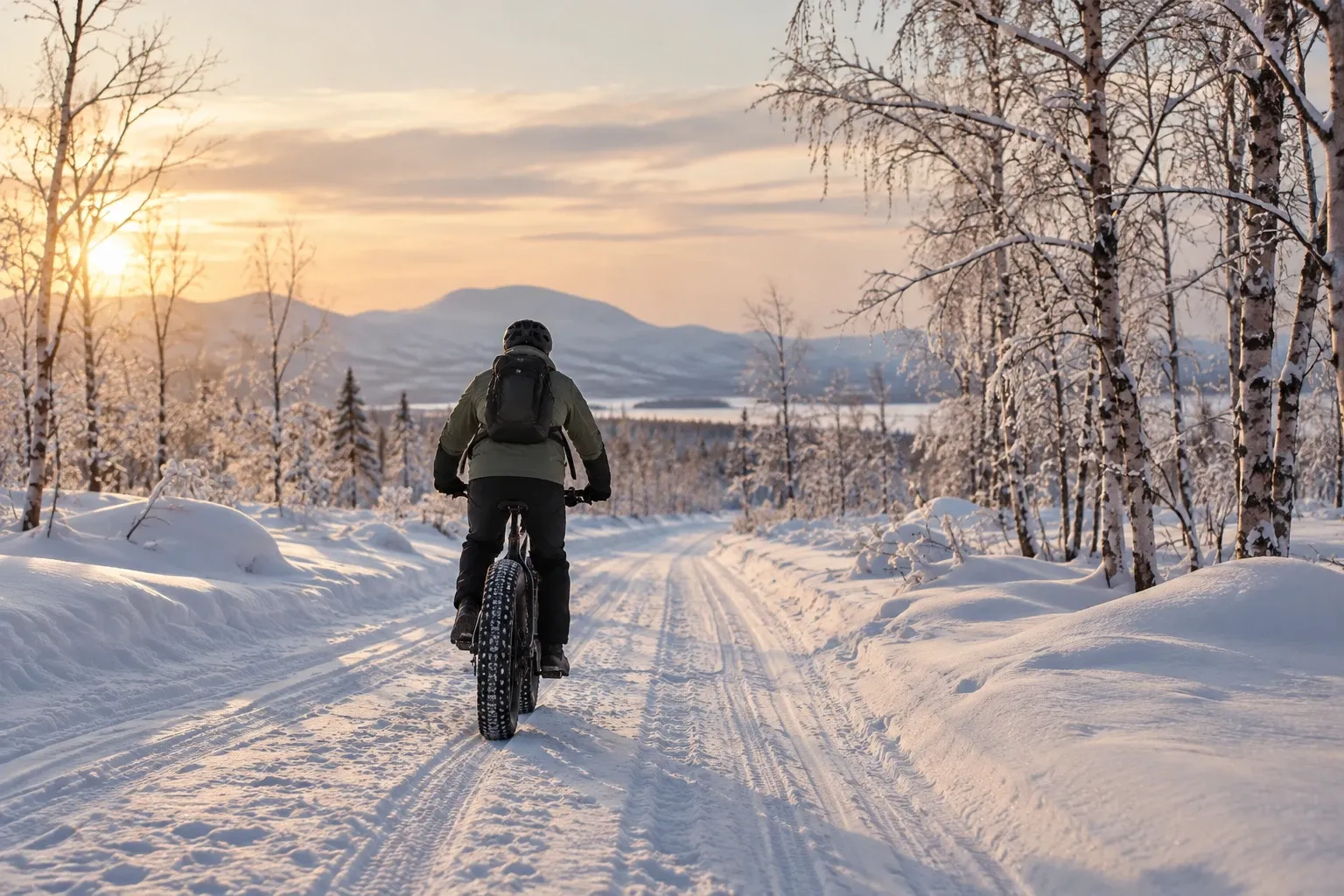
Sweden lets you ride a fatbike almost anywhere in winter nature, free and without asking. Three exceptions trip visitors up: groomed ski tracks, e-bikes and lake ice. Here is what the law, the agencies and the locals actually say.
When you need this
- You are booking a winter trip to Lapland or Jämtland and a fatbike tour or rental is on the list.
- You are bringing or renting a fatbike and want to know where you may ride without asking anyone.
- A groomed ski track or a snowmobile trail looks like the perfect riding surface.
- You plan to ride out onto a frozen lake or the sea ice of an archipelago.
- Your rental bike has a motor and you are not sure the rules are the same.
Your rights on snow
A fatbike is a mountain bike with tyres of about four inches or wider, run at very low pressure so it floats on packed snow. Sweden has no special rule for it. Cycling in nature is part of allemansrätten, the right of public access, as long as you damage nothing and show consideration. Naturvårdsverket, the Swedish Environmental Protection Agency, sets out the details, and they are the same in winter as in summer.
| You may ride | You may not ride |
|---|---|
| Private forest roads (enskilda vägar), including barriered ones unless a sign forbids it | Gardens, private plots and nurseries |
| Hiking and exercise trails, giving way to walkers | Young plantations that can be damaged |
| Frozen lakes, when the ice holds | Fields with growing crops |
| Snowmobile trails, in most places | Trails a municipality has signed as closed to bikes |
A landowner who wants to ban cycling on a private road needs the municipality’s permission. Protected areas are different. National parks and nature reserves have their own binding rules, which may ban cycling entirely or allow it only on certain trails. Check the noticeboard or the county board’s page first; our allemansrätten guide covers the wider right.
Ski tracks and snowmobile trails
Stay out of the groomed ski track
The firmest surface in a snowy town is often the groomed cross-country track, and it is the one place you should not ride. The Swedish Ski Association treats a prepared skidspår as a sports facility for skiing. Its track rules say walking or running in it is not allowed during the snow season. Kiruna bans walking on the whole track surface, skate lane and classic grooves alike, because grooming costs time and money.
No Swedish source we found mentions bikes by name. But if a walker’s boots are unwelcome, a fat tyre in the classic grooves is worse. A track that is a facility in the legal sense, for example with artificial snow or lighting, can also set its own rules and fees. Our cross-country skiing guide explains how tracks work.
Snowmobile trails are the fatbike’s highway
Naturvårdsverket notes that skiing and other travel can occur along some snowmobile trails (skoterleder), and Visit Östersund promotes the network round Östersund for fatbikes. Ride them early, before the sun softens the snow. Keep to the side and pull over for sleds: they are heavier and much faster than you, and a cyclist on a blind bend is hard to spot. Local signs and trail rules come first. See snowmobile tours for the traffic you will meet.
E-fatbikes: the rule visitors miss
Many rental and tour fatbikes have a motor, and that changes your rights. Naturvårdsverket says an e-bike limited to 250 W and 25 km/h is not part of allemansrätten. On trails or in terrain you need the landowner’s permission, or you keep to roads. A marked trail may already have an agreement with the landowner, so ask whoever runs your tour or rental whether its route has one.
| E-bike type | On roads | Off-road |
|---|---|---|
| Up to 250 W, assist to 25 km/h | A bicycle | Landowner’s permission needed; the Off-Road Driving Act does not ban it |
| Over 250 W or assist above 25 km/h | A motor vehicle | Landowner’s permission, and the Off-Road Driving Act applies |
A motor-vehicle e-bike is banned off-road on snow-free ground, on snow-covered young forest and farmland unless clearly harmless, and on any ground in the mountain areas the government designates. Breaches are fined. Whether switching off or removing the battery turns an e-bike back into a bicycle has not been tested in court, Naturvårdsverket says, so it cannot answer. The agency also says its e-bike position may be revised, which is why we will re-check it.
Riding on ice
A frozen lake is the most beautiful ride in a Swedish winter and the most dangerous. Issäkerhetsrådet, the Swedish ice-safety council, says to go on the ice only with at least 10 cm of clear core ice (kärnis). New ice, spring ice, snow-covered ice and sea ice can all be weak. Never go alone, and wear ice claws (isdubbar).
Speed is the fatbike-specific risk. The council warns that the faster you travel, the further you get onto weak ice before it breaks, and the harder the rescue. A bike reaches thin ice that a walker would have turned back from. Studded bike tyres are legal in any month, since the October–April stud season covers cars only. Read our full ice safety guide before your first lake.
The safest ice ride in the country is a managed one. Luleå builds an isbana, a plowed ice track of about 10 km round the city centre, and explicitly allows bikes alongside walkers, skaters, kick-sleds, prams and wheelchairs. The municipality measures the ice regularly while it runs. Once it closes for the season it stops measuring and warns people to take extra care, so the same route a week later is unchecked sea ice.
Reindeer, darkness and cold
Reindeer. Reindeer herding country covers roughly the northern half of Sweden, including most fatbike destinations. Frightening or harassing reindeer is an offence under the Reindeer Husbandry Act, even by negligence. If you meet a herd, stop and let them move away. Our reindeer guide explains why winter herds need space.
Darkness. In Kiruna the sun does not rise for about 27 days around midwinter. Carry a headlamp even on a short ride. On a road in darkness the law requires a white or yellow front light and a red rear light, switched on, plus reflectors; riding without them costs a fine. Riders under 15 must wear a helmet on a road. See polar night for how dark it gets.
Cold. Visit Östersund’s advice for winter riders: layers with a windproof, breathable outer layer, mittens rather than gloves, roomy shoes with wool socks, and a scarf you can pull up over your face. Keep e-bike batteries warm and plan shorter distances in hard frost. Our cold safety guide covers frostbite.
Where to ride
| Area | What it offers |
|---|---|
| Luleå and the Norrbotten coast | The bike-friendly isbana, and sea ice out to the archipelago, promoted for fatbikes by the regional tourism body |
| Östersund, Jämtland | Reflector-marked forest loops of about 20 km for headlamp riding, a snowmobile-trail network, and Storsjön’s ice when there is little snow on it |
| Swedish Lapland inland | Frozen rivers, marshes and forest, with shelters along routes |
| The mountains (fjäll) | Regulated areas ban motor traffic, which catches fast e-fatbikes |
| Southern Sweden | Snow cover is unreliable; fatbiking depends on the winter |
In the north the season runs roughly December to April. Midwinter brings hard snow but very short days. In February and March days lengthen quickly while the snow is still winter-firm. In late March and April the crust is firm in the morning and turns heavy as it melts, so ride early. Shelters with fireplaces on Lapland routes and along Luleå’s isbana make a long cold ride manageable. For Luleå as a destination, see our Luleå guide.
Mistakes to avoid
- Riding the groomed ski track because it is the firmest surface around. Use snowmobile trails, plowed roads or a trail signed for bikes.
- Assuming a rental e-fatbike has a bike’s rights. Ask about landowner permission, or keep to roads.
- Pumping the tyres hard. Fatbike tyres need very low pressure that you adjust to the surface; carry a small pump.
- Riding soft afternoon snow. Go out before the sun warms the trail.
- Going onto the lake alone. Never be alone on the ice.
- Chasing reindeer for a photo. Stop and let them move on.
Practical information
| Item | Detail | Checked |
|---|---|---|
| Riding under allemansrätten | Free | 2026-10-15 |
| Luleå isbana | About 10 km; bikes allowed; no fee mentioned by the municipality; 2025/26 season opened 12 December 2025, closed 27 March 2026 | 2026-10-15 |
| Fatbike rental and guided tours | Priced per operator; not published here | 2026-10-15 |
| Fine: no lights on a road after dark | 500 kr | 2026-10-15 |
| Off-road offence with a motor-vehicle e-bike | Fine, set case by case | 2026-10-15 |
| Harassing reindeer | Fine, set case by case | 2026-10-15 |
| Minimum lake ice (Issäkerhetsrådet) | 10 cm clear core ice | 2026-10-15 |
FAQ
Can I ride a fatbike anywhere in Sweden?
Almost anywhere in nature, under allemansrätten, as long as you damage nothing. You may ride private forest roads, trails and frozen lakes free. Stay off gardens, young plantations, fields with crops and prepared ski tracks, and check national park and nature reserve rules, which may ban cycling or limit it to certain trails. Walkers have priority on trails.
Can I ride a fatbike on cross-country ski tracks in Sweden?
Not on a prepared track. The Swedish Ski Association treats a groomed track as a sports facility for skiing in the snow season and says walking or running in it is not allowed; Kiruna bans walking on the whole track surface. No source we found allows bikes. Use snowmobile trails, plowed roads or a trail signed for bikes instead.
Do I need permission to ride an e-fatbike in Swedish nature?
Yes, off roads. Naturvårdsverket says a 250 W e-bike is not part of allemansrätten, so on trails or in terrain you need the landowner’s permission, though a marked trail may already have one. Over 250 W or assisting above 25 km/h, it is a motor vehicle under the Off-Road Driving Act, banned outright in the designated mountain areas.
Can I ride a fatbike on snowmobile trails?
Usually, yes. Naturvårdsverket notes that skiing and other travel can occur along some snowmobile trails, and Visit Östersund promotes the network round Östersund for fatbikes. Ride early, before the sun softens the snow, keep to the side and pull over for sleds, which are much heavier and faster. Local signs and trail rules come first.
Is it safe to fatbike on a frozen lake in Sweden?
Only when you know the ice holds: Issäkerhetsrådet’s figure is at least 10 cm of clear core ice, and snow-covered, spring and sea ice can be weaker. Never go alone, wear ice claws, and slow down, because speed carries you further onto weak ice. Luleå’s isbana is measured regularly while it is open.
When is the best time for fatbiking in Sweden?
In the north, roughly December to April. Midwinter brings hard snow but very short days, with polar night above the Arctic Circle. February and March usually combine settled snow and longer days. In late March and April the snow softens in the afternoon, so ride in the morning. Southern Sweden rarely has reliable snow cover.
Related guides
- Winter cycling in Sweden — plowed bike paths, studs and lights when the ride is in town.
- Ice safety in Sweden — the full ice routine before any lake ride.
- Cross-country skiing for visitors — why the groomed track belongs to skiers.
- Bikepacking Sweden — the same e-bike rule, with a tent, in summer.
- Mountain biking in Sweden — where to ride once the snow has gone.
Facts verified 2026-10-15. Sources: Naturvårdsverket, Sveriges Riksdag, Länsstyrelsen Norrbotten, Transportstyrelsen, Åklagarmyndigheten, Issäkerhetsrådet, Svenska Skidförbundet, Luleå and Kiruna municipalities, SMHI — full register in this topic’s source file. Found something outdated? Tell us and we’ll fix it.