Gotland rewards a long weekend if you split it right: Visby on foot, the north by car or bike, and a short last morning. Here is the plan, the transport that makes it work, and how it changes between summer and the off-season.
When you need this
You have three or four days and have already picked Gotland. Maybe you are arriving on a Friday evening ferry and leaving Monday, or you are coming in October and wondering what is still open. This page is the day-by-day sequence. For the island itself — its size, history, rules and every Gotland guide we have — start with our Gotland and Visby travel guide, the hub this plan builds on.
The plan at a glance
Visby is compact, so one day covers it. The rauk fields of Fårö sit at the island’s northern tip and take a full day. A third half-day fits a short excursion before you leave.
| Day | Summer (mid-May to mid-September) | Off-season (October to April) |
|---|---|---|
| Arrival evening | Walk inside the wall; Almedalen park at sunset | Same walk; it is all outdoors |
| Day 1: Visby | Ring wall, cathedral, staffed church ruins, Fornsalen museum | Ring wall, cathedral, Fornsalen (shorter winter hours) |
| Day 2: the north | Fårö raukar by car or bike; expect ferry queues 1 June–15 August | Fårö by car; a quiet ferry but short daylight |
| Day 3: half-day | Högklint or a rural church, then home | Högklint, then home |
Getting there and getting into town
The ferry from Nynäshamn (south of Stockholm) or Oskarshamn (on the Småland coast) to Visby takes about three hours. Fares are dynamic and highest on summer weekends, so a summer weekend is the most expensive time to cross. Flights take about 40–45 minutes from Arlanda and about 35 from Bromma. Our Gotland ferry guide covers ticket types and booking; domestic flights in Sweden covers the air option.
Once you land, Visby is close:
| You arrive at | Into town | Good to know |
|---|---|---|
| Visby airport | Bus line 61, about 10 minutes | Airport 3.5 km from the centre; card only on the bus |
| Visby ferry terminal | City bus line 6 to Visby bus station and Almedalen | Timed as far as possible to the ferries |
The late-arrival trap: from Monday to Thursday no city or regional bus leaves after 21:35, and the region says there is then no connection with the night ferries. A late Thursday arrival without a car means a walk or a taxi. Buy bus tickets in the region’s app or online before you travel; if you cannot, buy from the driver.
Day 1: Visby inside the wall
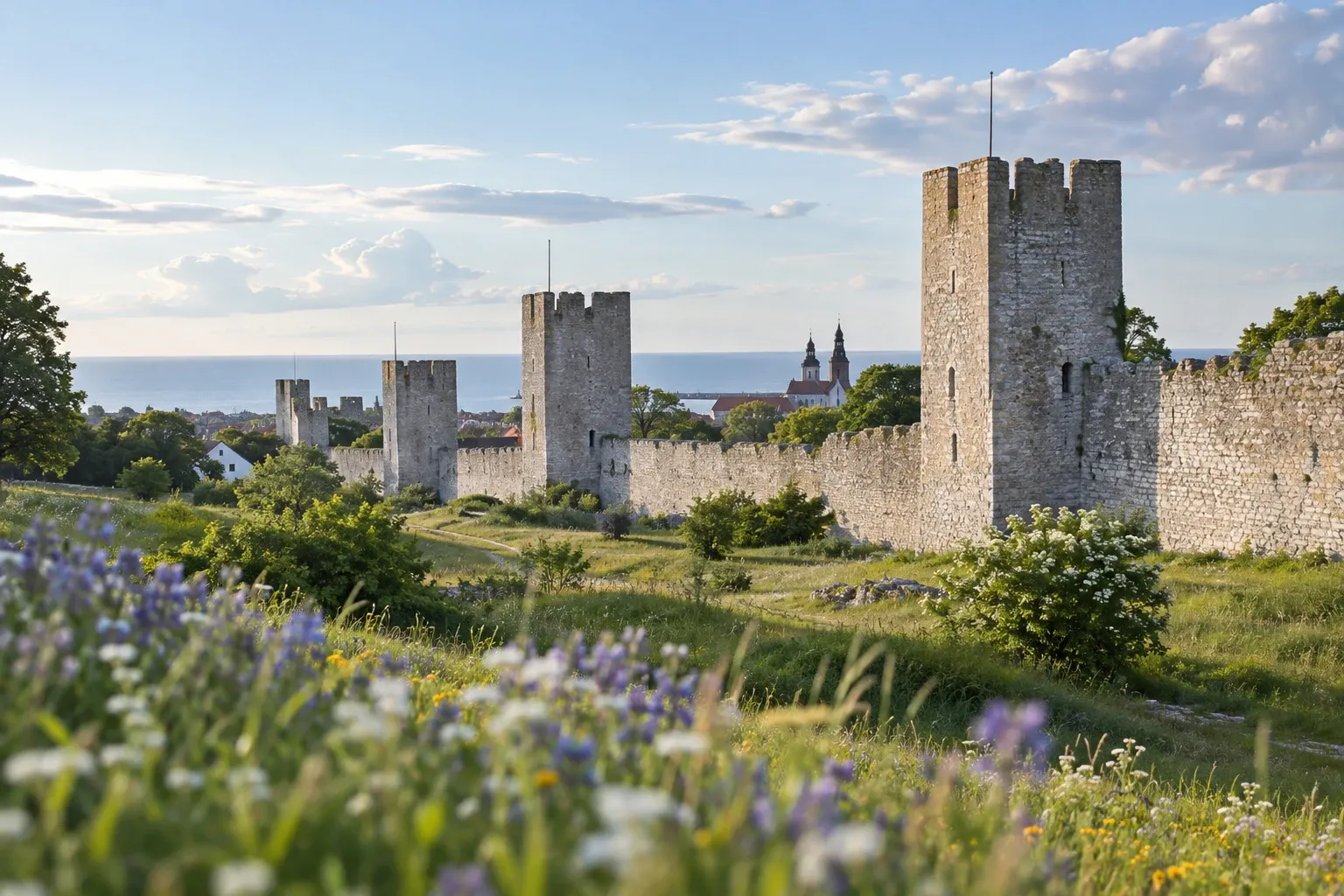
Visby has been a UNESCO World Heritage site since 1995. Its limestone ring wall, probably begun around 1250, is northern Europe’s oldest preserved town wall, and 17 medieval churches stood inside and just outside it. Only St Mary’s Cathedral is still in use; the rest are ruins.
- Walk the outside of the ring wall. The loop is about 3.4–3.6 km (UNESCO and Riksantikvarieämbetet, the National Heritage Board, give different figures) and free. Respect any fenced-off section: in February 2012 about 70 m² of the outer face collapsed north of Österport.
- St Mary’s Cathedral (domkyrkan) opens daily from 09:00. Access can be restricted during services and concerts, and pets are not allowed inside.
- The staffed church ruins — S:t Lars, Drotten and S:ta Karin — open in summer. The 2026 season is over, and the museum says they reopen around 1 May 2027.
- Fornsalen, Gotlands Museum’s main building, is the rainy-day anchor: a picture stone hall, the treasury holding what Gotland’s official tourism site calls the world’s largest Viking Age silver treasure, and the Midgård exhibition on the Viking Age. The county art museum, Gotlands Konstmuseum, is currently housed in the same building. Under-19s go free.
End the day in Almedalen park, and stay off the open wine bottle: drinks above 3.5% alcohol are banned in public across Visby’s inner town, outside licensed areas.
Day 2: Fårö and the raukar
The raukar — limestone sea stacks left from coral reefs about 430 million years ago — are Gotland’s signature landscape, and the best-known fields are on Fårö. You reach Fårö from Fårösund on Trafikverket’s free road ferry, a six-minute crossing to Broa (more on how these work in our guide to Sweden’s free road ferries).
This is the day the transport plan matters. Region Gotland’s bus line 20 runs from Visby to Fårösund, but no line in the region’s network continues onto Fårö. Your options:
| How | Works? | Watch out for |
|---|---|---|
| Car | Yes, the simplest | Summer queues; priority lanes for residents and some vehicles 1 June–15 August |
| Bus line 20 + your own bike | Yes, if the bike is ordinary | Bike places cannot be booked; e-bikes, tandems and trailers are never allowed on the bus |
| Bus only | No | You stop at Fårösund with the rauk fields still ahead |
Two reserves are the targets. Digerhuvud, on Fårö’s north-west coast, is the rauk field where the county board invites you to climb, explore or rest your back against a rauk. Langhammars, at the northern tip, has more than 50 raukar, some over 8 m tall, and the stacks on the back of the 200-kronor note.
Both are nature reserves with binding regulations (föreskrifter). Do not chip fossils from the raukar or take stones, blocks or fossils away — knocking fossils loose is prohibited across Gotland anyway. No camping, no motorhome overnighting at Langhammars, no driving off marked roads, and fires only at the marked places. For more on the island itself, see our Fårö guide.
Day 3: Högklint or a rural church
Keep the last day light so the ferry or flight home is never at risk.
Högklint is a nature reserve about 5.5 km south-west of Visby, where the cliff rises 48 m above the sea. It has parking, a toilet, a fire place and a trail heading south along the coast. The reserve bans damaging bedrock or boulders, fires outside designated spots, camping and parking outside designated spots.
A rural church is the summer alternative. The Diocese of Visby manages 92 medieval churches across the island, and from 15 May to 15 September they are open for visits in the daytime. The diocese’s app, 100 kyrkornas ö, guides you through them and is also in English. Outside that window, do not count on an unlocked door.
If you are cycling rather than driving, our Gotland by bike guide covers the island’s signed route, Gotlandsleden.
Summer or off-season?
Season changes this plan more than the weather does.
- Mid-May to mid-September: everything on the plan is open — rural churches, staffed ruins, Fornsalen 09:00–17:00. A separate summer bus timetable applies.
- Event weeks: Almedalsveckan (28 June–2 July 2027) and Medieval Week (8–15 August 2027) fill the ferry and every bed. Go for them, or go another week.
- October to April: Fornsalen 11:00–16:00 daily, closed 24, 25 and 31 December and 1 January; the staffed ruins, the Kajsartornet prison tower and the Norrbys museum farm are closed (Norrbys’ marked trail stays open). Fornsalen is free from 16:00 to 20:00 on the first Thursday of each month.
- Late-2026 weekends with a reason to go: the Gotland Truffle Festival, 13–15 November 2026, and Medieval Yule in Visby, 4–6 December 2026.
One more dated change: Region Gotland plans a new Visby city-bus network for summer 2027, so check the line numbers on this page against the new timetable then.
Rules that catch visitors
| Rule | Type | Consequence |
|---|---|---|
| No drinks above 3.5% in public in Visby’s inner town, outside licensed areas | Law (local ordinance) | A fine; the drink can be forfeited |
| No camping in a tent, van or motorhome on public places | Law (local ordinance) | An offence under the ordinance |
| No knocking fossils from rock; reserve bans on taking stones | Law | An offence |
| The ring wall is a protected ancient monument | Law | Any intervention needs a permit |
| No e-bikes on Gotland’s buses | Operator rule | No ride back |
Practical information
| Item | Detail (checked) |
|---|---|
| Ferry Nynäshamn or Oskarshamn–Visby | About 3 hours; dynamic fares, highest on summer weekends (2026-09-24) |
| Flight to Visby | About 40–45 min from Arlanda, 35 from Bromma (2026-09-24) |
| Airport to Visby | Bus line 61, about 10 min; card only on board (2026-10-15) |
| Fårö road ferry | Free, about 6 minutes (2026-09-25) |
| Bike on a Gotland bus | 20 kr, paid on board; no e-bikes (2026-09-25) |
| Fornsalen admission | Adults 150 kr October–April, 190 kr May–September; under 19 free (2026-10-15) |
| Fornsalen hours | 11:00–16:00 October–April; 09:00–17:00 May–September (2026-10-15) |
| Ring wall, Högklint, raukar | Free |
| Bus fares, car hire, taxis | Not listed here — check Region Gotland’s ticket site and local firms |
FAQ
How many days do you need on Gotland?
Three days covers the essentials: one for Visby’s ring wall, cathedral and museum, one for Fårö’s raukar in the north, and a half-day for Högklint or a rural church before you leave. Add days for Gotland’s south, beaches or cycling. Fewer than three means choosing between Visby and Fårö, because Fårö is a full day out.
Can you do a Gotland weekend without a car?
Mostly. Visby is walkable, line 6 serves the ferry terminal and line 61 the airport. Fårö is the exception: bus line 20 ends at Fårösund, and no regional line runs on Fårö, so bring an ordinary bike on the bus or ferry. E-bikes are never allowed on Gotland’s buses, and bike places cannot be booked.
Is it worth going to Fårö on a short trip?
Yes, if you give it a whole day. The free six-minute road ferry from Fårösund is easy, and the rauk fields at Digerhuvud and Langhammars are Gotland’s signature landscape. In summer, cars can queue at the ferry, and from 1 June to 15 August priority lanes serve residents and some vehicles first, so leave slack.
What is open in Visby in autumn and winter?
The outdoors never closes: the ring wall, the lanes and Högklint. St Mary’s Cathedral opens daily from 09:00, and Fornsalen opens 11:00–16:00 from October to April, closed on four days over Christmas and New Year. The staffed church ruins, Kajsartornet and Norrbys are closed for the season, and the ruins reopen around 1 May 2027.
How do I get from Visby airport or ferry terminal into town?
Visby airport is 3.5 km from the centre, and bus line 61 serves it year-round, taking about 10 minutes; on the bus you can only pay by card. From the ferry terminal, city line 6 runs to Visby bus station and Almedalen, timed as far as possible to the ferries. Monday to Thursday, no bus runs after 21:35.
When is the best time for a long weekend on Gotland?
Late May to mid-June, or late August after Medieval Week, gives open churches and ruins without the peak weeks. Avoid Almedalsveckan (28 June–2 July 2027) and Medieval Week (8–15 August 2027) unless you are going for them. Off-season weekends are quiet and cheaper on the ferry, but several sights close.
Related guides
- Gotland and Visby travel guide — the island hub: size, history, rules and every Gotland page.
- Taking the ferry to Gotland — routes, ticket types and when to book a car place.
- Gotland by bike — if the weekend turns into a cycling trip.
- Medieval Week in Visby — the August week to plan around, or for.
- A weekend in Gothenburg — the mainland city-break alternative.
Facts verified 2026-10-15. Sources: Riksantikvarieämbetet, UNESCO, Region Gotland, Länsstyrelsen Gotland, Trafikverket, Swedavia, Gotlands Museum, Svenska kyrkan (Visby diocese and cathedral parish), Destination Gotland, gotland.com — full register in this topic’s source file. Found something outdated? Tell us and we’ll fix it.