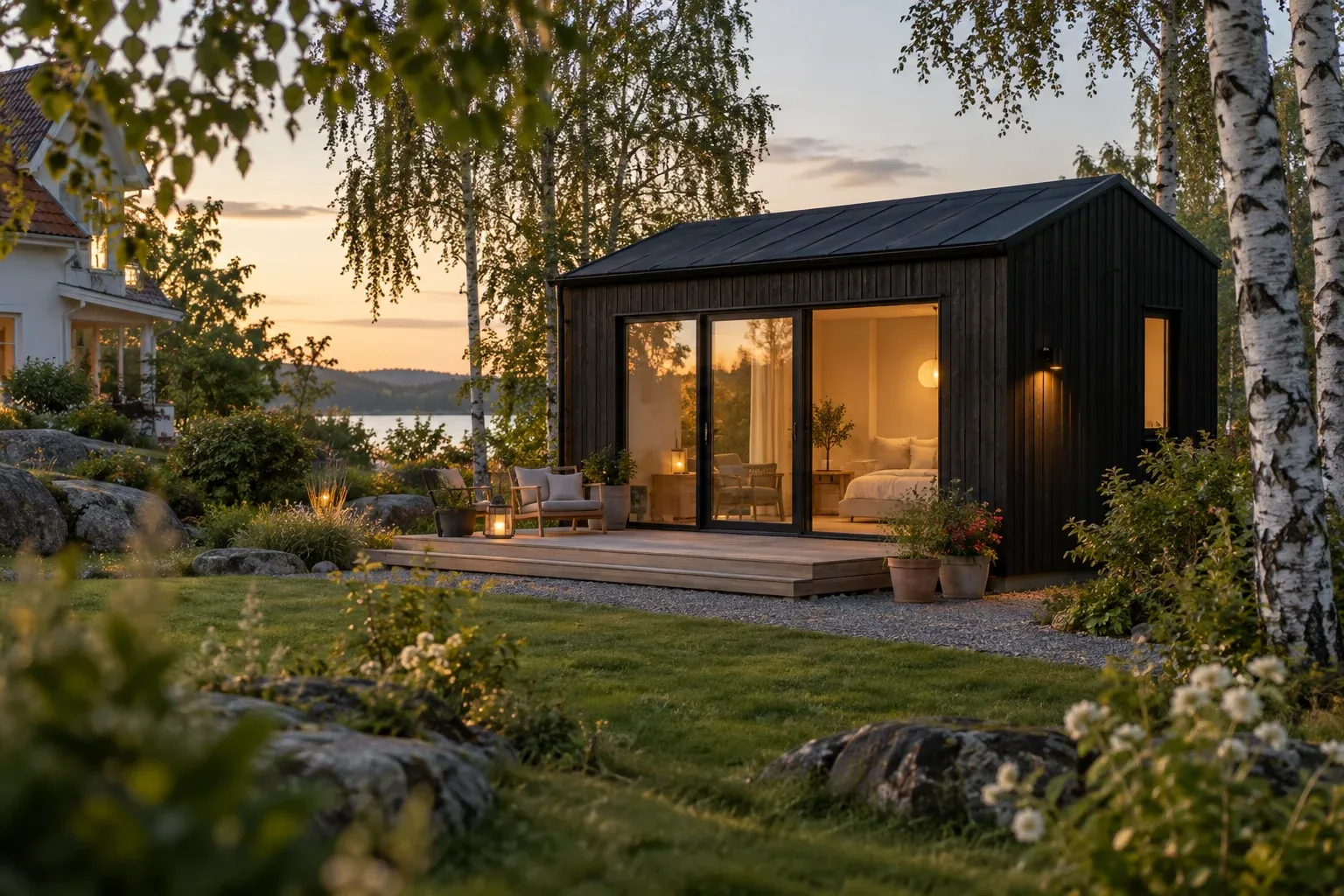
If you own a Swedish house or summer cabin, you can probably add a guest cottage, sauna or shed without asking anyone. But the attefallshus rules you may know were replaced in December 2025. Here are the limits that apply now, and the conditions that still catch owners out.
When you need this
You own a house or holiday cabin in Sweden, or you’re about to buy one, and you want to add a guest cottage, a sauna, a garden shed or an extension. A listing says “room for an attefallshus” and you want to know what that’s worth. A neighbour has asked you to sign a drawing. Or you’ve read two guides that give different numbers and want to know which one is right.
Tourists and tenants build nothing, so for a short visit this is background. For a foreign owner it is one of the most useful rules in Swedish property law: the permit rules attach to the property, not to your nationality or where you live.
What changed on 1 December 2025
A bygglov (building permit) is the municipality’s approval to build, extend or change the use of a building. The rules sit in the Planning and Building Act, plan- och bygglagen (PBL), and the municipality’s building committee, byggnadsnämnden, applies them. The main rule is that new buildings and extensions need a permit. What matters to owners is the list of exemptions, and that list was rewritten on 1 December 2025. Boverket, the national housing and planning agency, calls it the biggest change to the act in 15 years.
For years, Swedes put up small garden buildings under two well-known exemptions: the friggebod, a small shed, and the attefallshus, a larger annex that needed a notification to the municipality and a start decision before building. Both terms have been removed from the law. One rule for permit-free komplementbyggnader (ancillary buildings) and komplementbostadshus (ancillary dwelling houses) replaces them.
| Before 1 December 2025 | Since 1 December 2025 | |
|---|---|---|
| Names | Friggebod and attefallshus | Komplementbyggnad and komplementbostadshus |
| Notification for the building | Required for an attefallshus | Not required |
| Notification for plumbing, ventilation, stove | Required | Still required |
| Size outside a local plan | Smaller limits | Up to 50 m² per building, 65 m² in total |
| Must be smaller than the main house | No such condition | Yes |
| Permit-free extensions | 15 m² attefall extension | Up to 30 m² in total |
Changed in 2025: most English guides, and many Swedish ones, still describe the attefallshus with a notification and the 15 m² friggebod. Those rules ended on 1 December 2025.
The permit-free limits
Everything depends on one question: is your property inside a detaljplan (a local development plan)? The municipality can tell you, or check its map service.
| Condition | Inside a local plan | Outside a local plan |
|---|---|---|
| Largest single building | 30 m² building area | 50 m² building area |
| All permit-free ancillary buildings together | 45 m² | 65 m² |
| Ridge height | 4.0 m | 4.5 m |
| Placement | On the tomt (house plot) | On the tomt |
| Size compared with the main house | Smaller | Smaller |
| Distance to boundary | 4.5 m, or neighbours’ written consent | 4.5 m, or neighbours’ written consent |
| Distance to a railway track | 30 m from its centre, or the railway manager’s consent | Same |
If you meet every line, you need no permit and no notification for the building itself. A permit-free ancillary building may even conflict with the local plan, as long as it doesn’t break the plan’s provisions on protective measures.
The conditions that catch people out
Existing buildings count. Anything already built permit-free on the plot, including an old attefallshus, a friggebod or an older rural outbuilding, counts towards the 45 or 65 m² total. Boverket’s own example: a 30 m² attefallshus plus a 15 m² friggebod means you can build nothing more without a permit inside a local plan. If you’re buying, ask the seller what was built permit-free and how large it is.
It must be smaller than the house. This condition is new, and it matters for summer cottages. A 50 m² guest house next to a 40 m² cabin fails the test and needs a permit, even outside a local plan.
The tomt isn’t the whole property. In the law, the tomt is the land for the buildings plus the land directly around them that they need. On a large rural property that isn’t your forest or the far end of the meadow. A building placed outside the tomt needs a permit.
Neighbour consent must be written. Closer to the boundary than 4.5 meters, every affected neighbour must agree in writing. Where your plot borders a road or public place, the municipality or the road association counts as a neighbour too. Boverket suggests having neighbours sign the site plan and elevation drawings.
“Permit-free” doesn’t mean “rule-free”. The building must suit its surroundings and must not cause significant nuisance to your neighbours.
Guest houses with a kitchen and bathroom
A komplementbostadshus is an ancillary building fitted out as an independent home. It must meet Boverket’s requirements for a dwelling, including kitchen, toilet and shower, and must work as a home without depending on your main house. It follows the same size, height and placement rules as any other ancillary building, and it must complement a one- or two-dwelling house.
The building itself needs no notification, but the installations do. Putting in water, drainage, ventilation or a fireplace requires a notification (anmälan) to the building committee and a start decision (startbesked) before that work begins. The committee’s deadline for handling a notification is four weeks. Sewage, chimney sweeping and other running duties at a cabin are covered in owning a Swedish cabin.
One more exception: near airfields, training areas and firing ranges of national interest for total defence, a komplementbostadshus always needs a permit.
Extensions, decks and fences
You can extend a house without a permit by up to 30 m² in total, as long as the extension is no higher than the house’s ridge. Earlier permit-free additions count towards that 30 m²: attefall extensions, attefall dormers, canopies, decks, balconies and bay windows. The 4.5 m boundary rule applies here too. Changes that significantly affect load-bearing parts or fire safety need a notification.
Inside a local plan, decks, walls and fences are permit-free if they’re no higher than 1.8 m within 3.6 m of a building, or 1.2 m further away. Outside a plan the boundary rule is usually the only limit.
When you need a permit after all
Even a building that meets every size rule needs a permit in these situations:
- Closer to the boundary than 4.5 m without written consent from every affected neighbour
- Near total-defence installations, for a komplementbostadshus near airfields, training areas or firing ranges
- Protected buildings or areas, where a plan or area regulations protect special values, or for a specially valuable building
- Extended permit requirement in the local plan or area regulations for your area
Plans can also reduce the permit requirement, but provisions that do so stop applying on 1 December 2027.
If you need a permit, apply to the building committee. It must decide within ten weeks of a complete application, extendable once by ten weeks. You may not start until you have the startbesked, and the permit lapses if work hasn’t started within two years and finished within five. Outside a local plan you can first ask for a förhandsbesked (advance ruling) on whether a site can be built on at all; a positive ruling binds the permit decision if you apply within two years. Agricultural and forestry buildings outside a plan need no permit at all.
Getting it wrong is expensive. The municipality must charge a building sanction fee (byggsanktionsavgift) for breaches, even unintentional ones, of up to 50 price base amounts. It can also order you to remove what you built, normally within ten years of the breach.
Summer houses by the water
No planning-law exemption lets you build inside the shoreline protection zone. Strandskydd covers 100 meters from the shore of the sea, lakes and watercourses, up to 300 meters where the county board has extended it. Sheds, saunas and guest cottages all count. Building there without a dispensation is a crime punishable by fines or up to two years in prison. How dispensations work is covered in strandskydd, Sweden’s shoreline protection.
Warning: A cottage that is permit-free under the planning rules can still be illegal by a lake. Check strandskydd with the municipality before you order a kit.
Practical information
| Item | What to know | Checked |
|---|---|---|
| Permit-free komplementbyggnad (no installations) | No municipal fee: no permit or notification | 2026-10-14 |
| Building permit or notification | Set by each municipality’s taxa, capped at its average cost; check the municipality’s website | 2026-10-14 |
| Building sanction fee | Up to 50 price base amounts, set by government regulation per breach | 2026-10-14 |
| Permit decision deadline | Ten weeks from a complete application, extendable once by ten weeks | 2026-10-14 |
| Notification handling deadline | Four weeks | 2026-10-14 |
FAQ
Can I still build an attefallshus in Sweden?
Not under that name. Since 1 December 2025 the law speaks of a permit-free komplementbyggnad or komplementbostadshus instead. Inside a local plan you may build up to 30 m² (45 m² in total); outside, up to 50 m² (65 m² in total). It must be smaller than your house and at least 4.5 m from the boundary unless neighbours consent in writing.
Do I need to notify the municipality before building a guest cottage?
Not for the building itself, if it meets the size, height and placement rules. That is new: the old attefallshus needed a notification and a start decision. You still need a notification and start decision for water, drainage, ventilation or a fireplace in it. Check strandskydd and your local plan before you start.
What happened to the friggebod?
The friggebod was abolished as a separate category on 1 December 2025 and folded into the komplementbyggnad rule, which allows far larger buildings. A friggebod you already have still counts towards the total permit-free area on your tomt, so a 15 m² shed leaves 30 m² inside a local plan or 50 m² outside.
How close to the boundary can I build without a permit?
At least 4.5 meters from the boundary, and 30 meters from the centre of a railway track. Closer than that, every affected neighbour must agree in writing, or you need a permit. The municipality or a road association counts as a neighbour where your plot borders a road or public place.
Can I build near the water at my summer house?
Usually not without a separate dispensation. Strandskydd covers 100 m from the shore of the sea, lakes and watercourses, up to 300 m where extended, and applies to sheds, saunas and guest cottages even when the planning rules make them permit-free. Building there without a dispensation is a crime. Ask the municipality first.
Can a foreigner who owns a Swedish cabin build without a permit?
Yes, on the same terms as anyone else: the rules attach to the property, not to the owner’s nationality or residence. You must meet the size, height and placement conditions, respect strandskydd and your local plan, and file a notification for any plumbing, ventilation or fireplace. A non-resident owner can apply for a permit in the same way.
Related guides
- Strandskydd: Sweden’s shoreline protection — the rule that overrides permit-free building by the water
- Buying a summer house as a foreigner — what to check before you buy
- Owning a Swedish cabin — sewage permits, chimney sweeping and winter
- What a summer house really costs — the running budget a guest cottage adds to
- Kolonilotter: allotment gardens — tiny cottages under lease caps
Facts verified 2026-10-14. Sources: Sveriges riksdag (Plan- och bygglag 2010:900 as amended by Lag 2025:974, Plan- och byggförordning 2011:338, Miljöbalk 1998:808) and Boverket — full register in this topic’s source file. This is general information, not legal advice; your municipality’s building committee decides. Found something outdated? Tell us and we’ll fix it.