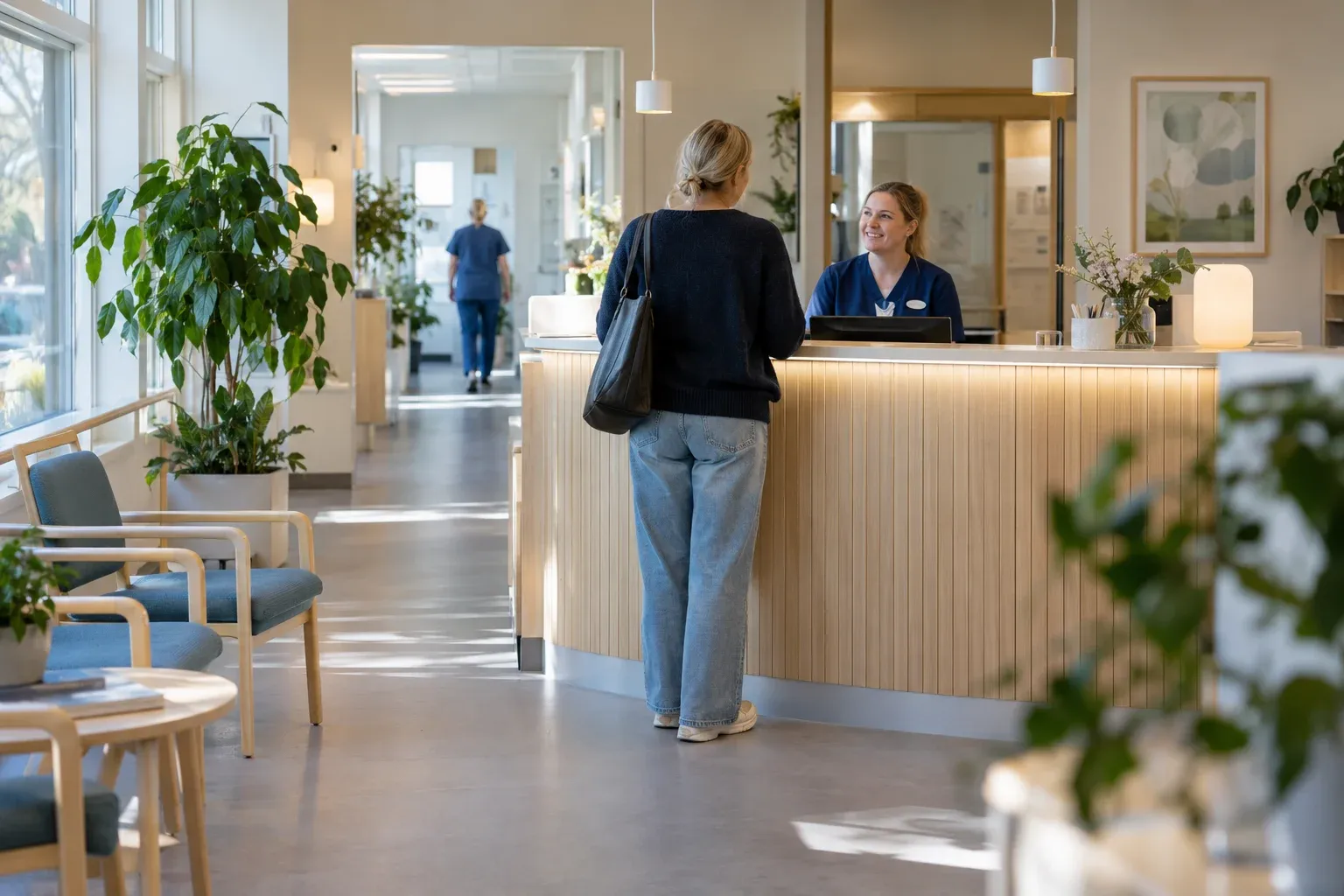
Swedish healthcare is cheap once you are inside it and expensive in the weeks before. Here is what makes you a resident in the system’s eyes, how to pick your clinic, and where your fees legally stop.
When you need this
You have just moved and want to know which clinic is “yours”. You hold a residence permit but no personnummer yet, and you need a doctor. You are an EU citizen working here and wonder whether your home card still counts. Or you keep paying patient fees and want to know when they stop.
How the system decides who is a resident
Healthcare in Sweden is run by 21 regions and paid for mainly through regional tax, so the fee at the desk covers only a small part of the real cost. The Health and Medical Services Act makes each region responsible for people who live in it, plus people entitled to Swedish care under the EU social-security rules without living here, such as EU citizens working in Sweden.
“Living here” means folkbokföring, population registration with Skatteverket. It brings the personnummer and, as Försäkringskassan puts it, care on the same terms as everyone else who lives in Sweden. How registration works is covered in moving to Sweden for work and the personnummer.
| Your situation | What gets you resident fees |
|---|---|
| Registered as living in Sweden | Registration itself |
| EU/EEA/Swiss citizen still insured at home | Your home European Health Insurance Card |
| EU citizen on a Swedish job under 12 months | Registering with Försäkringskassan |
| Living here, insured in another EU/EEA country, Switzerland or the UK | A certificate of entitlement from your insurer (often an S1) |
| Non-EU residence-permit holder, not yet registered | Nothing: you pay the full cost |
The gap before registration
This is the expensive part, and relocation guides often skip it. 1177, the regions’ joint health service, says it plainly: if you have a residence permit and need care before you are registered, you pay the full cost of the care yourself.
Immediate care is still given; it is the bill that changes. So keep private or travel health cover until registration comes through, and register as soon as you qualify. EU citizens have it easier: do not drop your EU health insurance card on arrival, because while you are insured at home it is what turns full cost into the patient fee.
A coordination number does not fix this. What counts is registration or an EU entitlement, not the number. A coordination number can serve as your patient identifier, but it does not open the 1177 login. With no Swedish number at all, clinics register you under a substitute reservnummer.
Listing at a vårdcentral
Once registered, you list (lista dig) at one vårdcentral, the primary-care health centre. The law requires regions to let you choose freely, without restricting you to your area, and to offer a fixed doctor contact, the fast läkarkontakt. You can be listed at only one at a time.
- Where: any public or region-contracted vårdcentral, anywhere in Sweden. 1177.se lets you compare clinics and their ratings.
- How: varies by region. Often online by logging in to 1177.se; some regions list you automatically at the nearest clinic unless you choose.
- Changing: at most twice a year unless there are special reasons.
- Why bother: the national care guarantee’s same-day contact applies to the vårdcentral where you are listed. The guarantee as a whole applies only in the region where you are registered.
The 1177 login needs a Swedish personnummer and Swedish e-identification, so set up BankID early. Behind it sit booking, messages, prescriptions and your fee-ceiling status; see 1177 in depth. You can always seek care at a vårdcentral even before you have listed; the emergency department is not the fallback.
What you pay, and where it stops
Each region sets its own visit fees and revises them every year, and you pay the fees of the region where you are treated. We deliberately do not quote them: check your region on 1177.se.
What is national is the ceiling, the högkostnadsskydd. The statute fixes it as a fraction of the price base amount, which the government sets each January. Once your outpatient fees reach it, you get a frikort and pay nothing more for outpatient visits for the rest of the period. A frikort is valid in every region.
The ceiling is a rolling 12 months, not a calendar year. It runs from your first paid visit. Note that date, and keep receipts if your provider does not record fees electronically.
| Counts toward the ceiling | Usually does not |
|---|---|
| Outpatient visit fees (doctor, nurse, specialist) | Vaccinations |
| Certain consumables | Certificates and health checks |
| Dental care given at healthcare fees | Missed appointments |
| Inpatient day charges, record copies, invoice fees |
Some groups pay less or nothing. Patients aged 85 and over pay no outpatient fees by law. Most regions charge nothing until the 20th birthday. Child health centres, antenatal care and called screenings are free. Children under 18 in the same family share one ceiling. A hospital stay is charged per day, with a statutory maximum.
Medicines and the second ceiling
Prescription medicines have their own ceiling, also running 12 months from your first purchase. You pay full price up to a first threshold, then a discount of 25, 75 and finally 90 percent, and after the ceiling subsidised medicines are free for the rest of the period. Under 18, they are free outright.
The ceiling rose by almost a third on 1 July 2025. Many English pages still quote the old figure; the current amount is in the table below. The subsidy also reaches people who work in Sweden without living here.
Only prescriptions carrying a Swedish workplace code count, so a prescription brought from abroad is dispensed at full price. See pharmacies in Sweden for the rest.
Dental care: a separate track
Dental care runs outside the healthcare fees. It is free through the year you turn 19. From the year you turn 20, if you are insured in Sweden, you get a small yearly general dental allowance (allmänt tandvårdsbidrag) and high-cost protection, both deducted on the dentist’s bill.
- Dentists set their own adult prices: ask for an estimate first, and a written one for larger work.
- Choose a clinic connected to the state dental support; most are, not all.
- New since 1 January 2026: from the year you turn 67, certain treatments cost 10 percent of the state reference price, and the dentist may not charge more than the reference price.
For a toothache today, see dental emergencies.
Practical information
| Item | 2026 figure | Notes |
|---|---|---|
| Regional visit fee | Set by your region | Check on 1177.se; revised yearly |
| Outpatient ceiling | SEK 1,450 per 12 months | 0.025 × price base amount; a region may set less |
| Medicine ceiling | SEK 3,800 per 12 months | First SEK 2,000 paid in full; since 1 July 2025 |
| Hospital stay | Max SEK 130 per day | Statutory maximum |
| Aged 85+ | No outpatient fees | By law |
| Medicines under 18 | Free | By law |
| Dental care | Free through the year you turn 19 | By law |
| General dental allowance | SEK 300–600 per year by age | SEK 600 at 20–23 and 67+ |
| Dental high-cost protection | You pay up to SEK 3,000 per 12 months | Then 50%, and 85% above SEK 15,000 (reference prices) |
| Care before registration, non-EU permit holder | Full cost | Keep private cover |
| Price base amount | SEK 59,200 | Set each January; drives the ceilings |
FAQ
How do I register with a doctor in Sweden?
You list at a vårdcentral, a primary-care health centre. Once you are registered as living in Sweden you can choose any public or region-contracted one, anywhere in the country, but only one at a time. Many regions let you list online via 1177.se; some list you automatically at the nearest clinic. Ask there for a fixed doctor contact.
How much does it cost to see a doctor in Sweden as a resident?
Each of the 21 regions sets its own visit fees and revises them every year, so check your region on 1177.se. What is national is the ceiling: in 2026 outpatient fees stop at SEK 1,450 over 12 months from your first paid visit. After that you get a frikort and pay nothing more for outpatient visits that period.
What is högkostnadsskydd in Sweden?
Högkostnadsskydd is Sweden’s statutory high-cost protection. For outpatient care, fees stop at SEK 1,450 per 12 months in 2026. For prescription medicines there is a separate SEK 3,800 ceiling: you pay the first SEK 2,000 in full, then a rising discount. Both are tied to the price base amount and run from your first payment.
Can I get healthcare in Sweden before I have a personnummer?
Yes, but the price depends on your status. Immediate care is always given. EU citizens still insured at home use their EU card; EU workers on short jobs register with Försäkringskassan. A non-EU residence-permit holder who is not yet registered pays the full cost, so keep private cover until registration and the personnummer come through.
Is healthcare free for children in Sweden?
Largely. Subsidised prescription medicines are free by law under 18, dental care is free through the year a child turns 19, and most regions charge nothing for outpatient visits until the 20th birthday. Child health centres are free. Siblings under 18 also share one outpatient fee ceiling, so a family stops paying sooner.
Does Swedish healthcare cover dental care for adults?
Only partly. From the year you turn 20, if you are insured in Sweden, you get a yearly general dental allowance and high-cost protection: the state pays half of costs above SEK 3,000 in 12 months and 85 percent above SEK 15,000. Dentists set their own prices, so ask for an estimate first.
Does a coordination number give me access to Swedish healthcare?
Not by itself. Resident fees follow population registration or an EU entitlement, such as working in Sweden while insured here. A coordination number can be used as your patient identifier, but it does not open the 1177 login. EU workers on short jobs should register with Försäkringskassan; everyone else should check their status before treatment.
Related guides
- Moving to Sweden for work — registration and the first weeks, which decide when resident fees start
- The personnummer — why registration unlocks the system
- BankID — the key to the 1177 login
- Pharmacies in Sweden — filling the prescriptions that count toward the cap
- Healthcare as a visitor — the four doors, if you need care before you are settled
Facts verified 2026-10-06. Sources: Sveriges riksdag (Hälso- och sjukvårdslag 2017:30, Lag 2002:160, Lag 2008:145, Tandvårdslag 1985:125), Regeringen, 1177, TLV, Försäkringskassan and Västra Götalandsregionen — full register in this topic’s source file. This is general information, not medical or legal advice. Found something outdated? Tell us and we’ll fix it.