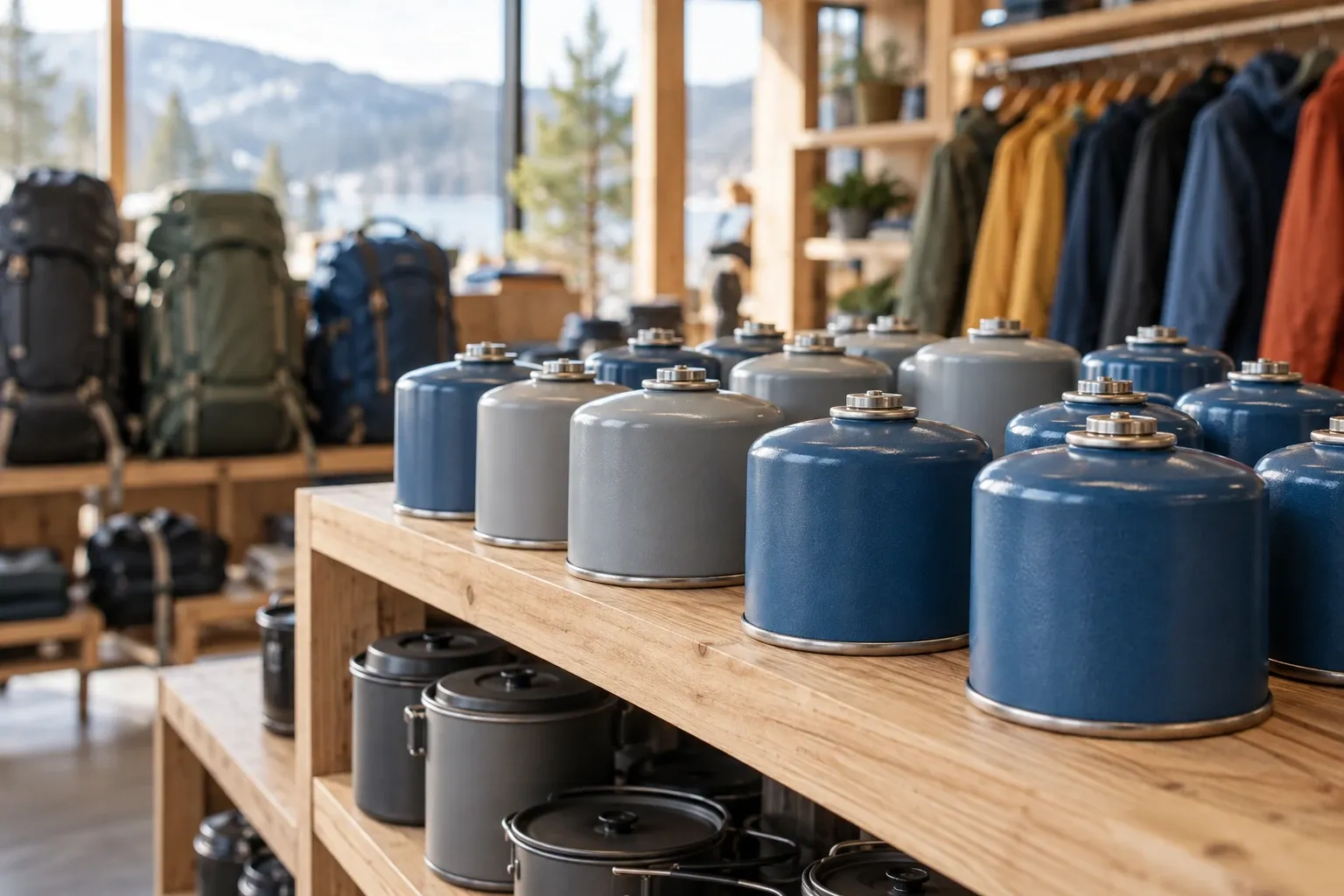
Sweden sells outdoor gear everywhere, but it rarely sells it cheaply. Pack your clothing from home, plan to buy stove fuel and repellent on arrival, and know the four items that come with legal strings before you reach the till.
When you need this
You are packing for a hike, a paddle or a ski trip and wondering whether to bring your gear or buy it in the land of famous outdoor brands. Or you have just landed and your stove has no fuel, because you could not fly with it. Maybe the weather turned and you need a shell or boots fast. Or you have a can of bear spray from home and are not sure it is legal here. It isn’t.
Is outdoor gear expensive in Sweden?
Clothing and footwear are. Eurostat, the EU’s statistics office, compares price levels across Europe every year. Its 2025 figures, released in July 2026, put Sweden’s clothing-and-footwear price level well above the EU average:
| Country | Clothing and footwear, 2025 (EU = 100) |
|---|---|
| Denmark | 132.0 |
| Sweden | 129.6 |
| Finland | 121.8 |
| Norway | 113.8 |
| Germany | 101.8 |
| Netherlands | 92.8 |
Two things in that table surprise people. Sweden was dearer than Norway for clothing in 2025, so the old habit of “buy it in Sweden, it’s cheaper than Oslo” no longer holds for a jacket. And the gap has widened: Sweden stood at 123.1 the year before. A German visitor pays roughly 27% more here for the same basket of clothing; a Dutch visitor, about 40% more.
The index covers all clothing and footwear, not outdoor gear alone, so treat it as a direction rather than a price list. The direction is clear: pack what you already own and buy only what you lack. Fjällsäkerhetsrådet, Sweden’s mountain-safety council, makes the same point from another angle. It says good equipment does not have to be expensive; clothes and shoes simply need to withstand wind and wet and work in layers. Our guide to dressing in layers covers what those layers must do.
Fuel: the one thing you must buy here
If you fly, you cannot bring stove fuel. Transportstyrelsen, the Swedish Transport Agency, lists propane and butane as banned in both cabin and checked baggage, and liquid fuel is not allowed either. The stove itself may fly if it is cleaned, free of fuel residue and packed without cartridges. A canister found at security is confiscated, and you land without fuel.
So plan where you will buy it on day one:
- Gas canisters (gaspatron) are sold in outdoor and sports shops, which cities and most gateway towns have.
- Denatured alcohol for spirit stoves, sold as T-röd, sits on supermarket and hardware shelves.
- Hut shops are not a plan. STF, the Swedish Tourist Association, runs shops in only some mountain huts, in a small and a large tier, and items run out. Buy enough for the whole route before you leave the road.
Two cold-weather notes: butane-rich canisters perform poorly in the cold, and a part-full canister cannot fly home with you either. In the mountains, empty canisters go into the hut’s sorted recycling, which is taken out by snowmobile in winter. For which stoves stay legal during a fire ban, see camping stoves during fire bans.
Where to shop
Swedes own a lot of outdoor gear, so it is easy to find. The question is which kind of shop has what you need.
| Need | Where Swedes buy it |
|---|---|
| Shell, layers, boots, tents | Specialist outdoor shops and sports chains in cities and gateway towns |
| Stove gas | Outdoor and sports shops |
| T-röd and trail food | The last supermarket before the trail; hardware shops |
| Insect repellent (myggmedel) | Pharmacies, supermarkets, outdoor shops |
| Basics at the trailhead | STF mountain station shops |
| Used gear | Flea markets and classifieds sites |
Cities such as Stockholm, Gothenburg and Malmö have the widest choice. In the mountains, every STF mountain station at a trailhead has a shop, and the larger ones rent out gear. Trail food is food for VAT purposes, so it carries the temporary 6% rate wherever you buy it.
Borrow, rent or buy second-hand
For a short trip, the cheapest gear is gear you don’t buy.
Fritidsbanken is a network of free libraries for sports and outdoor equipment. It lends donated tents, stoves, skis, skates and life jackets for up to 14 days, with no deposit and no late fees, and nothing to pay if something breaks in normal use. The catch is that branches sit in ordinary towns and suburbs rather than resorts, and stock depends on donations. In October 2026 there was no branch in Åre or Malung-Sälen. Our Fritidsbanken guide explains how to borrow as a visitor.
Mountain stations rent gear at the larger STF sites, and STF members get discounts on rental and shop goods. Stations open roughly from midsummer to mid or late September, and from late February to late April or early May.
Second-hand outdoor kit turns up at flea markets and on classifieds sites. A private seller may only take Swish, the Swedish phone payment most visitors cannot use, and buying from a private person gives you no withdrawal right. See loppis and second-hand shopping and buying on Blocket.
Items with legal strings
Four kinds of gear are regulated in ways visitors don’t expect.
Pepper spray and bear spray: leave them at home. Sweden’s Weapons Act (vapenlag 2026:408) treats tear-gas devices and comparable sprays like firearms. The police say you need their permit both to possess pepper spray and to bring it into Sweden, and that it is hard to get. Possessing one without a permit is an offence. Swedish bears are shy; our bears guide covers what to do instead.
Knives: legal to buy, conditional to carry. Sweden’s Knife Act bans carrying a knife in a public place without a good reason. The police list fishing, hunting, mushroom picking with a suitable knife and an outing that includes grilling as justified; a large “survival knife” for a picnic is not. Carrying without a reason can bring a fine or up to a year in prison. Keep the knife in the pack for the trip, not on the belt in town; details are in Sweden’s knife law.
Repellent: buy it here. An insect repellent must be approved by Kemikalieinspektionen, the chemicals agency, before it may be marketed, sold or used in Sweden. A product from home may not be. Approved products carry a registration number, and label age limits and daily-use limits bind you.
Small gas cartridges. Non-flammable cartridges for other equipment, such as a life-jacket inflator, may fly: up to four per person, with the airline’s permission. Stove gas is flammable and is not covered.
At the till: VAT, tax-free, returns and sales
The shelf price is the price. Swedish law requires prices to include VAT (moms), 25% on gear. Pay by card in kronor; if a terminal offers your home currency, decline, because the conversion carries a margin.
Tax-free for non-EU residents. If you live outside the EU, you can reclaim VAT from shops that offer tax-free:
- Ask at the till whether the shop offers tax-free, and get the form.
- Spend at least 200 kr including VAT in one purchase.
- Keep the item unused, and take it out of the EU by the end of the third month after the purchase month.
- Get the export stamp before you leave the EU. Tullverket names stamping points at Arlanda and Landvetter; elsewhere, check in advance. If your goods are in hand luggage and you connect through another EU airport, the stamp comes there.
Without the stamp there is no refund, and it can’t be added afterwards. Residents of Norway and Åland follow a separate rule. The full process is in our VAT refund guide.
Returns are not a right. Sweden has no legal right to return a non-faulty item bought in a shop. Öppet köp (money back) and bytesrätt (exchange) are store policies, and sale items may be excluded. Ask before paying, get the terms printed on the receipt, and keep it. Don’t buy boots on arrival and walk the trail in them hoping to return them. Faulty goods are different: you can complain to the business for three years. If it refuses, ARN, the state consumer-disputes board, accepts complaints in English. Online purchases carry a 14-day withdrawal right. See returns, öppet köp and ångerrätt.
Sales. Summer stock is cleared from around Midsummer, handy if you arrive in July. Black Week in late November and the mellandagsrea on 27–30 December are the other peaks. A reduced price must be shown against the lowest price of the previous 30 days, so compare with that rather than the “-50%” sign. Dates and rules are in Swedish sales seasons.
Practical information
| Item | Amount or rule |
|---|---|
| Clothing and footwear price level, 2025 | Sweden 129.6 (EU = 100); Germany 101.8; footwear alone 125.0 |
| Overall household price level, 2025 | Sweden 121 |
| VAT on gear | 25%, included in the shelf price |
| VAT on food, trail food included | 6% from 1 April 2026 to 1 January 2028 |
| Tax-free minimum (non-EU residents) | 200 kr per purchase incl. VAT; refund company keeps a fee |
| Fritidsbanken loan | Free, up to 14 days, no deposit |
| Stove gas and fuel in air luggage | Not allowed, cabin or checked |
| Pepper or bear spray | Police permit needed to possess or bring in |
| ARN complaint | 150 kr fee; clothing and shoes claims above 750 kr |
| Gear, gas and fuel prices | Not published here: vary by shop, brand and season |
FAQ
Is outdoor gear expensive in Sweden?
Clothing and footwear are. Eurostat’s 2025 comparison put Sweden at index 129.6 against an EU average of 100, behind only Denmark among the countries we compared, and well above Germany at 101.8, Norway at 113.8 and the Netherlands at 92.8. The index covers all clothing, not outdoor gear alone, but the message is clear: bring what you already own.
Can I fly to Sweden with gas canisters for my stove?
No. Transportstyrelsen, the Swedish Transport Agency, lists propane and butane as banned in both cabin and checked baggage, and stove fuel is not allowed either. The stove itself may fly if it is cleaned, free of fuel residue and packed without cartridges. Plan to buy gas or fuel after you land, before the last town on your route.
Where can I buy camping gas in Sweden?
Gas canisters are sold in outdoor and sports shops, which cities and most gateway towns have. Denatured alcohol for spirit stoves, sold as T-röd, sits on supermarket and hardware shelves. Do not rely on mountain hut shops: they come in small and large tiers and items run out. Buy enough for the whole route before you leave the road.
Can I get the VAT back on outdoor gear bought in Sweden?
Yes, if you live outside the EU. Buy from a shop that offers tax-free, spend at least 200 kr including VAT in one purchase, keep the item unused and take it out of the EU by the end of the third month after the purchase month. Get the export stamp before leaving the EU. Norway and Åland residents have a separate rule.
Can I return outdoor gear I bought in a Swedish shop?
Only if the shop offers it. Sweden has no legal right to return a non-faulty item bought in a shop; öppet köp and exchange are voluntary store policies, and sale items may be excluded. Ask before paying and get the terms on the receipt. Faulty goods are different: you can complain to the business for three years. Online purchases carry 14 days’ withdrawal.
Can I buy or bring bear spray or pepper spray in Sweden?
Not without a police permit. Sweden’s Weapons Act treats pepper spray and other tear-gas devices like firearms, and the police say you need permission both to possess one and to bring it into the country, and that it is hard to get. Leave bear spray at home; Swedish bears avoid people, and our bear guide covers what to do instead.
Can I borrow or rent outdoor gear instead of buying it?
Yes. Fritidsbanken branches lend donated tents, stoves, skis, skates and life jackets free for up to 14 days, with no deposit, though stock and opening hours vary by branch. STF’s larger mountain stations rent out gear at trailheads. For a short trip, either beats buying at Swedish clothing prices.
Related guides
- Fritidsbanken: borrow outdoor gear for free — the no-cost alternative to buying, and how visitors borrow.
- Camping stoves during fire bans — which stove and fuel to buy so you can still cook in a dry summer.
- Dressing in layers — what the clothing you pack actually needs to do.
- VAT refunds in Sweden — the full tax-free process for non-EU visitors.
- Sweden’s knife law — when carrying your new knife is legal.
Facts verified 2026-10-15. Sources: Eurostat, Transportstyrelsen, Polismyndigheten, Kemikalieinspektionen, Sveriges Riksdag (vapenlag 2026:408, knivlagen 1988:254, mervärdesskattelag 2023:200), Skatteverket, Tullverket, Konsumentverket, ARN, Fritidsbanken, STF, Fjällsäkerhetsrådet — full register in this topic’s source file. Found something outdated? Tell us and we’ll fix it.