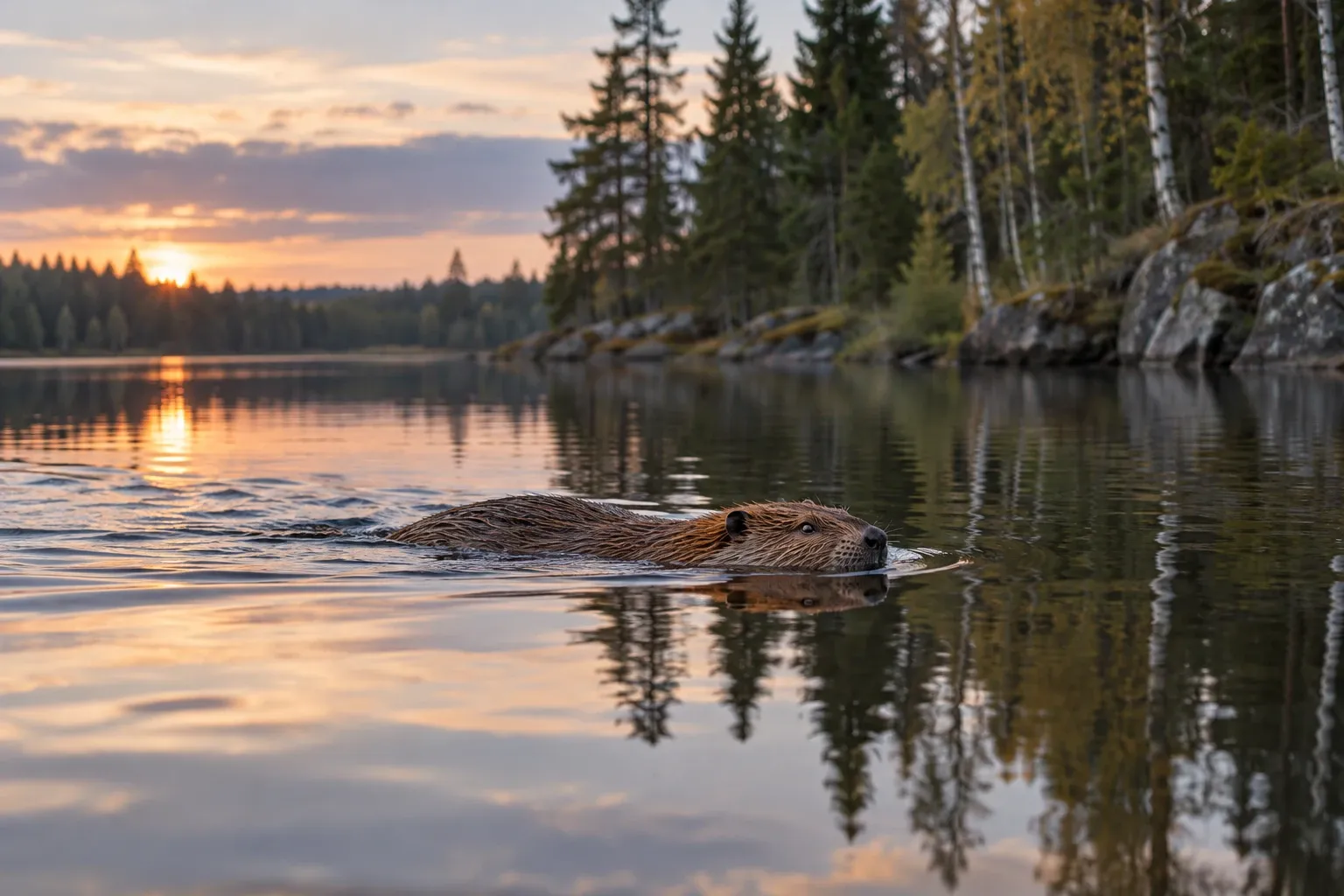
The beaver is the easiest of Sweden’s large wild mammals to find without a guide. It stays on the same water, leaves signs you can’t miss and appears at dusk. Here’s how to read the shoreline, time your evening and stay on the right side of the rules.
When you need this
You’re paddling, camping or staying in a lakeside cabin and you notice tree stumps chewed to a point. Maybe you want to see a beaver without booking a tour, or you’re in Stockholm and wonder whether they really live in the city’s waters. Or you’re planning a spring or autumn trip and want to know whether hunters will be sitting at the same lake.
Where beavers live in Sweden
The Eurasian beaver (bäver) is Sweden’s largest rodent, at 18–22 kg and up to a meter long plus a flat tail. It lives mainly in water and is active at night. The Swedish Museum of Natural History (NRM) gives its range as lakes and rivers in northern Götaland, Svealand and large parts of Norrland.
It isn’t only a wilderness animal. The Stockholm county board says beavers are spread across the whole county, and NRM notes beavers reaching islands in the Stockholm archipelago. Beavers also turn up along the west coast and in the brackish Baltic, but they need fresh water to drink and to rinse salt from their fur.
This is a comeback story. Hunting for fur and castoreum, a scent secretion, wiped beavers out in Sweden by the late 1800s. Beavers from Norway were released in Jämtland from the early 1920s, with 78 more released between 1923 and 1939.
How many are there now? Nobody knows precisely. NRM’s figure of about 100,000 dates from around 2000. The Swedish Forest Agency’s 2016 review gave about 130,000, as an estimate from earlier surveys. Any page quoting an exact current number is guessing.
How to tell a beaver lives here
You’ll almost always see the signs before the animal. Fresh signs mean the water is in use now.
| Sign | What it looks like | What it tells you |
|---|---|---|
| Gnawed stump | Deciduous tree chewed to a pencil point, pale chips around it | Fresh chips: beavers are active here now |
| Lodge (hydda) | Mound of sticks and mud, typically 1–2 m high and several meters across | A family’s home; watch it from a distance |
| Bank burrow | Just a hole at the waterline on a lake or big river | Beavers on deep water often skip building a lodge |
| Dam (dämme) | Wall of sticks and mud across a small, shallow stream | Ponded water upstream |
| Tail slap | A loud smack on the water at dusk | A warning signal: you’ve been noticed |
NRM also notes that beavers sometimes leave huge trees deeply gnawed but standing. Don’t pitch a tent or tie up a boat under one.
When to go: the beaver year
The daily rule is simple. Go late in the evening or just before sunrise, because beavers forage on land almost only at night and you’ll usually see one swimming. The season shapes the rest.
| Period | What beavers are doing | For you |
|---|---|---|
| Spring, ice-out to May | Eating fresh shoots after a winter of bark | Good watching; hunting still open until 10 or 15 May |
| Early June | Kits born, one to four per litter | Families stay together for two years |
| June–August | Feeding mostly on water plants and herbs | Best window: no hunting, long evenings |
| Autumn | Felling trees and building an underwater food store | Fresh signs easiest to find; hunting opens 1 October |
| Winter | In the lodge, short swims under the ice | Little to see; broken new ice at a shore opening can be a sign |
NRM adds that beavers may be active by day in remote, undisturbed places, since their eyes are built like a daytime animal’s. Don’t plan on it.
How to watch: an evening at the water
- Find fresh sign by day. Walk the shore and look for pale chips and newly felled aspen, birch or willow.
- Come back before sunset. Sit down an hour or more ahead and stay into dusk.
- Sit downwind, low and still. Beavers see poorly but hear and smell well.
- Listen. You may hear gnawing before you see a wake.
- Use a canoe if you can. Drifting quietly along a shore with fresh sign is the classic method; see our guide to canoeing in Värmland and Dalsland.
Bring binoculars and dark clothing that doesn’t rustle. In June and July, a head net makes the wait far more pleasant; our mosquito guide explains where they’re worst.
Lodges, dams and the law
Watching beavers is free. Allemansrätten, the right of public access, lets you walk, paddle and stop by lakes and rivers, though protected areas can set stricter rules. The Environmental Code’s duty to neither disturb nor destroy applies to everything you do there.
The lodge is where the law is firmest. Destroying one needs a county board permit at any time of year, under the Hunting Ordinance. The Hunting Act protects the nests of game outside the open season and counts interfering with a nest as hunting.
| Structure | 1 October–30 April | 1 May–30 September |
|---|---|---|
| Lodge | County permit, only if absolutely necessary to prevent serious damage | County permit still required |
| Dam | County permit, only if absolutely necessary to prevent serious damage | May be destroyed without a permit |
The dam rule exists for landowners whose roads or forest flood; it’s not a visitor’s business. For you the rule is simpler: look, don’t touch, and never climb on a lodge or dam.
Beavers, swimmers and dogs
Beavers are shy on land, but they can defend their water. In 2007 a beaver in the Bottenån river at Lindesberg bit a woman swimming with her family, and she needed hospital treatment. A child had been attacked at the same spot earlier. It’s rare, but don’t swim toward a beaver or near its lodge.
Dogs are the likelier flashpoint. A loose dog in beaver water risks a bite. It will also send the beaver diving, and a beaver can stay under for up to 15 minutes. From 1 March to 20 August, Swedish law requires dogs to be kept from running loose wherever there is wildlife. In practice, keep the dog leashed at the shore all year. See our guide to the leash law in Sweden.
Hunting season: the overlap nobody mentions
Beavers are game in Sweden. They’re not on the strict-protection list. The general season is set by the Hunting Ordinance:
- Dalarna, Gävleborg, Västernorrland, Jämtland, Västerbotten and Norrbotten: 1 October–15 May
- Rest of the country: 1 October–10 May
The new annex that takes effect on 1 July 2027 keeps both dates. Outside the season, county boards can permit protective culls against damage. They warn this risks orphaning kits, which depend on their parents until the season opens.
The catch for watchers: hunters usually wait at the water or stalk at dawn and dusk, the same hours you’ll be there. In spring and autumn, wear something visible, and ask locally if you’re unsure. Our guide to hiking during hunting season covers the rest.
Guided trip or on your own?
On your own costs nothing and works well once you’ve found fresh sign. A guide raises the odds because they know the local water and which signs are fresh. Visit Sweden lists guided beaver safaris of about five hours. The state-owned Halle- and Hunneberg ecopark near Vänersborg lists beaver safaris among its regular activities. Our wildlife safari guide lists the questions to ask any operator.
On a rainy day, naturum Färnebofjärden in Gysinge has a beaver lodge in its exhibition. It opens roughly May to October, with daily hours in high summer.
Practical information
| Item | Detail |
|---|---|
| Cost of watching on your own | Free under allemansrätten |
| Guided beaver safari | Price set by the operator; Visit Sweden’s examples last about five hours (checked 2026-10-15) |
| Best months | May–September; no general hunting from mid-May to 30 September |
| Best hours | Before sunset into dusk, or before sunrise |
| Hunting season | 1 Oct–15 May in the six northern counties; 1 Oct–10 May elsewhere |
| Dog rule | Under control, not loose, where there is wildlife, 1 March–20 August |
| Lodges | Never touch; destroying one needs a county permit all year |
| Indoor alternative | Naturum Färnebofjärden, Gysinge; opening days vary by month (checked 2026-10-15) |
FAQ
Where can you see beavers in Sweden?
On lakes, rivers and streams across most of the country: northern Götaland, Svealand and large parts of Norrland, according to the Swedish Museum of Natural History, and throughout Stockholm county, according to its county board. Any water with freshly felled deciduous trees and pointed, chewed stumps is a good bet. Canoe country such as Värmland, where the county board handles beaver permits, suits watching from the water.
When is the best time to see beavers in Sweden?
Late in the evening or just before sunrise, from ice-out in spring to early autumn. Beavers forage on land almost only at night, so you usually see one swimming at dusk. Summer avoids the hunting season, which opens on 1 October. In winter they stay in the lodge, so tours and self-guided watching pause.
Are beavers dangerous to people or dogs?
Rarely, but they can bite in the water. In 2007 a beaver in a river at Lindesberg bit a swimmer, who needed hospital care. Don’t swim toward a beaver or close to its lodge. Keep dogs leashed at the shore; Swedish law requires dogs to be kept from running loose where wildlife lives from 1 March to 20 August.
Can you see beavers in Stockholm?
Yes. The Stockholm county board says beavers are spread throughout the county, and the Swedish Museum of Natural History notes beavers reaching archipelago islands. Look along quieter lake shores, streams and bays with chewed deciduous trees, and go at dusk. Sightings are never guaranteed, but the signs are easy to find.
Is it legal to visit or touch a beaver lodge?
Looking is fine; touching is not. Allemansrätten lets you watch from the shore or a canoe, but destroying a lodge needs a county board permit all year, and interfering with the nest of protected game counts as hunting. Dams have a seasonal rule that concerns landowners. Keep your distance, stay quiet and never climb on a lodge or dam.
Are beavers hunted in Sweden?
Yes. Beavers are game with a general season from 1 October to 10 May, extended to 15 May in the six northern counties from Dalarna to Norrbotten. Hunters usually wait at the water at dawn and dusk. Outside the season, county boards can allow protective culls against damage. If you watch in autumn or spring, wear visible clothing.
Related guides
- Wildlife safaris in Sweden — if you’d rather go with a guide: safari types and what to ask.
- Wildlife in Sweden — every large animal you might meet, and which are protected.
- Canoeing in Värmland and Dalsland — the best platform for a quiet beaver evening.
- Allemansrätten explained — the right that makes watching free, and its limits.
- Färnebofjärden National Park — river wilderness with a beaver exhibit at its naturum.
Facts verified 2026-10-15. Sources: Naturhistoriska riksmuseet, Sveriges Riksdag (Jaktförordning 1987:905, Jaktlag 1987:259, Miljöbalken, Lag 2007:1150), Länsstyrelsen Stockholm and Värmland, Skogsstyrelsen, Naturvårdsverket, Visit Sweden — full register in this topic’s source file. Found something outdated? Tell us and we’ll fix it.