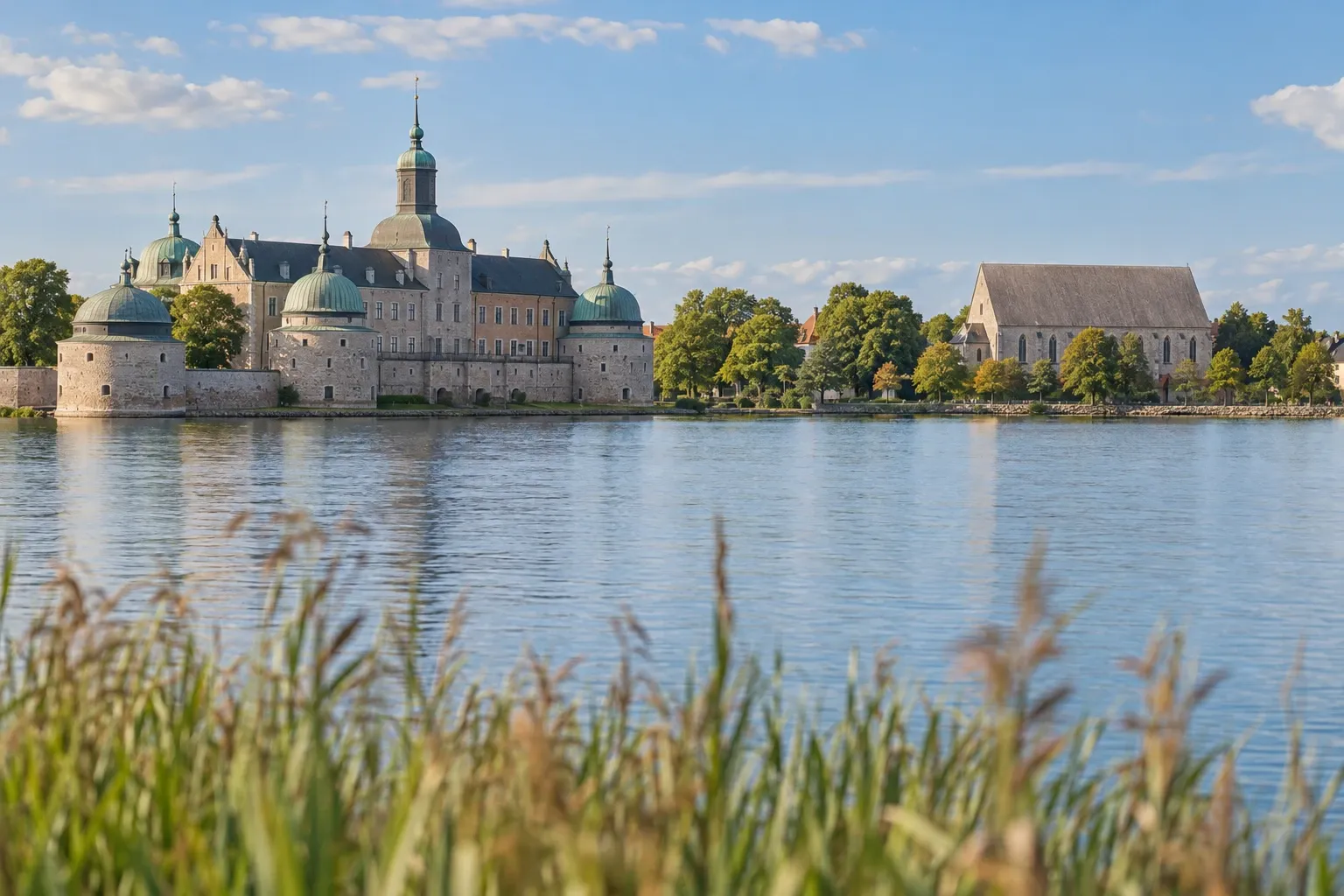
Vadstena packs a medieval abbey, a Renaissance castle and Sweden’s oldest town hall into a few lakeside streets. Getting there and finding things open takes a little planning, especially out of season. Here’s what to know.
When you need this
You’re staying in Linköping or Motala and want a day on Lake Vättern. You’re driving around the lake, or following a pilgrim route to Saint Birgitta’s town. Or you’ve looked up “Vadstena castle” and want to know whether anything is open in November. This page covers the town and its nearest surroundings. For the region and its rail links, see our Linköping and Norrköping guide.
Vadstena sits on the east shore of Vättern in Östergötland. By road it is about 16 km south of Motala and 51 km west of Linköping. It received town privileges in 1400. Swedes drop the d when they say it: roughly “vast-e-na”.
Getting there
Vadstena has no train station. The municipality’s own advice is to take a train or long-distance bus to Linköping, Mjölby or Motala and finish by Östgötatrafiken bus. In the timetable valid 17 August–12 December 2026:
| Route | Bus | Time | How often |
|---|---|---|---|
| Motala Central → Vadstena | 612 | About 25 minutes | Every 30 minutes on weekday mornings, then hourly; weekend trips too |
| Skänninge station → Vadstena | 661 | About 23 minutes | Daily; connects with Östgötapendeln, the regional train, at Skänninge |
Ignore bus 613. Both the castle’s and the abbey museum’s directions say 612 or 613 from Motala. In the current timetable, 613 is a loop from Motala to Fågelsta and back, and it never reaches Vadstena. Line 612 is the one you want. Timetables change in December, so check the Östgötatrafiken app before you travel.
Paying is simple:
- Tap a bank card (Visa, Visa Electron, Mastercard or Maestro, physical or in a phone wallet) on the reader when you board. This works on the rural buses and on Östgötapendeln.
- One card, one person. A group needs a card each, or tickets bought in the app.
- Discounts need the app. Youth, student and senior prices aren’t given when you tap.
Our guide to paying for buses in Sweden explains how this cashless system works across the country.
By car, take the E4 and then road 206 via Skänninge from Linköping, or road 919 from Motala or Ödeshög. Some older directions, including the municipality’s, still call that road riksväg 50. From Stockholm it is about 246 km, a little over three hours; from Gothenburg about 241 km. Parking in Vadstena is free. Where a sign asks for one, display a parking disc (p-skiva). The tourist office and other outlets hand them out free.
The abbey: church, museum and Saint Birgitta
Vadstena exists as a destination because of Saint Birgitta (heliga Birgitta, Saint Bridget of Sweden). Born in 1303, she was a noblewoman, mother of eight and visionary. In 1346 King Magnus Eriksson and Queen Blanka gave her the royal estate at Vadstena for a convent. Pope Urban V approved her order, the Order of the Most Holy Saviour, in 1370. She died in Rome on 23 July 1373, was canonized on 7 October 1391, and in 1999 was named a patron saint of Europe. Since 2025, Vadstena Abbey and her Revelations have been part of Sweden’s national cultural canon.
The abbey church (Klosterkyrkan) was begun in 1369 and consecrated on 16 February 1430. It was built in limestone to Birgitta’s instruction that it be plain, “humble and strong”. Inside are two medieval sculptures of Birgitta and, in the choir, the reliquary that, according to the parish, holds remains of Birgitta and her daughter Katarina. The monks’ house closed in 1550 and the nuns’ in 1595, and the church has been Vadstena’s parish church since 1829. It holds three Michelin stars, and in summer 2,500–3,000 people visit a day. No admission fee is stated. Our Church of Sweden guide explains why its churches are open to visitors.
Sancta Birgitta Klostermuseum stands next door, in a palace the Bjälbo royal family built in the 1260s. The museum calls it the best-preserved high-medieval palace in the Nordic countries. To find the entrance, leave the church, turn left and round the corner to the lawn called Gräsgården. The building has been a convent, a home for war veterans, briefly a prison and, from the 1820s to the 1950s, part of a mental hospital. It opened as a museum in 2003, and Östergötlands museum has run it since 2022.
Adults pay 110 kr, and everyone under 18 gets in free. There is no lift: ramps serve the entrance and the chapter hall, but the upper floor and the museum’s own toilets are hard to reach. An accessible toilet is in the building next door.
The abbey is still a place of prayer. Pilgrimscentrum, run by the Church of Sweden’s Linköping diocese, celebrates mass every morning at 08:00. The Catholic Birgittine sisters live at the abbey of S:ta Birgittas abbedi Pax Mariae, where the public is welcome at daily services.
| Birgitta’s days | What happens |
|---|---|
| 1 June or nearest Saturday | Feast of the shrine, a popular Birgitta festival |
| 23 July | Her “heavenly birthday”, the summer feast |
| 2 August | Saint Katarina’s day |
| 7 October | Canonization day, with an ecumenical service |
Vadstena Castle
Vadstena Castle (Vadstena slott) began as a fortress. The Riksdag decided in 1544 to strengthen the country’s defences, and work started in 1545. From 1554 Gustav Vasa had it rebuilt as a residence for his son Duke Magnus, and Johan III turned it into a Renaissance palace. Royals stopped living there in 1716. Since 1899 it has housed the Regional Archives (Landsarkivet), part of the National Archives.
You can walk round on your own: the castle’s history and a model of the fortress are on the first floor, with the old kitchen and a cannon tower. The furnished top floor holds 16th–18th-century interiors. In summer the second floor, with the wedding hall, is closed, because Vadstena-Akademien, founded in 1964 to train young singers, stages opera there.
Out of season the castle’s hours shrink. In autumn 2026 it is open daily until 1 November, then mostly at weekends. The Christmas market (Gammeljul) runs from 27 to 29 November. The castle’s summer 2027 hours had not been published when we checked. The Renaissance guided tour runs at weekends at 14:00 until 2 November, then on Saturdays.
The old town
Vadstena’s town hall (Rådhuset) on Rådhustorget was first mentioned in 1411, and it is the oldest preserved town hall in Sweden. Its tower dates from the early 1500s, and the building was damaged when Danish troops raided the town in 1567. Councillors met there until Vadstena merged with Motala in 1974–1979, and it is now a listed building (byggnadsminne).
Nearby, Rödtornet, the red tower, is all that is left of St Peter’s, the old town church. When it was pulled down, its furnishings moved to the abbey church. The abbey church has no bell tower, so Rödtornet’s three bells still ring for it.
The tourist office, Vadstena InfoCenter at Storgatan 28, is staffed on weekdays 10:00–16:00, closed for lunch 12:00–12:30. Its self-service room is open daily 09:00–21:00.
The lake: swimming, fishing and walking
Vättern is Sweden’s second-largest lake, about 135 km long. The municipality runs four official beaches. You can also bathe along the central lakeside promenade, Strandpromenaden, including a small beach by the castle that families like. Swimming from the boat jetties isn’t allowed. A partly adapted bathing place at the bottom of Lastköpingsgatan, by the folk high school, has a ramp into the water. The bottom there is partly pebbles, and the municipality suggests bathing shoes. Natural bathing spots elsewhere have no toilets, and the municipality doesn’t test their water. Dogs are banned from the official beaches from 1 June to 15 September, except in the signed dog areas.
Fishing is free. Anyone, foreign visitors included, may fish Vättern with rod and line from shore or boat without a permit. Grayling (harr) is off-limits in the whole lake all year. See free fishing in Sweden.
Take the lake seriously on the water: its weather can go from near-calm to a gale very quickly. Watch the forecast, wear a life jacket and head for shore early. In an emergency call 112. The Sea Rescue Society has a station at Vadstena–Motala.
For a walk, follow the promenade north around the Tycklinge udde headland and back into town, about 4 km. If you’re arriving by boat, the guest harbor has 50 berths with electricity, 14 of them at buoys in the castle moat.
Omberg and Tåkern
Two nature areas lie close by. Omberg, a hill on the lake south of town, is Sveaskog’s Ekopark Omberg: 1,700 hectares of beech forest and ancient oaks, visited by more than 70,000 people a year, with a view from Hjässan, its highest point. The Östgötaleden trail runs from Omberg through Borghamn and the village churches of Rogslösa, Örberga and Nässja into Vadstena.
Inland lies Tåkern, a lake known for its birds. Its visitor center, naturum Tåkern, is a building clad in reeds, run by the County Administrative Board, and entry is free during opening hours. The surrounding nature reserve has trails and bird towers.
Mistakes to avoid
- Looking for a train to Vadstena. The last leg is always by bus.
- Taking bus 613 from Motala. It no longer goes to Vadstena; take 612.
- Turning up at the museum on an autumn weekday. From October it opens mainly on Saturdays.
- Expecting the castle’s wedding hall in July. It’s an opera stage in summer.
- Fishing for grayling. It’s banned in the whole of Vättern.
Practical information
| Item | Detail |
|---|---|
| Location | East shore of Lake Vättern; Motala 16 km, Linköping 51 km by road |
| By car | Stockholm about 246 km; Gothenburg about 241 km; parking free (disc where signed) |
| By bus | 612 from Motala Central, 661 from Skänninge station; tap a bank card (timetable to 12 December 2026) |
| Abbey church | Open daily; Sep–May Mon–Thu 08–16, Fri 08–19, Sat–Sun 10–16; Jun–Aug Mon–Fri 08–19, Sat–Sun 09–19; no fee stated |
| Klostermuseum | Adult 110 kr, under 18 free; guided visit 160 kr adult, 50 kr age 8–17 (checked 2026-10-15) |
| Klostermuseum hours 2026 | Daily 1 Jun–30 Aug; Thu–Sun Apr–May and Sep; Oct–Dec Saturdays plus 24–31 Oct and 26–27 Dec; 11–17 |
| Vadstena Castle | Adult 110 kr, senior or student 100 kr, age 7–17 80 kr, under 7 free; guided tour 145 kr adult (checked 2026-10-15) |
| Castle hours, autumn 2026 | Daily 12–16 to 1 Nov; 2–26 Nov weekends 12–16; 30 Nov–20 Dec Saturdays 12–16; 26–30 Dec and 2–6 Jan daily 12–16 |
| Heritage card | Kulturarvskortet: half-price entry at castle and museum |
| Tourist office | Storgatan 28; Mon–Fri 10–16; self-service room daily 09–21 |
| Naturum Tåkern | Free during opening hours |
| Fishing | Free with hand tackle; no grayling |
FAQ
Where is Vadstena and how far is it from Stockholm?
Vadstena is a small town on the east shore of Lake Vättern in Östergötland, about 16 km by road south of Motala and 51 km west of Linköping. From Stockholm it is about 246 km, a little over three hours by car; from Gothenburg about 241 km. Swedes drop the d and say roughly “vast-e-na”.
How do I get to Vadstena without a car?
Trains stop in neighboring towns, not in Vadstena. Take Östgötapendeln to Skänninge and change to Östgötatrafiken bus 661, or take bus 612 from Motala Central, about 25 minutes. Both ran daily in the autumn 2026 timetable. Pay by tapping a Visa or Mastercard on the reader or use the app. Ignore older pages that say bus 613.
What does it cost to visit Vadstena Castle and the abbey museum?
In 2026 castle entry is 110 kronor for adults, 100 for seniors and students, 80 for ages 7–17 and free under 7; the guided Renaissance tour is 145. Sancta Birgitta Klostermuseum charges adults 110 kronor and lets everyone under 18 in free. The Kulturarvskortet heritage card halves entry at both. No fee is stated for the abbey church.
When is Vadstena Abbey Church open?
Every day of the year. From September to May it opens Monday–Thursday 08:00–16:00, Friday 08:00–19:00 and weekends 10:00–16:00; from June to August weekdays 08:00–19:00 and weekends 09:00–19:00. Saint Birgitta’s canonization day, 7 October, has its own hours, 08:00–18:00, and shorter hours apply on Christmas and New Year holidays.
Who was Saint Birgitta?
Birgitta Birgersdotter, born in 1303, was a Swedish noblewoman, mother of eight and visionary who founded the Order of the Most Holy Saviour. King Magnus Eriksson and Queen Blanka gave the royal estate at Vadstena for her convent in 1346, and the pope approved her rule in 1370. She died in Rome in 1373, was canonized in 1391 and named a patron saint of Europe in 1999.
Is the Klostermuseum open in winter?
Only on some days. In 2026 it opened weekends in January and February, Saturdays in March, Thursday–Sunday in spring and September, and daily from 1 June to 30 August. From October to December it opens on Saturdays plus 24–31 October and 26–27 December, always 11:00–17:00. Groups can book guided visits all year, outside public hours.
Can I swim and fish at Vadstena?
Yes. The municipality runs four official beaches, and you can bathe along the central lakeside promenade, including a small beach by the castle, but not from the boat jetties. Anyone may fish Vättern with rod and line from shore or boat without a permit; grayling is protected all year. Check the forecast before boating, since the lake can turn rough quickly.
Related guides
- Linköping and Norrköping — the Östergötland hub, its trains and its museums.
- The Göta Canal — the canal crosses Vättern at Motala, 16 km away.
- Gränna — the polkagris town further down Vättern’s east shore; for the lake’s south end, see Jönköping and Lake Vättern.
- Swimming in Swedish lakes — beach culture and water quality.
- Sigtuna — another historic small town, near Stockholm.
Facts verified 2026-10-15. Sources: Vadstena kommun, Svenska kyrkan Vadstena, Sancta Birgitta Klostermuseum (Östergötlands museum), Vadstena Slott, Östgötatrafiken, Länsstyrelsen Östergötland, Sveaskog, SMHI, Vätternvårdsförbundet and Sveriges riksdag (Fiskelag) — full register in this topic’s source file. Prices and hours are 2026 figures; bus times are from the timetable valid to 12 December 2026. Found something outdated? Tell us and we’ll fix it.