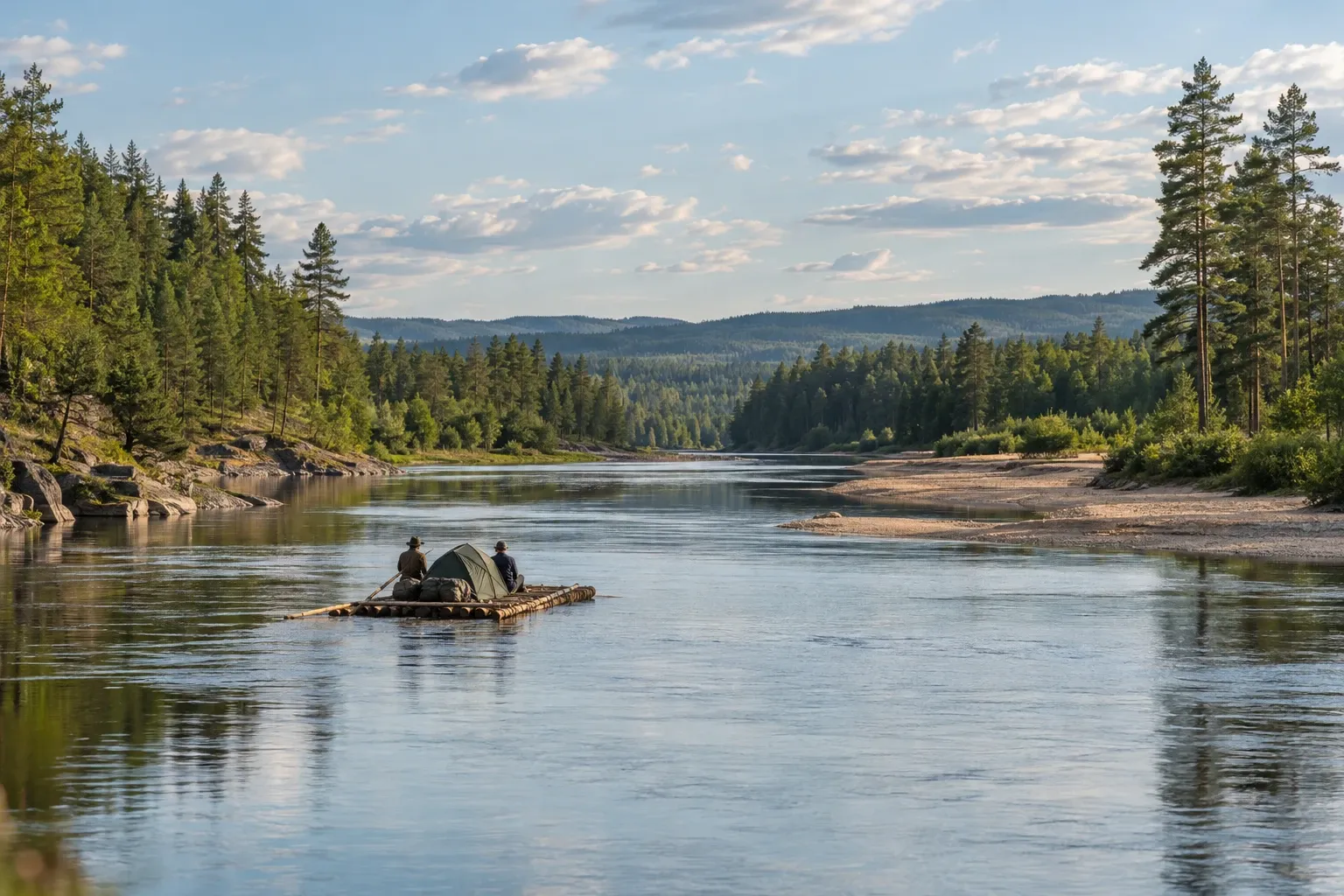
Building your own log raft and drifting down the river that carried Sweden’s timber is one of the country’s oddest and best outdoor trips. Here is what it really demands, which rules on the water are law and which are contract, and when the river itself says no.
When you need this
You’re weighing up a timber-raft trip for a family, a group of friends or a team, and want to know whether a one-day taster or a week on the river fits. Or you’ve booked, and now you’re wondering where you’ll sleep, what to do about toilets and drinking water, whether anyone needs a license, and whether a beer on deck is legal. Or it’s late summer, the river is high in the news, and you want to know whether your trip will go ahead.
Sweden’s last log-driving river
The Klarälven rises near the Norwegian border, crosses Norway as the Trysilelva and flows south through the whole of Värmland to Lake Vänern at Karlstad. For centuries it was a timber highway. A statute regulated floating across the Swedish–Norwegian border as early as 1766, a floating association was formed in 1893, and the river became Värmland’s biggest floatway, more than 400 km in total. At its peak in the 1950s, more than 1,800 people worked floating timber on it, according to Länsstyrelsen Värmland, the county administrative board.
To speed the logs south, the river was straightened: boulders were blasted away, islands removed and side channels closed, in the final decades with bulldozers. The county board has since been putting stone and gravel back on about 25 km between Sysslebäck and Höljes, with work in the river from 2021.
Most guides stop at “floating ended in 1991”. That is only half of it. Flottning (log driving) on the Klarälven stopped in the autumn of 1991. On 27 November 1997 the government formally closed the Klar/Trysilelva as a public floatway (allmän flottled) — the last one in Sweden. Visit Värmland calls today’s raft trip a journey along “Sweden’s last timber floating route”, and that is accurate on both counts.
How a timber-raft trip works
You don’t rent a finished raft. You build it. At a riverside building site in the upper valley, an instructor teaches the knots and lashings, you tie logs together with rope, and the instructor checks the raft before it leaves. A finished raft weighs about a ton. Then your group is on its own: no guide aboard, your own stops, your own camps. The current moves you at about 2 km/h, and you’ll always be heading south.
| Trip type | What it involves | Distance |
|---|---|---|
| One day | Build in the morning, drift, dismantle; most groups finish in the early evening | About 10 km |
| Five days | Briefing evening and a night at the meeting point, build day, then three nights on the river | Depends on water and wind |
| Eight days | Build, then about a week on the river with time for hikes ashore | About 50 km |
The longest package has run since 1980. Daily distance is not fixed: water level, wind and weather decide how far you get, and the river looks similar for days. Signs are few on purpose, so carry the topographic map the operator provides and keep track of the villages you pass.
Is it for you?
It is slow, but it is not passive. Building takes a few hours of hard physical work, and steering a ton of logs around a sandbank or freeing it from rocks, a backwater or a fallen tree can take more. The main operator’s terms are clear:
- At least two adults aged 18 or over on every raft
- All adults must be able to swim
- Up to six people per raft; groups of ten or more travel at least five to a raft
- Advance booking is mandatory, and participation is at your own responsibility
Children are welcome. Operators charge children aged 3 to 15 half the adult price and supply buoyancy aids. But building and freeing a stuck raft is adult work, so count your strong adults before you book, not after.
Rules on the river: law, guidance and contract
Three layers of rules apply, plus the operator’s contract. Knowing which is which tells you what is negotiable.
| Rule | What it says | Type |
|---|---|---|
| Boat license | None needed for a leisure boat under 12 m long and 4 m wide; a raft is far smaller | Law |
| Landing and camping | Allemansrätten (the right of public access): go ashore, swim and moor briefly at any shore that isn’t part of a tomt (private plot) or bird-protected; overnight stays a night or so at one spot | Official guidance |
| Distance to houses | No minimum distance is laid down; disturbing residents is what counts | Official guidance |
| Knappnäs nature reserve (near Likenäs) | Fires only at a specially prepared place marked with a sign; no damaging trees or dead wood; no collecting mosses, lichens, fungi or invertebrates | Law (reserve regulations) |
| Ginbergsängen nature reserve (south of Ekshärad) | No picking herbs, mosses, lichens or mushrooms; no collecting insects | Law (reserve regulations) |
| Fire bans | A county or municipal ban closes every fire place on the route; breaching one is punishable by a fine | Law |
| Fishing | Not part of allemansrätten; you need a fiskekort (local fishing permit) on the Klarälven | Law |
| Two swimming adults per raft | Required before the raft may leave | Operator contract |
Most of the raft stretch lies inside the Natura 2000 site “Klarälven, övre delen”, which runs about 150 km from Höljes to the Edsforsen power station. It is home to the unique Klarälven salmon. Read the reserve signs when you land, and see our guides to wild camping rules and how to check a fire ban for the detail behind the table.
Can you drink on a raft?
Sweden’s drunk-boating law, sjöfylleri in the Maritime Code, sets a 0.2 per mille limit only for vessels that can do 15 knots under power or have a hull at least 10 m long. A log raft is neither. But the same section makes it an offence to steer any vessel when too affected to do it safely. We found no source deciding whether a log raft legally counts as a vessel, so treat whoever is steering as covered and keep them sober. The wider rules are in our boating in Sweden guide.
Water level and safety
The river decides whether your trip runs. In September 2024 SMHI, the national weather and water agency, issued a yellow warning for high current speeds on the upper Klarälven from Höljes to Edebäck. The dam at Höljes released about 460 m³ per second against a normal 100, the raft-building site flooded and booked trips were cancelled. Floods are not only a spring problem.
SMHI’s yellow warning for high flows means water in rivers can move fast enough to be dangerous to anyone in or near it. Check SMHI’s warnings the week before, and never launch against the operator’s advice.
On board, wear the buoyancy aid rather than sitting on it. Transportstyrelsen, the transport agency, says children and adults who cannot swim should wear a räddningsväst (rescue vest with a collar that holds the head up). Almost half of those who drowned after falling out of a boat would have survived with a life jacket, according to the civil-defence agency’s information service. Our water safety guide covers sizes and types. In an emergency, call 112 and describe the nearest village or bridge.
Life aboard: sleeping, water, toilets and mosquitoes
Sleeping. You camp wherever allemansrätten allows: sandy shores and banks away from houses and farmland, a night at a time. Paid campsites along the river offer toilets and showers when you want them.
Drinking water. The main operator says river water is fit to drink only after boiling, and supplies freshwater containers on trips of three days or more. Washing up and brushing teeth are fine without boiling.
Toilets. Operators pack a spade and toilet paper. Bury waste well away from the water, or use campsite toilets; Knappnäs reserve has a dry toilet at its rest area.
Cooking and fire. Cook on a storm-type camping stove on the metal platform the operator provides. A campfire is legal only where no ban is in force and, inside Knappnäs, only at the prepared place marked with a sign. Our guide to camping stoves during fire bans explains what keeps working when bans tighten.
Mosquitoes and ticks. Mosquitoes are mainly active ashore in the evening and rarely over open water, and they are worst after a big spring flood followed by heat. The state’s mosquito-control area is far downstream at Forshaga, not on the raft stretch. Region Värmland recommends TBE vaccination for everyone over 3 at risk of tick bites in the county; see our tick guide.
Supplies. Multi-day trips pass three small grocery stores along the river.
Mistakes to avoid
- Expecting a lazy float. Building alone takes hours; most one-day groups finish in the early evening.
- Booking without two swimming adults per raft. The raft won’t leave.
- Assuming late summer is flood-proof. The 2024 cancellations came in September.
- Lighting a fire on a sandbank during a ban because it’s “on sand by the water”.
- Casting a line without a fiskekort.
- Ending the trip early somewhere else. The main operator charges SEK 5,000 per raft to collect people, gear and logs from an unagreed spot.
Practical information
| Item | Detail (checked 2026-10-15) |
|---|---|
| Where | Upper Klarälven valley, northern Värmland (Torsby and Hagfors municipalities) |
| Speed | About 2 km/h on the current |
| Trip lengths | One day (about 10 km) to eight days (about 50 km) |
| Season | Main operator’s 2027 season: early June to late August; peak price band mid-July to early August |
| Price structure | Per person; children 3–15 half the adult price; amounts set by the operator |
| Abandoning the trip at an unagreed place | SEK 5,000 per raft (main operator’s terms) |
| Who | At least two adults 18+ per raft, all adults able to swim; up to six people per raft |
| Getting there | Regional bus from Karlstad up the valley, about two hours; no bus to the main meeting point at weekends |
| License | None |
| Emergency | 112 |
FAQ
What is timber rafting on the Klarälven?
It is a slow drift down Värmland’s main river on a raft you lash together yourself from logs and rope. An instructor teaches the knots and checks the raft; then your group travels on its own at about 2 km/h, camping on the banks. The river was Sweden’s last log-driving route until floating stopped in 1991.
Do you need experience or a license to steer a log raft?
No license: Sweden requires none for boats under 12 by 4 meters, and a raft is far smaller. No experience either, since the operator teaches the build and steering. But it is physical work, and the main operator requires at least two adults aged 18 or over who can swim on every raft.
How long does a timber-raft trip take?
From one day to about a week. A one-day trip covers the build, roughly 10 kilometers of drifting and dismantling, and usually ends in the early evening. Multi-day packages run five or eight days, with the longest covering about 50 kilometers and leaving time for hikes ashore. Water level, wind and weather decide your daily distance.
Can children go timber rafting?
Yes. Operators price children from 3 to 15 years at half the adult rate and include buoyancy aids, but at least two adults who can swim must be on every raft. Transportstyrelsen advises that children who cannot swim wear a rescue vest with a collar. Building and freeing a stuck raft is adult work.
Where do you sleep on a timber-raft trip?
Wherever allemansrätten allows: on the banks and sandy shores, away from houses and farmland, for a night at a time. You can also pull in at paid campsites along the river for toilets and showers. In Knappnäs nature reserve, fires are allowed only at a prepared place marked with a sign, and a county fire ban closes every fire place.
Can you drink alcohol on a timber raft?
Sweden’s 0.2 per mille boating limit applies only to vessels that can do 15 knots or are at least 10 meters long, which a raft is not. But the same law makes it an offence to steer any vessel when too affected to do it safely, and alcohol and moving water are a poor mix. Keep whoever steers sober.
Related guides
- Canoeing in Värmland and Dalsland — the paddling alternative on the same waters, with campsite cards and fire periods
- Värmland — the region around the river, from Karlstad to Mårbacka
- Wild camping rules — the tent rules for every night ashore
- Fire bans — how to check today’s status and what each tier stops
- Mosquitoes in Sweden — what to pack for river evenings in July
Facts verified 2026-10-15. Sources: Länsstyrelsen Värmland, SMHI, Sveriges riksdag (Sjölagen; Lag om skydd mot olyckor), Transportstyrelsen, Krisinformation, Naturvårdsverket, Region Värmland, Visit Värmland, SVT and the raft operator’s own terms — full register in this topic’s source file. We name no operator and publish no package prices or current fire-ban status. Found something outdated? Tell us and we’ll fix it.