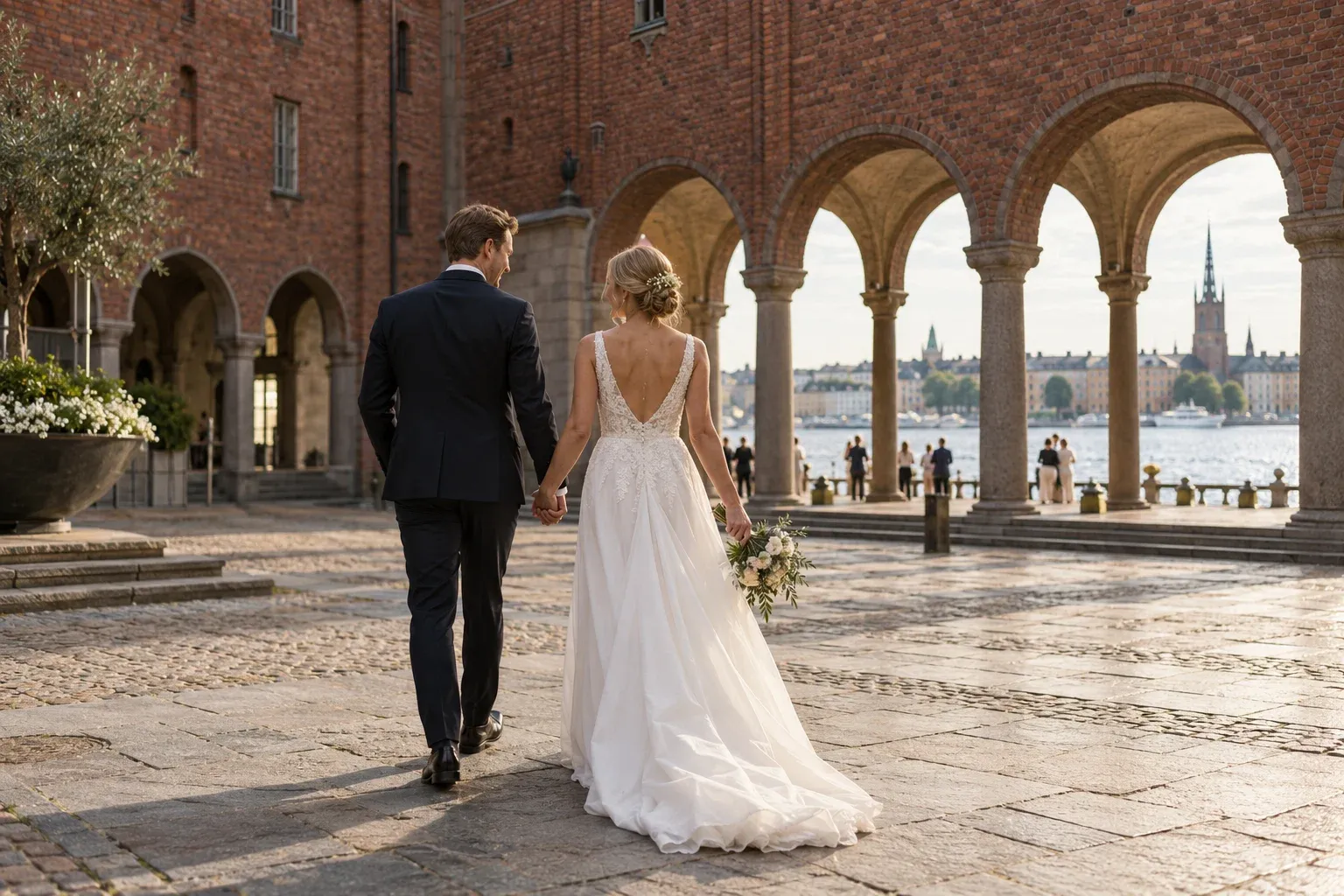
You don’t need to live in Sweden or hold Swedish citizenship to marry here. You do need one piece of paperwork that controls your whole timeline. Here is what the law requires, how to time it, and what you take home afterward.
When you need this
You live abroad and want to marry in Sweden, whether at Stockholm City Hall, in a country church, by a lake or in Lapland in winter. Or one of you is Swedish or lives here and the other doesn’t. You might be a same-sex couple from a country that won’t let you marry at home.
This guide is also for anyone deciding how early to start the paperwork, whether to book the date first, and whether the certificate will be accepted back home.
Who can marry in Sweden
Swedish marriage law covers anyone who marries before a Swedish officiant. It doesn’t matter where you live or what passports you hold. Marriage has been gender-neutral since 1 May 2009. The impediments are short and absolute:
| You cannot marry if… | Note |
|---|---|
| Either of you is under 18 | No exemptions |
| Either of you is already married or in a registered partnership | Earlier marriages must be shown to have ended |
| You are related in a direct line, are siblings, or one is the other’s uncle/aunt | Adoptive ties count as blood ties |
| You are first cousins | New from 1 July 2026 |
The 2026 change most guides miss: since 1 July 2026, first cousins can no longer marry in Sweden, and the county board permission route for close relatives was abolished. From 2 July 2026, a foreign first-cousin marriage is generally not recognized in Sweden either, unless Skatteverket had already registered it.
There is one extra rule for couples with no Swedish connection. If neither of you is a Swedish citizen or lives in Sweden, each of you must also prove you may marry under the law of a country where you are a citizen or resident, which you choose. If at least one of you is Swedish or lives here, only Swedish law is checked.
The hindersprövning, step by step
The hindersprövning (“examination of impediments”) is a check by Skatteverket, the Swedish Tax Agency, which also runs the population register. Every marriage in Sweden needs one first, and you must apply together. It is free.
- Check your eligibility against the table above.
- Choose the law for your capacity check if neither of you has a Swedish tie, and get a certificate from that country showing you may marry. Skatteverket calls this an äktenskapscertifikat.
- Gather documents. Each partner not registered in Sweden needs a passport or similar ID with date of birth, a civil-status certificate from their country of residence (preferably issued within the last four months), and a divorce decree or death certificate if previously married.
- Fill in form SKV 7880 (Hindersprövning, ansökan och försäkran). It includes a sworn statement that you are not related and whether you have been married before. Both sign it in original and send it by post or hand it in at a service office.
- Book the ceremony in parallel. See the options below.
- Receive the certificate of no impediment together with a vigselintyg, the form the officiant fills in at the wedding. Send both to your officiant or venue by their deadline.
- Marry, with witnesses and valid ID.
- Collect your proof of marriage from the officiant, who also reports the wedding to Skatteverket.
Dual citizens can ask for the check to be based on either country’s law. Skatteverket’s pages don’t state translation rules for foreign documents, so ask them if yours aren’t in Swedish or English.
Timing: the four-month window
This is where foreign couples come unstuck. When neither of you is a Swedish citizen or resident, Skatteverket says it takes about 8 weeks before your case is even assigned to an officer. Missing documents add more time. Then the certificate is valid for four months from issue and cannot be extended.
So you can be too late and too early. The working rule is to post a complete application roughly three to four months before the wedding. You can usually book the ceremony first: Stockholm City Hall explicitly lets you book before applying.
Add margin for international post on both legs. Swedish administration also slows in July, so leave extra time for a summer wedding.
Civil, church or private ceremony
Any authorized officiant can marry you. That means a civil officiant appointed by the county board (länsstyrelsen) and booked through the municipality, or a priest or official of a faith community authorized to marry.
| Option | How to book | Good to know |
|---|---|---|
| Civil, at the municipality | Contact the municipality where you want to marry | Each sets its own days, venues, fees and deadlines |
| Stockholm City Hall | E-service requiring Swedish BankID; email the wedding office otherwise | Saturdays in the Oval room; long waiting times; about five minutes; Swedish or English |
| Weekday City Hall ceremony | Bookable about a month ahead | No guests; staff act as witnesses |
| Private civil wedding | Email a municipal officiant, then register the booking | Your venue; in Stockholm register at least 14 days ahead; you pay officiant travel |
| Church of Sweden | Contact the parish | As a rule, one partner must be or become a member |
| Other faith communities | Contact the community | Their ceremony, Swedish law’s eligibility check |
The Church of Sweden marries same-sex and opposite-sex couples on equal terms. A wedding is almost always free for members, apart from special requests. The service can use another language, but the church says the formal declaration must be in Swedish. In 2025, 12,135 couples married in the church, 26.6% of all weddings. A religious officiant is never obliged to marry a couple.
Foreign embassies in Sweden can marry couples only if the Swedish government has authorized them to.
On the day: witnesses, ID and language
The law says a marriage is entered “in the presence of relatives or other witnesses”. It sets no number. Two is what officiants ask for in practice. At Stockholm City Hall the witnesses must be over 18 and understand the language of the ceremony, and staff can step in if you bring none.
Both of you must be there at the same time and each must say yes. Proxy and online weddings are impossible. Both of you must also show valid ID, a passport if you have no Swedish ID card. Stockholm checks that the names on your certificates match your passports.
You must both understand the ceremony. If one of you understands neither Swedish nor English, Stockholm books an interpreter free of charge, but you pay if you don’t turn up.
Same-sex couples
Same-sex couples marry under exactly the same rules, in civil ceremonies and in the Church of Sweden. The catch comes from the capacity test. If your home country bans same-sex marriage, you can’t get a certificate saying you may marry there. In that case you can both ask Skatteverket to apply Swedish law alone, which it can do for special reasons.
Whether your home country recognizes the marriage afterward is its decision, not Sweden’s. See LGBTQ+ travel in Sweden for wider rights.
Taking the marriage home
Sweden doesn’t issue the “international marriage certificate” some countries expect. The Swedish equivalent is a population-register extract, and only people registered in Sweden can get one. For a non-resident couple, the key document is the certificate the officiant must hand you straight after the ceremony. Keep the original safe.
If your home authority wants an apostille, a notarius publicus (notary public) adds it; county board websites list them. Skatteverket issues no apostilles. For countries outside the apostille system, contact Sweden’s Ministry for Foreign Affairs about legalisation. Then register the marriage at home under your country’s rules.
Mistakes to avoid
- Planning it like a Las Vegas wedding. There is no same-week licence. The eligibility check is the critical path.
- Calling two witnesses the law. It’s practice. Bring two adults who understand the ceremony anyway.
- Assuming any couple can marry in a Church of Sweden church. As a rule, one of you must be a member. Ask the parish early.
- Sending an old civil-status certificate. Skatteverket wants a recent one, preferably under four months old.
- Printing invitations before the certificate arrives. A late certificate means no wedding on the booked date.
Practical information
| Item | Detail |
|---|---|
| Who checks eligibility | Skatteverket (hindersprövning), joint application on form SKV 7880 |
| Fee for the check | Free |
| Wait before a case officer is assigned (no Swedish tie) | About 8 weeks (Skatteverket, checked 2026-10-06) |
| Certificate validity | 4 months, cannot be extended |
| Minimum age | 18, no exemptions |
| Witnesses | Statute: “relatives or other witnesses”; practice: two adults |
| Civil ceremony fees | Set by each municipality; check its wedding page |
| Church of Sweden wedding | Almost always free when one partner is a member |
| Apostille | From a notary public, not Skatteverket |
FAQ
Can foreigners get married in Sweden?
Yes. Neither partner needs to be Swedish or live in Sweden. You must first apply jointly to Skatteverket for a free eligibility check, the hindersprövning. If neither of you is a Swedish citizen or resident, each must also show you may marry under the law of a country where you are a citizen or resident. Then any authorized officiant can marry you.
How long does the hindersprövning take?
For a couple where neither partner is a Swedish citizen or resident, Skatteverket says it takes about 8 weeks before the case is assigned to an officer, then processing follows. The certificate is valid for four months and cannot be extended, so apply roughly three to four months before the wedding. Times change; check Skatteverket’s page.
What documents do we need to marry in Sweden?
Each partner not registered in Sweden needs a passport or similar ID showing date of birth, a civil-status certificate from their country of residence, preferably under four months old, and proof any previous marriage ended. Some need a certificate of capacity to marry from home. Both sign form SKV 7880 in original.
How many witnesses do you need to get married in Sweden?
The law only says the ceremony takes place in the presence of relatives or other witnesses; it sets no number. In practice officiants ask for two. At Stockholm City Hall the two witnesses must be over 18 and understand the language of the ceremony, and staff can step in if you bring none.
Can a same-sex foreign couple marry in Sweden?
Yes. Swedish marriage has been gender-neutral since 1 May 2009, in civil ceremonies and in the Church of Sweden. If your home country bans same-sex marriage, you cannot prove capacity under its law, but you can both ask Skatteverket to apply Swedish law alone. Whether your home country recognizes the marriage is up to it.
Can we get married in the Church of Sweden if we are not members?
As a rule, no: the church says at least one partner should be or become a member. Parishes can make exceptions, so ask the parish where you want to marry. Members’ weddings are almost always free. A civil ceremony, or a wedding in another faith community, is the alternative open to every couple.
Will our Swedish marriage be recognized at home?
Usually, but your home country decides. Sweden issues no “international marriage certificate”; keep the certificate the officiant gives you. If your authorities want an apostille, a Swedish notary public adds it; Skatteverket does not. Register the marriage with your own country afterward.
Related guides
- LGBTQ+ travel in Sweden — rights, recognition and protections for same-sex couples.
- Visa requirements for Sweden — the wedding trip is a visit; you and your guests follow normal entry rules.
- Stockholm City Hall — the City Hall where Stockholm holds its Saturday civil weddings.
- Church of Sweden — membership, and what to expect inside a Swedish church.
- Booking timeline for Sweden — when summer accommodation for your guests sells out.
Facts verified 2026-10-06. Sources: Sveriges riksdag (Äktenskapsbalken; Lag 1904:26 s.1), Skatteverket, City of Stockholm, Church of Sweden — full register in this topic’s source file. Found something outdated? Tell us and we’ll fix it.