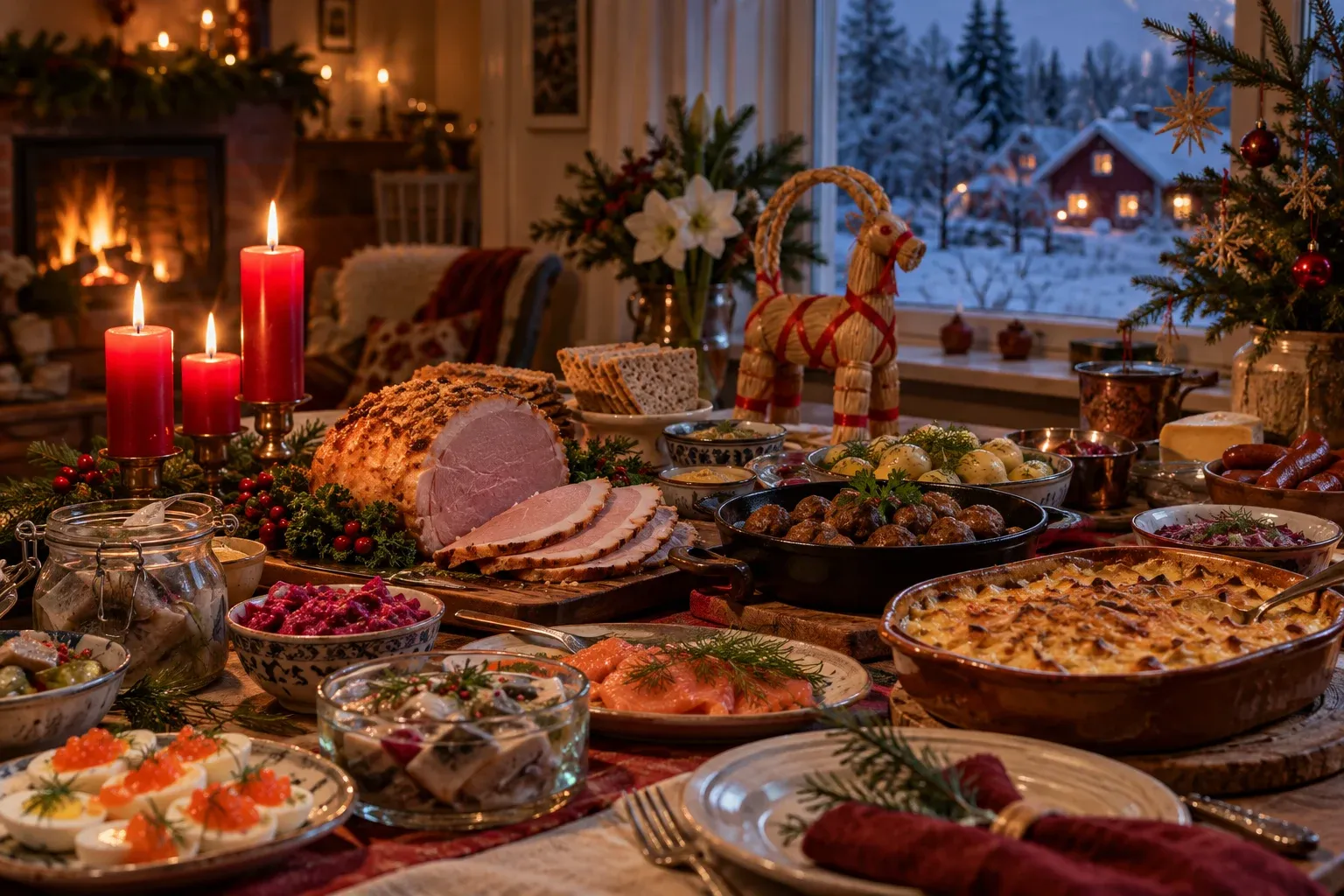
Swedish Christmas is on the 24th, Midsummer is a Friday and Easter dinner is on Saturday. Here is why the eve wins, how Swedish law quietly makes room for it, and which eves actually close the country.
When you need this
Your trip touches 24 December, the Midsummer Friday or 31 December. A Swedish friend has invited you “for Christmas” and you are not sure which day to turn up. Or you are reading a timetable, a parking sign or a shop door that says afton (eve) or dag före helgdag (day before a holiday) and wondering what it means for you.
It also matters if you are German or Dutch and expect 24 December to be an ordinary working day, or if you are working in Sweden and wonder whether Christmas Eve is yours by right.
Why the eve is the main day
The biggest days of the Swedish year are aftnar, eves: julafton (Christmas Eve), midsommarafton (Midsummer Eve), nyårsafton (New Year’s Eve), påskafton (Easter Eve). The red days that follow are quieter.
Three official sources explain why, and they agree:
| Source | What it says |
|---|---|
| Svenska kyrkan (Church of Sweden) | Every Sunday and holiday in the church year begins at 18:00 the evening before, and in Sweden this has led to celebrating many holiday eves, such as Midsummer Eve and Christmas Eve |
| Svenska Akademiens ordbok (SAOB) | The meaning “the day before a feast” comes from the vigils that used to begin on the afternoon before a holy day |
| Isof (state institute for language and folklore) | Christmas Eve’s weight is “a remnant of Catholic times”, when vigils were kept the evening before a feast; after the Reformation the vigil merged into the celebration |
You will often read that “the day used to begin at sunset”. That points the same way but is the less precise popular version; the official sources talk about the church day and its vigils.
Not every eve has the same story. Midsummer Eve was fixed on 23 June until 1952 and moved to the Friday in 1953 to fit the working week. Valborgsmässoafton (Walpurgis Night) falls on 30 April because Valborg’s name day is 1 May. And New Year’s Eve is an eve everywhere, because the year turns at midnight. The Swedish part is what the eve means legally and practically.
Not holidays, yet treated like Sundays
Here is the paradox. None of Sweden’s eves is a public holiday. The statutory list in Lag (1989:253) names every Sunday plus 13 days, and no afton is among them.
Yet two other statutes single out exactly three eves:
- Semesterlag 3 a § (Annual Leave Act): “Med söndag jämställs allmän helgdag samt midsommarafton, julafton och nyårsafton” — for annual leave, those three eves count as Sundays, so they never use up a leave day.
- Lag (1930:173) 2 §: a statutory deadline falling on midsommarafton, julafton or nyårsafton moves to the next working day, just as for a Sunday.
Neither law gives anyone the day off. That comes from collective agreements, which commonly grant paid leave (permission) on exactly those three eves. Most Swedes are free; shop staff, transport crews and care workers often are not.
Sweden’s other systems classify the same three days in their own way:
| System | How the big three eves are treated |
|---|---|
| Annual leave (Semesterlag) | As Sundays |
| Public transport | Saturday timetable; Christmas Eve loses its night traffic |
| Stockholm parking signs | Dag före helgdag, day before a holiday |
| Holiday law | Ordinary days — not on the list |
No system calls them holidays. Every system makes room for them. The holiday list itself has not changed since 2005; the Riksdag’s latest review, decided on 25 February 2026, rejected every motion, and none proposed adding an eve.
The two tiers of eves
For a visitor, Sweden’s eves fall into two groups:
| Tier | Eves | What happens |
|---|---|---|
| Big three | Midsommarafton (Friday 19–25 June), julafton (24 December), nyårsafton (31 December) | Shops run half days; Systembolaget closed (Midsummer, Christmas) or short (New Year’s Eve); Saturday timetables; most offices shut |
| Ordinary eves | Påskafton (Easter Saturday), valborgsmässoafton (30 April), allhelgonaafton (Friday before All Saints’), trettondagsafton (5 January) | Normal rules for the day of the week; the celebration happens in the evening |
The ordinary eves have no special legal status at all. Påskafton is the day most Swedes eat the Easter meal, but Systembolaget opens to its usual Saturday 15:00 close, and that is the only buying window of the Easter weekend. Valborg is a bonfire party on a working day, loudest in Uppsala and Lund; public transport runs a weekday service, with night traffic in at least one region. Allhelgonaafton and trettondagsafton are fully ordinary, and Systembolaget keeps normal hours on both.
What closes on the big three
Christmas Eve, not Christmas Day, is the Swedish Christmas. By the 25th the celebration is over and the country is shut, so if you are invited for Christmas, expect an afternoon-to-evening event on the 24th. Midsummer works the same way: the Friday is the party, the Saturday is the red day.
Systembolaget, the state alcohol shop and the only legal retailer of drinks above 3.5%, is the tightest constraint. It is closed on Christmas Eve and Midsummer Eve and closes at 15:00 on New Year’s Eve. Shopping centres close at lunchtime or early afternoon on all three eves, and rural Sweden stops harder than the city centres, where hotels, many restaurants and tourist attractions keep going.
Three habits avoid every problem:
- Buy alcohol at least a day before any big-three eve, and go in the morning.
- Read the Saturday timetable, not the weekday one.
- In Stockholm, check the parking sign’s rules for dag före helgdag.
German visitors get a useful contrast: in German law 24 and 31 December are normal working days. In Swedish law they are not holidays either, but the country behaves as though they were.
Practical information
| Eve | 2026–2027 date | Systembolaget | Public transport |
|---|---|---|---|
| Allhelgonaafton | Friday 30 October 2026 | Ordinary hours | Weekday timetable |
| Julafton | Thursday 24 December 2026; Friday 24 December 2027 | Closed (open until at least 19:00 on 22–23 December 2026) | Saturday timetable, no night traffic |
| Nyårsafton | Thursday 31 December 2026 | Open until 15:00 (until at least 19:00 on 29–30 December 2026) | Saturday timetable |
| Trettondagsafton | Tuesday 5 January 2027 | Ordinary hours | Weekday timetable |
| Påskafton | Saturday 27 March 2027 | Usual Saturday hours, to 15:00 | Saturday timetable |
| Valborgsmässoafton | Friday 30 April 2027 | Ordinary hours | Weekday, night traffic in some regions |
| Midsommarafton | Friday 25 June 2027 | Closed | Saturday timetable |
Systembolaget’s 2026–2027 hours are from its own holiday calendar; it notes that local deviations can occur. Transport rules are set per region, so check your county’s operator. Leave on the big three costs employees no annual-leave day.
FAQ
Why do Swedes celebrate Christmas on Christmas Eve?
Because the church day traditionally began the evening before. The Church of Sweden says every Sunday and holiday begins at 18:00 the previous evening, and Isof calls the importance of Christmas Eve a remnant of Catholic times, when vigils were held the night before a feast. After the Reformation the vigil merged into the celebration, so the 24th became the day.
Is Christmas Eve a public holiday in Sweden?
No. Christmas Eve is not on Sweden’s statutory list of public holidays; Christmas Day and Boxing Day are. Even so, the Annual Leave Act treats it as a Sunday, most collective agreements give the day off, Systembolaget is closed, shops run half days and public transport runs a Saturday timetable without night services.
Is Midsummer Eve a public holiday in Sweden?
No, Midsummer Day is — the Saturday falling 20–26 June. Midsummer Eve is the Friday before it and is the real celebration. Like Christmas Eve and New Year’s Eve, it counts as a Sunday under the Annual Leave Act, and collective agreements commonly give it off. Systembolaget is closed and most of the country stops.
Why is Midsummer Eve always on a Friday?
Because it was moved there in 1953. Until 1952 Midsummer Eve was fixed on 23 June; from 1953 it moved to the nearest Friday so that it would fit the working week more easily, according to Isof. The law now defines Midsummer Day as the Saturday falling 20–26 June, so the Eve is the Friday falling 19–25 June.
Which eves close shops and Systembolaget in Sweden?
Three: Midsummer Eve, Christmas Eve and New Year’s Eve. Systembolaget is closed on the first two and shuts at 15:00 on New Year’s Eve, and shopping centres run half days. Easter Saturday, Walpurgis Night, All Saints’ Eve and Epiphany Eve are ordinary days, with Systembolaget open its normal hours. Check the store, since local deviations occur.
Do Swedes get Christmas Eve off work?
Most do, but not by law. No statute gives anyone the three big eves off. The Annual Leave Act only says they count as Sundays, so leave taken across them uses no holiday days. The day off itself usually comes from a collective agreement, which commonly grants leave on Midsummer Eve, Christmas Eve and New Year’s Eve. Shops and services still need staff.
Is Walpurgis Night a holiday in Sweden?
No. Valborgsmässoafton, 30 April, is an ordinary working day; the public holiday is 1 May. The celebration falls on the eve because Valborg’s name day is 1 May. Public transport runs a weekday timetable, in some regions with extra night services, and the bonfires and student parties happen after work.
Related guides
- Swedish public holidays — the full calendar and what closes on each red day.
- Swedish Christmas traditions — what actually happens on 24 December.
- Midsummer in Sweden — the Friday celebration and where to join it.
- Systembolaget hours — the alcohol shop’s closures around every holiday.
- Kalle Anka on Christmas Eve — why the country stops at 15:00 on the 24th.
Facts verified 2026-10-06. Sources: Sveriges Riksdag, Isof, Svenska kyrkan, Svenska Akademien (SAOB), Systembolaget, Västtrafik, Stockholms stad, Unionen and Vision — full register in this topic’s source file. Found something outdated? Tell us and we’ll fix it.