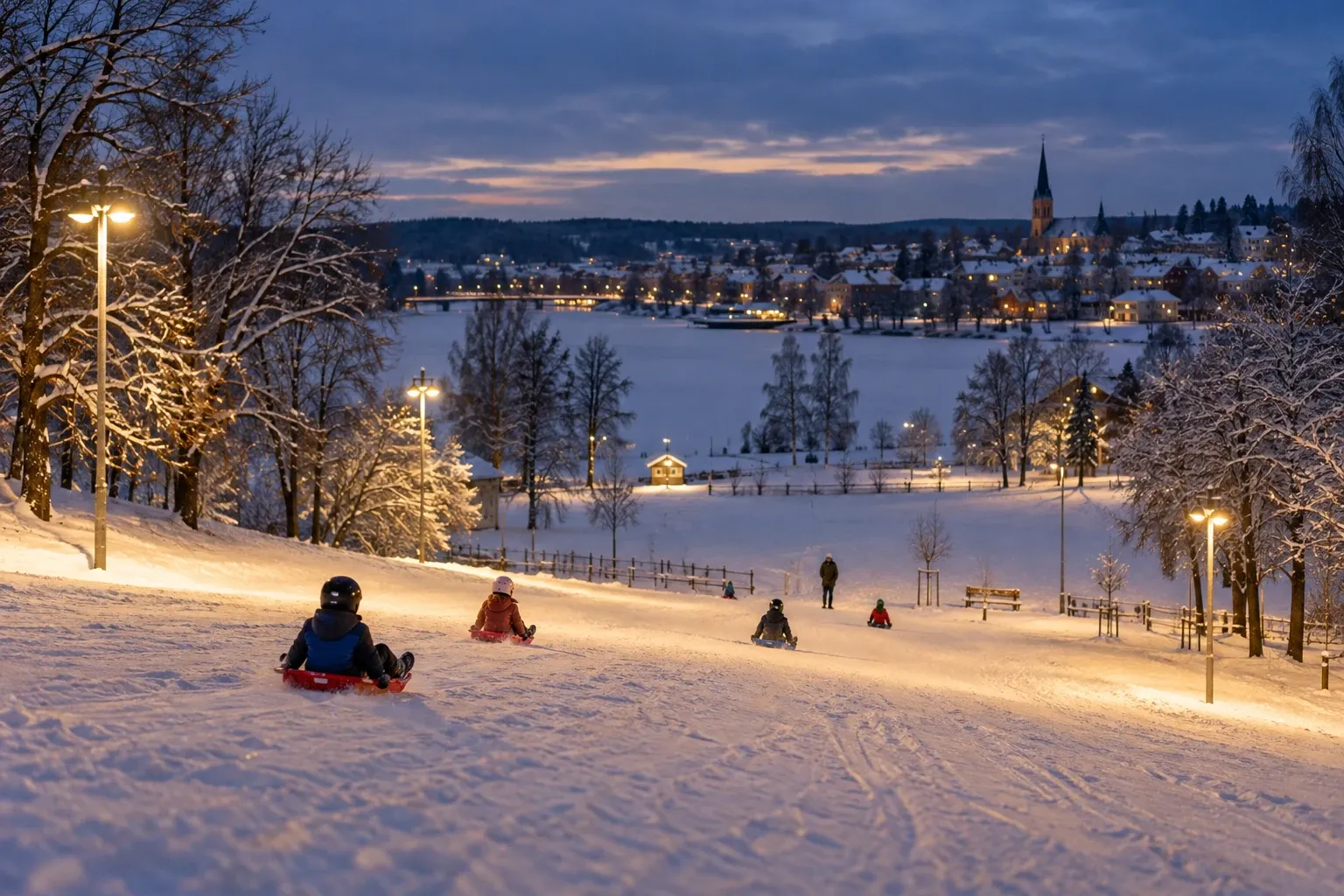
Swedish children spend their winters on a plastic sled on the nearest slope. Your children can too, at almost no cost, once you know where the hills are, what the helmet rule really is, and where the snow actually falls.
When you need this
You are planning a winter trip with children and wondering what they will do between meals. Or you have arrived, there is snow outside, and the children want to sled. This guide covers the free, everyday version of Swedish winter play: town sledding hills, kick-sleds and snow building. It does not cover lessons and lift passes; for those, see skiing in Sweden.
Will there be snow? Check before you book
The postcard image of a snowy Swedish winter only holds in parts of the country. SMHI, the Swedish weather service, says Götaland’s coastal areas average fewer than 50 snow-covered days a year. On Skåne’s south coast, snow cover usually forms only well into December, if at all. Northern Lapland and the mountains average more than 200.
| Where | Snow you can expect |
|---|---|
| Skåne and the Götaland coasts | Under 50 snow days a year; often none to sled on |
| South of central Värmland – southern Dalarna – central Gästrikland | Snow may come and go during the winter |
| Inland Norrland | A reliable winter season |
| Northern Lapland and the mountains | Snow cover more than 200 days a year |
The trend runs one way. SMHI’s climate indicator, updated in December 2025, shows the number of snow-cover days in Sweden falling since about 1990. Many travel pages still describe a snowy national winter. If sledding is the point of the trip, book inland or north.
Where to sled: the town hill and open land
Most Swedish towns maintain designated sledding hills, pulkabackar. Search the municipality’s website for pulkabacke and you will usually find a list. Some are floodlit into the evening; Haraberget in Herrljunga, for example, is lit until 21:00. Many have a gentler side slope for small children next to the steep one. Even Malmö, with its unreliable snow, keeps a hill with a flatter and a steeper side at Bulltofta.
Signs and municipal pages often say use is på egen risk, at your own risk. Neither municipal page we read mentioned any fee.
Outside designated hills, allemansrätten (the right of public access) applies. Naturvårdsverket, the Swedish Environmental Protection Agency, says you may move on snow almost everywhere, with a few limits:
- not over someone’s private plot or close to their home
- not over plantings, such as gardens and young forest plantations
- over frozen, snow-covered fields only when no crops can be harmed
- on foot, off the groomed cross-country ski tracks
Before the first run, walk the hill. Look for trees, rocks and fences, and check where the run ends. It must not end at a road, a car park or a lake. A child who cannot stop slides straight into traffic, or onto ice that may not hold. Teach children to walk up at the side, and to clear the bottom quickly after each run.
Helmets: what the law says and what doctors say
Here law and health advice part ways, and many pages blur them. Swedish traffic law (trafikförordningen) requires a helmet for cyclists under 15 and for riders of motorcycles, mopeds and open snowmobiles. It says nothing about sleds, and there is no helmet requirement for sledding.
1177, the national health information service, is unambiguous anyway: children need a helmet for sledding, as for skating, skiing, inline skating and skateboarding. A paediatric emergency doctor told TV4 in February 2026 why. Children’s heads are larger and heavier relative to their bodies, and a hard blow can shake the brain inside the skull. In the worst case, it causes a brain bleed.
The practical answer: the bike or ski helmet you already own goes on for the sled too. In an emergency, call 112. It is free and works without a SIM.
Sleds, kick-sleds and the traffic rules
A few rules in the traffic ordinance do bind:
| Situation | Rule |
|---|---|
| Kick-sled (sparkstötting) | The rider counts as a pedestrian; use the pavement or footpath |
| Sled, kick-sled, skis or skates on a road | May not be towed or pushed by a motor vehicle, except on farm tracks with little traffic |
| Trailer-sled behind a motor vehicle | May not carry people on a road |
The kick-sled is a northern classic for getting around snowy towns, and the pedestrian rule tells you where it belongs. Towing children behind a car on a snowy road is tempting and illegal. Off-road snowmobile rides belong with a guide; see snowmobile tours.
Ski resorts: keep sleds off the pistes
The slope rules that Swedish resorts apply, written by the ski-lift industry body SLAO, say plainly that sledging is not allowed on ski slopes. Skiers come fast from above, and the same rules tell everyone to walk up at the side and stop only where they are clearly visible. At a resort, sled on the town hill or well away from the pistes. Check the resort’s website for anything it offers.
Snow caves, ice and cold: three real risks
Plowed snow piles. The huge banks at car parks and school yards look like perfect cave material. They are not. Snow packed by a plow or tractor becomes almost as heavy as concrete, and a collapsing roof traps a child much as an avalanche would. In January 2026, a child was seriously injured when a snow cave collapsed at a school in Nordanstig. The alternative is easy: heap up your own small pile and hollow it out like an igloo, with an adult nearby and a shovel to hand.
Ice. A frozen lake at the bottom of a hill is the worst run-out there is. Issäkerhetsrådet, Sweden’s ice safety council, says children on ice must always have at least one adult with them. Read ice safety on frozen lakes before anyone steps onto it.
Cold. A child sitting on a sled in the wind cools faster than one who is walking. 1177 notes that small children’s hands and feet cool first. Feel the neck and forehead: if they are cold, it is time to go in. Dress in layers, as in layering for Swedish winter, and pack spare mittens. Midwinter afternoons are dark, so put reflectors on children walking home along roads.
Borrowing instead of buying
For a one-week trip, a sled is an awkward thing to buy and carry home. Fritidsbanken, a network of free sports-equipment libraries run mostly by municipalities, lends gear free for up to 14 days, with no age limit. Sleds have been among the items on its shelves, but stock varies by branch and goes quickly in a cold snap. Check the stock search or call first; our Fritidsbanken guide explains how borrowing works.
Practical information
| Item | Details (checked 2026-10-15) |
|---|---|
| Municipal sledding hill | No fee mentioned on the municipal pages read; at your own risk |
| Floodlit hills | Some, e.g. Haraberget, Herrljunga, lit until 21:00 |
| Fritidsbanken sled loan | Free, up to 14 days, if in stock |
| Sled, snowracer or helmet in a shop | Prices vary by type and shop |
| Helmet for sledding | Not required by law; 1177 says children need one |
| Sleds on ski pistes | Not allowed under resort slope rules |
| Sportlov (February school holiday) | Weeks 7–10 in 2027, varying by municipality |
| Snow-cover days, Götaland coasts | Under 50 a year on average |
| Snow-cover days, northern Lapland | Over 200 a year on average |
| Emergency | 112 |
FAQ
Do kids need a helmet for sledding in Sweden?
Not by law. Swedish traffic law requires helmets for cyclists under 15, but no rule covers sleds. Health advice is clear, though: 1177, the national health guide, says children need a helmet for sledding, skating and skiing. Children’s heads are large and heavy relative to their bodies, so a hard fall can cause a serious head injury. Bring the bike or ski helmet.
Where can we go sledding in Sweden?
Most towns have designated sledding hills, called pulkabackar, listed on the municipality’s website; some are floodlit into the evening. Outside them, the right of public access lets you sled on most open snowy land, as long as you stay off private gardens, the area close to homes, and plantings. Avoid any slope that ends at a road, car park or lake.
Can we sled on the ski slopes at a resort?
No. The slope rules Swedish resorts apply say plainly that sledging is not allowed on ski slopes. Skiers come fast from above, and the same rules tell everyone to walk up at the side and stop only where they are clearly visible. Use a municipal sledding hill instead, and check the resort’s own website for anything it offers off the pistes.
Is there reliable snow for sledding in southern Sweden?
Not reliably. SMHI says Götaland’s coastal areas average fewer than 50 days of snow cover a year, and on Skåne’s south coast snow usually arrives only well into December. South of a line through central Värmland, southern Dalarna and central Gästrikland, snow may not last all winter. Northern Lapland averages over 200 snowy days a year.
Can I borrow a sled instead of buying one?
Often, yes. Fritidsbanken, a network of free sports-equipment libraries run mostly by municipalities, lends gear for up to 14 days at no charge, with no age limit. Sleds have been among the items on its shelves, but stock varies by branch and goes fast in a cold snap, so check the stock search or call first.
Is it safe for kids to dig snow caves in snow piles?
Not in plowed piles. Snow packed by a plow or tractor becomes almost as heavy as concrete, and a collapsing roof can trap a child much like an avalanche; a child was seriously injured this way at a Swedish school in January 2026. A safer option is to heap up your own small pile and hollow it out, with an adult nearby and a shovel ready.
Can I tow a sled behind a car or snowmobile?
Not on a road. Swedish traffic law forbids anyone on a sled, kick-sled, skis or skates on a road from being towed by a motor vehicle, except on farm tracks with little traffic. A trailer-sled coupled to a motor vehicle may not carry people on any road. Off-road snowmobile rides are guided-tour territory; see our snowmobile guide.
Related guides
- Ice safety on frozen lakes — read before any child goes near lake ice.
- Cold injuries: frostbite and hypothermia — how to spot them in a child.
- Fritidsbanken: borrow sports gear free — sleds, skates and skis without buying.
- Sportlov and Swedish school holidays — which February week each region takes.
- Sweden with kids — the family rules beyond winter.
Facts verified 2026-10-15. Sources: 1177, Sveriges Riksdag (Trafikförordningen), Naturvårdsverket, SMHI, Issäkerhetsrådet, Malmö stad, Herrljunga kommun, resort slope rules — full register in this topic’s source file. Found something outdated? Tell us and we’ll fix it.