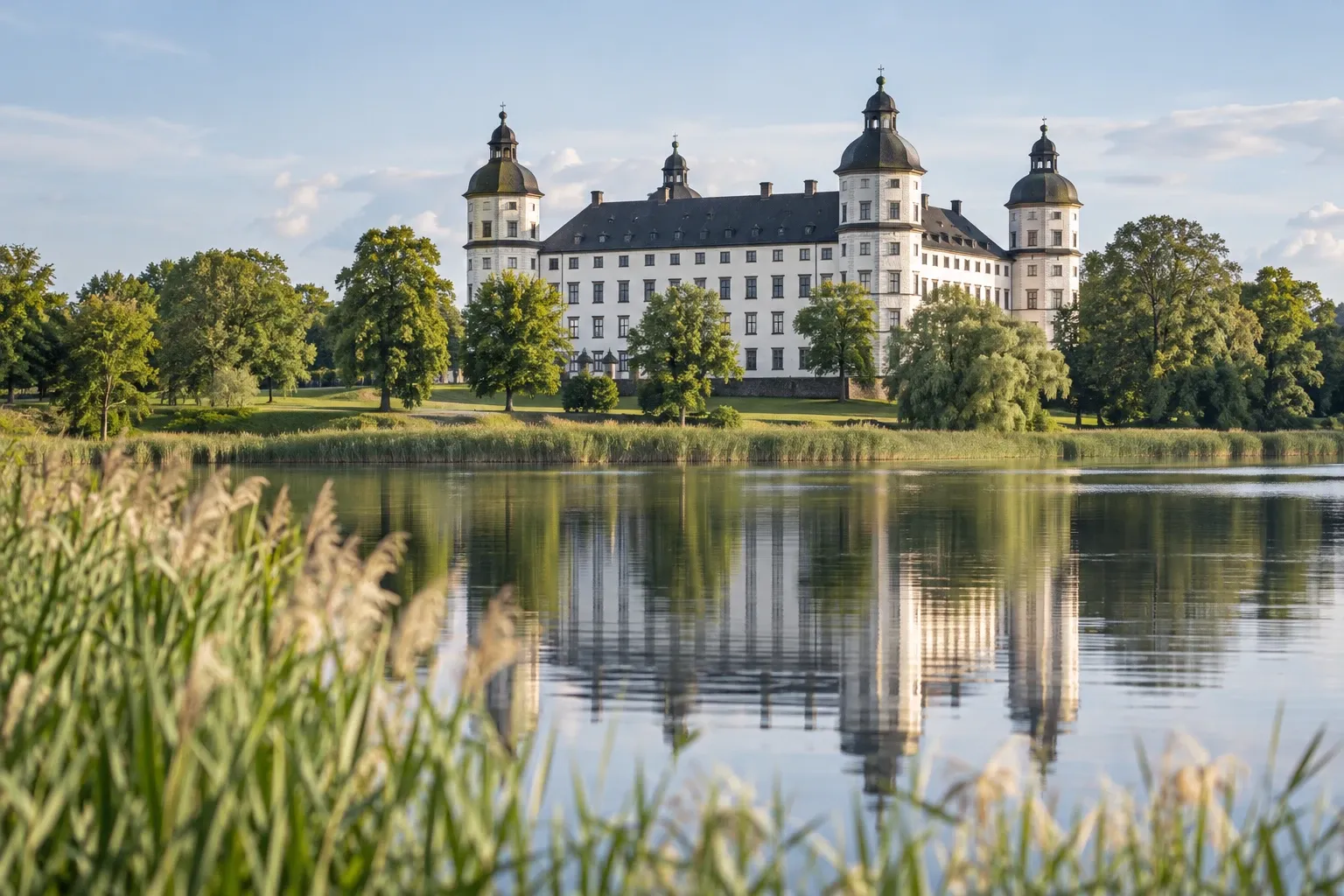
Skokloster is a 17th-century castle with its contents still in place, down to a banquet hall the builders never finished. It is also closed to walk-in visitors for most of the year, and reaching it without a car takes a train and a sparse bus.
When you need this
You’re planning a day out from Stockholm, Uppsala or Västerås and Skokloster is on your list. Or you have a date in mind outside summer and want to know if the doors will be open. You may be travelling without a car, with a wheelchair or a stroller, or you may just want to see Arcimboldo’s Vertumnus in the flesh.
When it is open: the season comes first
Skokloster is not a year-round museum, and this is the fact most travel listings leave out. From October until Easter, the castle opens only for digital lectures and pre-booked groups. The exceptions are the autumn half-term week and the Christmas market. When we checked in mid-October 2026, every day of the week was marked closed.
| Period | Drop-in opening | Hours |
|---|---|---|
| 24 October–1 November 2026 (autumn half-term) | Daily | 11:00–16:00 |
| 28–29 November 2026 | Christmas market (julmarknad) | 11:00–16:00 |
| Winter until Easter | Digital lectures and booked groups only | — |
| 26–29 March 2027 (Easter) | Daily | 11:00–16:00 |
| May 2027 | Weekends, plus 6–7 May (Ascension) | 11:00–16:00 |
| 1 June–31 August 2027 | Daily | 11:00–17:00 |
| September 2027 | Weekends | 11:00–16:00 |
Guided tours run daily from 1 June to 31 August, in Swedish and in English, and you buy tickets on site. During the 2026 autumn half-term there were 45-minute tours daily: in English at 12:45, in Swedish at 13:45 and 15:15. The half-term week also brings ghost tours (spökvisningar) for brave visitors aged 8 and up. These sell online first, and any unsold places go on sale in the shop.
Groups can book a private tour all year, by day or in the evening, for up to 15 people. That is the only way inside on an ordinary winter weekday.
National Day, 6 June, is a special case. Håbo municipality holds its traditional National Day celebration at Skokloster. In 2026 the King and Queen attended, the stage programme started at 10:20, and the county board told visitors to arrive early because of traffic. See our Swedish National Day guide for the rest of the day.
Getting there
Skokloster sits on the Skohalvön peninsula on Lake Mälaren, between Stockholm and Uppsala, in Håbo municipality. The address is Skoklostervägen 100.
By train and bus
| From | Route | Time |
|---|---|---|
| Stockholm Central | SL commuter train to Bålsta, then UL bus 311 towards Skokloster | About 1 h 15 min |
| Uppsala Central | UL bus 895 towards Bålsta to Yttergrans kyrka, then bus 311 | About 1 h 40 min |
| Västerås | SJ train to Bålsta, then bus 311 | About 1 h 15 min |
Two traps catch visitors here. First, tickets change at Bålsta. SL tickets are valid on the commuter train as far as Bålsta. Bus 311, though, is run by UL, Uppsala County’s public transport, and needs a UL ticket. UL is cashless: buy in the UL app or with a Visa or Mastercard on board. Our Stockholm public transport guide explains SL tickets.
Second, the weekend bus is thin. Line 311 is a loop through Skokloster, in both directions. In the autumn 2026 timetable it ran roughly hourly on weekdays. On Saturdays, Sundays and holidays there were only three morning trips one way, then a bus about every two hours the other way from early afternoon. Look up your return trip in UL’s timetable before you leave Bålsta. The timetable changes in mid-December.
By car
From Stockholm take the E18 towards Enköping and exit at Bro onto roads 269 and 263, then follow the signs: 66 km, about an hour. From Uppsala take road 255 towards Sigtuna and then road 263: 49 km, about 50 minutes. From Västerås or Enköping, leave the E18 at Bålsta.
Parking is free, by the church, 300 m from the castle along a firm gravel road. It has EV chargers and eight motorhome bays. Two disabled parking spaces are right beside the castle, on the lake side.
By boat
Excursion boats from Uppsala have sailed down the Fyris river and across Mälaren to the castle in summer. One operator lists its Skokloster trip as returning in July 2027, with a stop of 2 hours 45 minutes at the castle. If you arrive in your own boat, the summer jetty is free for up to 24 hours, space permitting.
What you see inside
Field marshal Carl Gustaf Wrangel, made rich by the Thirty Years’ War, began the castle in 1654 with his wife Anna Margareta von Haugwitz. It is a square with a tower at each corner, and the exterior was finished in 1668. When Wrangel died in 1676, much of the interior was still bare. The National Property Board, which owns the building, calls it the largest private building project in the country at the time.
What makes Skokloster unusual is the fideikommiss, an entailed estate passed down undivided. Wrangel’s daughter Juliana and her husband Nils Brahe made the castle one, so nothing movable could leave it. The Brahe family held it until 1930, then the von Essen family. The state bought the castle and its contents in 1967. Today the museum counts over 50,000 objects, about 1,000 paintings and close to 30,000 books.
Your ticket covers the ground-floor exhibition Drömmar om Skokloster (“Dreams of Skokloster”), the state apartments one floor up (paradvåningen) and any temporary exhibitions. A free audio guide opens on your phone by QR code. It covers both areas in Swedish, English, German, French, Italian, Finnish and Spanish, and has a family track. Bring headphones.
A guided tour adds the rooms you can’t otherwise reach:
- The Wrangel armoury (Wrangelska rustkammaren): six rooms on the third floor, with guns, swords, armour, bows, a Greenlandic kayak and a South American hammock.
- The Unfinished Hall (Ofullbordade salen): the great banquet hall, left uncompleted after Wrangel’s death.
The Vertumnus story, corrected
The castle’s most famous object is Vertumnus, Giuseppe Arcimboldo’s face composed of fruit, painted as a gift for Emperor Rudolf II. It hangs in the ground-floor exhibition, so you can see it without a tour.
You’ll often read that Wrangel brought it home as war booty. The castle’s own history tells it differently. Swedish troops did take it from Prague in 1648, but it next turns up in the estate of Per Brahe the Younger, at Bogesund. Magnus Brahe moved it to Skokloster only between 1828 and 1845. It became world-famous after a 1987 exhibition in Venice.
Stairs, cold and house rules
There is no lift. A ramp at the main entrance gives step-free access to the ground floor only, with the shop, the permanent exhibition and an accessible toilet (without a door opener). The castle has four floors, 32 steps apart, with a landing halfway. Steps are 15 cm high, and there is a handrail. A guided tour climbs 99 steps and comes down 100. Folding chairs can be borrowed. If you cannot manage the stairs, the museum offers an equivalent tour of the ground-floor exhibition. Our accessible Sweden guide covers wider planning.
Dress for the weather inside. Only the ground floor has lighting and central heating. The upper floors are dark, and in the colder months they are very cold; in summer they can be warm.
The house rules are short:
- No large bags or backpacks; free lockers are outside the visitor toilets.
- No umbrellas in the exhibitions.
- No food or drink inside the castle.
- Photos are welcome, but no tripods or selfie sticks.
- Only guide dogs and assistance dogs indoors.
- Strollers stay at the entrance by the ticket desk.
Free Wi-Fi is available; the login is printed on your receipt.
Around the castle
The park has lime avenues, some as old as the castle, and an orchard of about 150 apple trees, with its own variety, Grågylling från Skokloster. In autumn you may pick fallen apples. The lawns in front of the castle are for picnics and boules. In spring, flowers the nuns may have brought, such as snake’s-head fritillary and martagon lily, bloom there.
For children under 19, admission is free. Parkleken Paradiset, a free outdoor playground on 17th-century themes, is open all year. The shop sells a “castle safari” sheet for hunting animals hidden in the paintings and ceilings.
The medieval church next door dates from the 1200s and belonged to a Cistercian nunnery that stood here until the 1500s. From outside you can look down into the Wrangel burial chapel and see the family coffins. The ruin of Flasta church, the nuns’ first church, from the 1100s, is about a quarter of an hour’s walk away.
On foot, Upplandsleden, a 500 km hiking trail, crosses the peninsula through two nature reserves. A café sits close to the castle. The National Property Board is also turning the Stenhuset, a medieval stone house where the Wrangels lived before the castle, into a castle café during 2026.
Practical information
| Item | Detail (checked 2026-10-15) |
|---|---|
| Adult admission | 140 kr; pensioners and students pay the same |
| Under 19 | Free, including tours with a paying adult |
| Companion of a disabled visitor | Free |
| Guided castle tour | 190 kr including admission |
| Ghost tour, autumn half-term 2026 | 190 kr including admission; +10 kr service fee online |
| Annual pass, all Statens historiska museer museums | 450 kr; guided tour +50 kr |
| Accepted city passes | Admission only; guided tour +50 kr |
| Audio guide, playground, parking, summer jetty | Free |
| Private group tour (max 15) | 1,200 kr per group + 140 kr per person; 2,200 kr per group from 17:00 and at weekends |
| Train and bus fares | In the SL and UL apps |
| Address | Skoklostervägen 100, 746 96 Skokloster |
FAQ
Is Skokloster Castle open in winter?
Not for drop-in visitors, apart from a few dates. From after the autumn half-term until Easter the castle opens only for digital lectures and pre-booked groups. In 2026 it opens daily 24 October to 1 November and for the Christmas market on 28–29 November. The 2027 season starts at Easter, 26 March, and runs daily from 1 June to 31 August.
How do I get to Skokloster Castle from Stockholm without a car?
Take the SL commuter train from Stockholm Central to Bålsta, then UL bus 311 towards Skokloster; the trip takes about an hour and a quarter. Your SL ticket covers the train to Bålsta, but the bus needs a UL ticket, bought in the UL app or by card on board. Weekend buses run roughly every two hours, so check the return times first.
Is Skokloster Castle free for children?
Yes. Children and young people under 19 get free admission, and on a guided tour they also go free with a paying adult. A companion of a disabled visitor enters free too. The audio guide, the outdoor playground and the castle park cost nothing for anyone. Adults pay an admission fee, with a higher price if a guided tour is included.
Are there guided tours of Skokloster Castle in English?
Yes, when the castle is open. Public castle tours run daily from 1 June to 31 August, in Swedish and English, with tickets bought on site. During the 2026 autumn half-term an English tour ran daily at 12:45. Outside the season, groups can book a private tour all year. The free audio guide also covers English.
Is Skokloster Castle wheelchair accessible?
Only the ground floor. A ramp at the main entrance leads to the shop and the permanent exhibition, and there is an accessible toilet, without a door opener. There is no lift: the three upper floors are reached by stairs, 32 steps per floor. Visitors who cannot climb are offered an equivalent tour of the ground-floor exhibition. Two disabled parking spaces are beside the castle.
Can I see Arcimboldo’s Vertumnus at Skokloster?
Yes. The castle owns Giuseppe Arcimboldo’s Vertumnus, the face composed of fruit that he painted for Emperor Rudolf II, and shows it in the ground-floor exhibition Dreams of Skokloster. Swedish troops took it from Prague in 1648, but it reached Skokloster only between 1828 and 1845, when Magnus Brahe moved it there. It became world-famous after a 1987 exhibition in Venice.
Related guides
- Day trips from Stockholm — other half-day and full-day escapes to weigh against Skokloster.
- Sigtuna, Sweden’s first town — the medieval town on the same stretch of Mälaren.
- Uppsala travel guide — the other base for a Skokloster trip, by bus or by summer boat.
- Mariefred and Gripsholm Castle — the other great Mälaren castle, reached by steamboat and rail.
- Drottningholm Palace — a royal Baroque palace to compare with Skokloster.
Facts verified 2026-10-15. Sources: Skoklosters slott (Statens historiska museer), Statens fastighetsverk, UL, SL, Länsstyrelsen Uppsala län — full register in this topic’s source file. Found something outdated? Tell us and we’ll fix it.