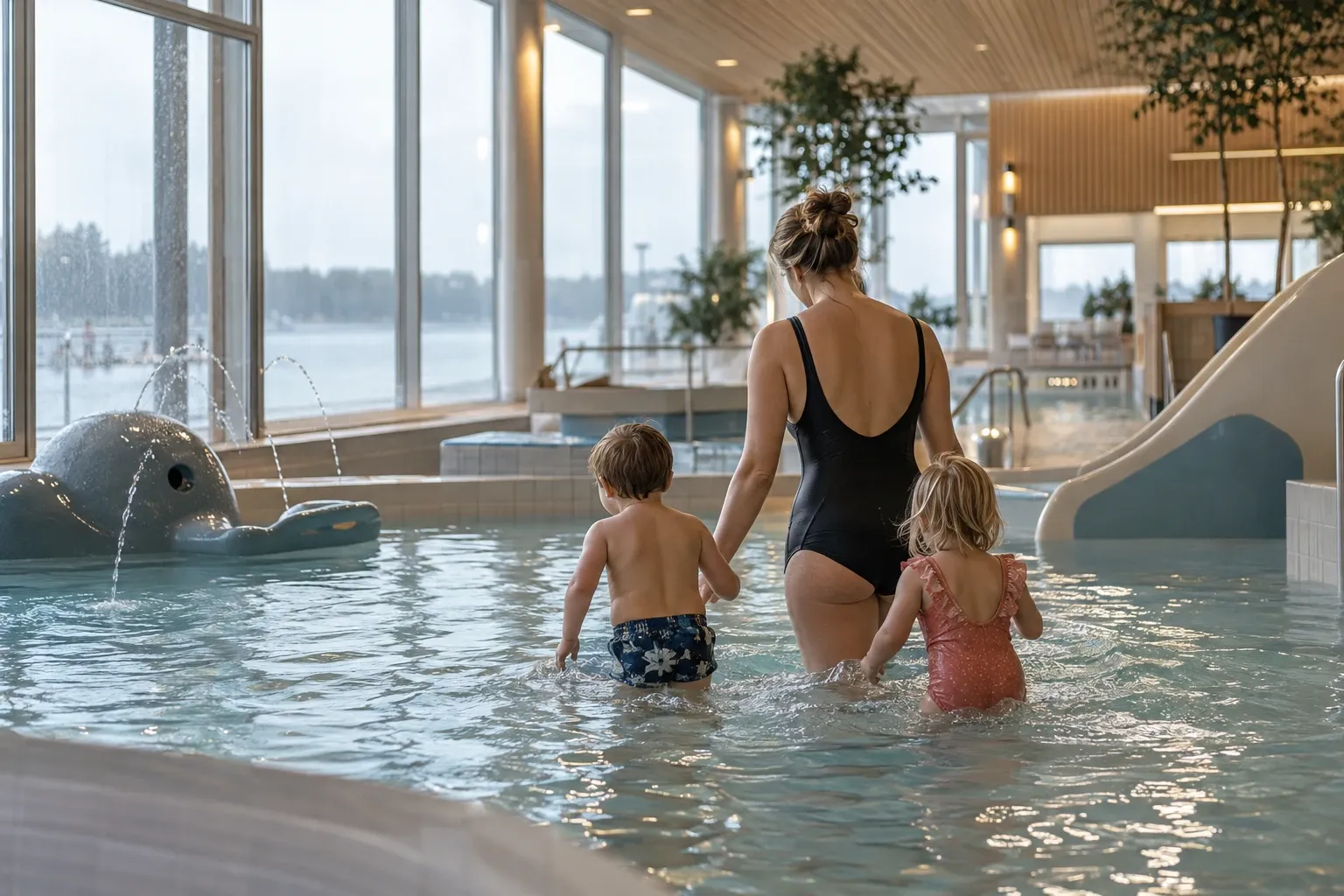
Rain on a family trip in Sweden is normal, and the country is well set up for it. Most of what works is public and cheap or free. The rules that catch visitors are about supervision, not money.
When you need this
The forecast shows rain all day, and you’re in a cabin, a small town or a city with children. Maybe it’s a school-holiday week and everyone else had the same idea. Maybe you just want to know whether your eight-year-old can go into the pool while you sit in the café. (They can’t.)
Summer is the wettest season at most Swedish weather stations, so wet days fall right in the family travel season. The west coast gets the most: Gothenburg averages about 912 mm of rain a year against about 546 mm in Stockholm.
Your six indoor options
| Option | Typical cost | Best ages | Adult must stay? |
|---|---|---|---|
| Swimming hall / leisure pool | Entry fee set by the municipality | All; under-12s with an adult | Yes, under 12 |
| Public library, children’s section | Free by law | 0–12 | Yes |
| State museum | Free under 19; adults pay | 4+ | Yes |
| Science centre | Entry fee set by each centre | 4–14 | Yes |
| Indoor play centre (lekland) | Paid per child | About 1–12 | Yes, you’re responsible |
| Open preschool (öppen förskola) | Free | 0–5 or 0–6 | Yes, you’re responsible |
Start with the free rows. Then choose by age: the under-sixes do best in an open preschool, a library children’s room or a play centre. Children from about four to fourteen get the most from a science centre, museum or leisure pool. With mixed ages, the swimming hall works for everyone.
Swimming halls and leisure pools
Almost every Swedish town has a simhall or badhus (indoor swimming hall), usually run by the municipality. Larger ones are äventyrsbad, leisure pools with slides. Each sets its own house rules, but on the point that matters for families they agree.
Children under 12 swim with an adult. Konsumentverket, the Swedish Consumer Agency, says an adult must be with children under 12 or children who cannot swim, and that most pools have this rule. Stockholm requires the adult to be at least 18 and able to swim. Many pools define “able to swim” as falling into deep water and swimming 200 metres, 50 of them on your back. Gothenburg lets children who can swim come alone from the year they turn 12. Uppsala’s Fyrishov allows at most three children under 12 per adult.
Lifeguards don’t replace you. Konsumentverket is blunt: don’t leave your child at the pool, and don’t trust anyone else to keep watch. Drowning happens quickly and silently, even in shallow children’s pools. Armbands are not life jackets, so a child wearing them still needs your eyes on them. On slides, wait for the green light and follow the rules on how many may ride at once.
What to bring and do:
- Swimwear made for swimming, not underwear or gym shorts.
- A swim nappy (badblöja) for small children; Folkhälsomyndigheten, the Public Health Agency, advises pools to ask for one.
- A padlock or a 10-kronor coin for the locker, depending on the pool.
- A payment card: some pools are cashless.
- Shower without swimwear first, with soap, then put your swimwear on.
Look on the pool’s own page that morning for hours and partial closures. Two things help with small children. One is a varmbassäng (warm pool) or barnbassäng (children’s pool), because toddlers tire quickly in a cold 25-metre pool. The other is a family changing room. Lund’s Högevall, for example, stops children going into the other sex’s changing room from age 7, and family rooms like those at Malmö’s Hylliebadet avoid the problem. Children under 4 swim free at Stockholm’s municipal pools with a paying adult; other towns set their own child prices. Our guide to Swedish swimming pools covers the changing-room routine in full.
Libraries and open preschools
Public libraries are free and open to everyone by law. Every municipality must have one, and borrowing costs nothing. You don’t need a library card to sit down, read and use the toilets. Most have a children’s section (barnavdelning), which makes the library the zero-cost reset on a long wet day. Some children’s rooms limit who comes in: Stockholm’s Rum för barn at Kulturhuset is for children 0–9 and their adults, and someone in the group must be under 10. See our guide to public libraries.
For the youngest, Sweden has an option few visitors know about. The öppen förskola (open preschool) is a free drop-in play room for small children with an adult, run by municipalities and by Church of Sweden parishes. Malmö’s are for children 0–6. Visits are free, you don’t register in advance, and you can visit any open preschool you like. A typical parish one is for 0–5-year-olds and serves a fika for 20 kr a person.
There are two catches. You are responsible for your child the whole time. Hours are short, often mornings on certain weekdays, and some close over Christmas, summer and school holidays. Check the day’s hours before you go.
Museums and science centres
Children and young people under 19 enter Sweden’s state museums free, to all exhibitions. This is law, not a promotion: it is written into each museum’s government instruction. Nationalmuseum’s instruction restates it in a version in force from 1 August 2026. Adults have paid since free adult entry was abolished in the 2023 state budget. So a family of four with two children pays only the two adult tickets. Municipal and private museums set their own prices.
Some museums close on Mondays, so check the weekday first. In school-holiday weeks some extend their hours: Malmö Museum, normally closed on Mondays, opens on Mondays in the February, Easter, autumn and Christmas breaks. Skansen opens 10:00–16:00 daily over the 2026 autumn break.
Science centres are Sweden’s underrated rainy-day asset. The national association has 20 members, and about 80% of their two million yearly visitors come in their free time, not with school. They are spread well beyond the big three cities:
| Region | Science centres |
|---|---|
| North | Teknikens Hus (Luleå), Exploratoriet (Skellefteå), Curiosum (Umeå), Technichus (Härnösand) |
| Central | Science center 2047 (Borlänge), Tekniska museet and Tom Tits Experiment (Stockholm area), Visualiseringscenter C (Norrköping), Fenomenmagasinet (Linköping) |
| West | Universeum (Gothenburg), Navet (Borås), Innovatum (Trollhättan), Molekylverkstan (Stenungsund), Balthazar (Skövde), Dalénium (Stenstorp) |
| South and islands | Upptech (Jönköping), Kreativum (Karlshamn), Vattenhallen (Lund), Science Center Malmö Museer, Fenomenalen (Visby) |
Each sets its own entry fee, so check its page. For Stockholm’s museums day by day, see our rainy day in Stockholm plan; for Gothenburg, Gothenburg’s museums.
Indoor play centres
A lekland is a commercial indoor play centre: climbing frames, slides, ball pits and a toddler zone, usually in a retail park. You pay per child; at the largest chain’s centres adults always enter free. Socks are compulsory there, for adults too, and children may not be left alone in the park.
The legal picture is clear. The operator is primarily responsible for safety under the Product Safety Act. Konsumentverket tells operators to make sure accompanying adults understand that they are responsible for their child during the visit. In practice that means you stay.
The safety record is the honest caveat. In 2019, Konsumentverket followed up 16 of the roughly 100 play centres in Sweden. It found serious safety deficiencies at every one it examined. The problems included openings where a child’s body fits through but the head does not, and falls from too great a height onto hard surfaces. That is the most recent published review we found, so treat it as dated, but look at the equipment your child uses, especially in the toddler zone.
A trampoline park is something else. Konsumentverket says it is not a play centre and needs different supervision. In foam pits and on air bags, land on your bottom or back, never feet or head first, or you risk serious injury.
The holiday-week trap
What breaks a rainy day is often the calendar, not the weather. In a school-holiday week (lov), every family in town heads for the same pool and play centre at once.
| Break | When | What to expect |
|---|---|---|
| Höstlov (autumn break) | Week 44; 26–30 October in 2026 in the big cities | Busy pools, museum holiday hours |
| Sportlov (winter sports break) | Weeks 7–10 by town; 15 February – 14 March 2027 | Busy indoor venues, one region at a time |
| Christmas and summer | Late December; the summer break | Some open preschools closed |
Arrive at opening time; the quiet hour is the first one. Or swap the play centre for a library or a science centre.
Then go out anyway, at least between stops. Swedish children play outside in the rain, dressed in layers, rain trousers and rubber boots, and 1177, the national health guide, suggests a sydväst (sou’wester) in rain. A short walk between a morning swim and an afternoon at the library resets everyone. Our guide to outdoor play in all weather explains why Swedes take this so seriously.
Practical information
| Item | Cost or rule |
|---|---|
| State museum, under 19 | Free by law, all exhibitions |
| State museum, adult | Paid since 2023; set by each museum |
| Public library | Free by law |
| Municipal pool | Set by each municipality; adult, child and family tickets |
| Pool, under 4 (Stockholm) | Free with a paying adult |
| Indoor play centre | Paid per child, varies by operator |
| Science centre | Set by each centre |
| Open preschool | Free; a parish fika 20 kr per person (October 2026) |
| Swimming alone | From 12, if able to swim (pool rules) |
FAQ
What can you do with kids in Sweden when it rains?
Go to a municipal swimming hall or leisure pool, a public library’s children’s section, a state museum or a science centre. Under-19s enter state museums free, libraries cost nothing, and Sweden has 20 science centres built for hands-on play. With under-sixes, an open preschool is a free drop-in play room. Paid indoor play centres are the commercial option.
Can my child go into a Swedish swimming pool without me?
Not under 12, at most pools. Konsumentverket says an adult must be with children under 12 or children who cannot swim, and Stockholm requires that adult to be 18 or older and able to swim. In Gothenburg, children who can swim may come alone from the year they turn 12. Lifeguards do not replace your supervision.
Are Swedish museums free for children?
State museums are: their government instructions require free entry to all exhibitions for children and young people under 19. Adults have paid since free adult entry was abolished in 2023. Municipal and private museums set their own prices, so check the museum’s page before you go.
What is a lekland in Sweden?
A lekland is a commercial indoor play centre with climbing frames, slides and ball pits, usually charging per child. Parents stay and are responsible for their child, and socks are often compulsory for everyone. The operator is responsible for safe equipment under the Product Safety Act, but a 2019 official review found serious deficiencies at all 16 centres examined.
Is there anything free for toddlers on a rainy day in Sweden?
Yes. The öppen förskola, an open preschool, is a free drop-in play room for children up to five or six with an adult, run by municipalities and Church of Sweden parishes. No registration is needed in Malmö. Library children’s rooms are free too. Hours are short and some close in school holidays, so check first.
What should I bring to a Swedish swimming hall with kids?
Swimwear made for swimming, not underwear; a swim nappy for small children; a towel; a padlock or a 10-kronor coin for the locker; and a payment card, since some pools are cashless. Everyone showers without swimwear first. Look for a family changing room if a parent has a child of the other sex.
Related guides
- Swimming pools in Sweden — the shower, swimwear and changing-room rules in full.
- Rainy day in Stockholm — which museums open on which weekday, and a one-ticket day plan.
- Sweden with kids — child fares, car seats and the few rules families must follow.
- Swedish school holidays — which weeks are busy where, so you can plan around them.
- Water safety in Sweden — life jackets and supervision at lakes and the sea.
Facts verified 2026-10-15. Sources: Sveriges riksdag and Svensk författningssamling (SFS 2026:1467, Bibliotekslag 2013:801), Konsumentverket, Folkhälsomyndigheten, 1177 Vårdguiden, SMHI, Stockholm, Gothenburg, Malmö, Lund and Uppsala municipal pools, Föreningen Svenska Science Centers, Sveriges Radio — full register in this topic’s source file. Found something outdated? Tell us and we’ll fix it.