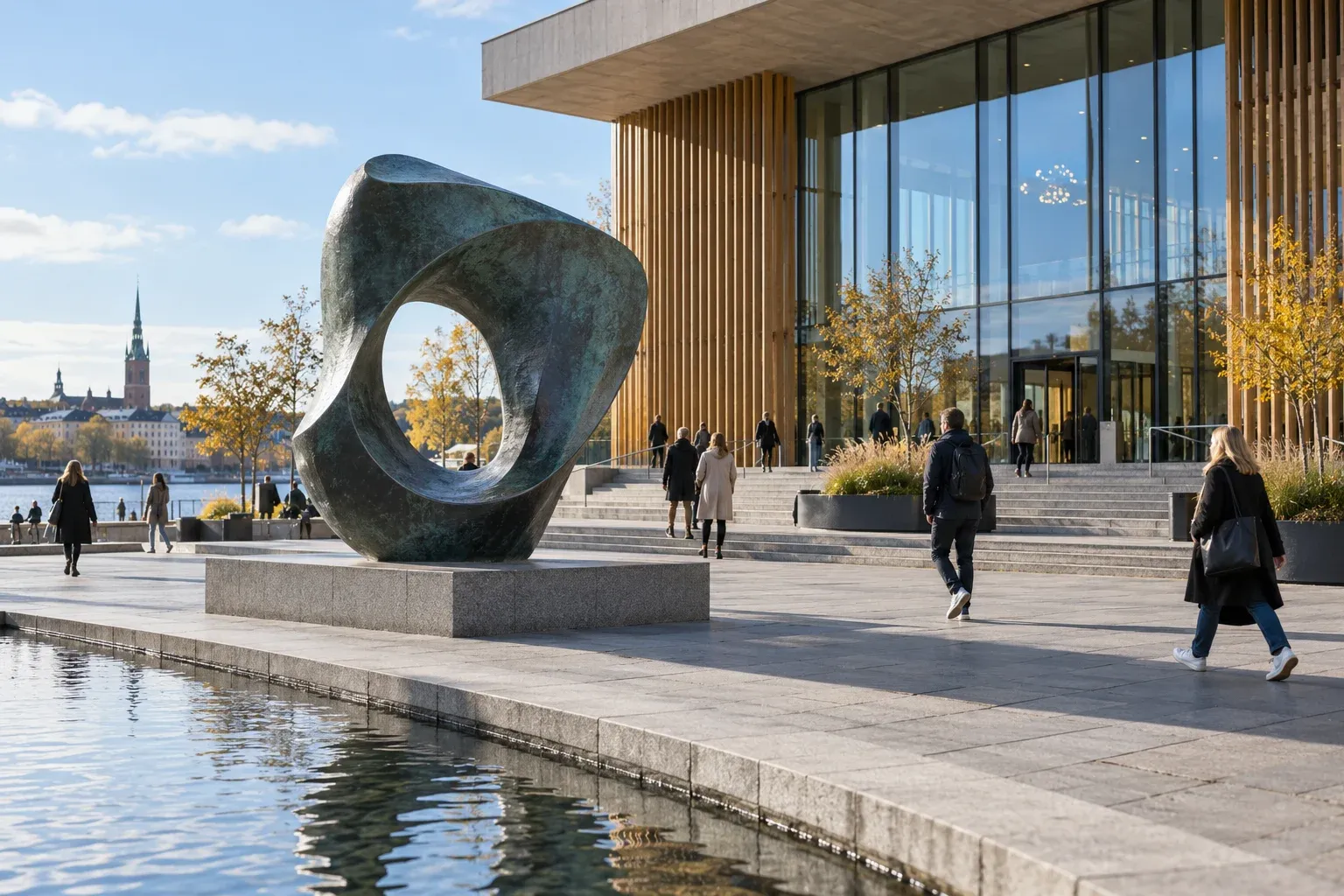
That sculpture outside a Swedish school or the mosaic in a station is rarely an accident. Here is how the one-percent rule really works, what changed in 2026, and how to find the art yourself.
When you need this
You have noticed that Swedish hospitals, schools, care homes and stations carry real artworks, and you wonder who paid for them. Maybe you want a free art walk in Stockholm, Göteborg, Malmö, Lund or Umeå. Or you have read that “Swedish law requires 1% for art” and want to know if that holds up — or you are an artist, architect or planner moving to Sweden and will meet the rule at work.
What the one-percent rule is
The enprocentsregeln (“the one-percent rule”) is a funding principle. When a public body builds, rebuilds or extends, about one percent of the budget goes to konstnärlig gestaltning — artwork designed for that specific place. Statens konstråd, the state’s public-art body, calls it an economic principle and stresses that there has never been one single model.
The idea came from Axel Romdahl, director of Göteborg’s art museum, who argued in a 1933 newspaper article that a democratic state should take over the patron role once held by princes and the church. A government inquiry followed, and in 1937 the Riksdag adopted Proposition 1937:157. That decision set the financing principle and created Statens konstråd (Public Art Agency Sweden).
| Year | What happened |
|---|---|
| 1933 | Axel Romdahl proposes setting aside a share of public building costs for art |
| 1937 | The Riksdag adopts the principle and creates Statens konstråd |
| 1947 | The state stops calculating with one percent; Statens konstråd gets a fixed annual budget instead |
| 1957 | Gotland becomes the first municipality to adopt the rule |
| 1963 | The City of Stockholm adopts it |
| 2018 | National policy for designed living environments names the rule a “direction-setter” for state builders |
| 2026 | Statens konstråd becomes part of Moderna Museet (1 January) |
It is a principle, not a law
This is the part most summaries get wrong. No statute requires anyone to spend one percent on art. And the state itself only used the percentage as a calculation rule for ten years, from 1937 to 1947. Since then Statens konstråd has worked from an annual appropriation, and state builders apply to it for art projects it funds in whole or in part.
The 2018 national policy Politik för gestaltad livsmiljö (“policy for designed living environments”) wrote the rule back in as a riktningsgivare — a direction-setter — for state agencies. It points the way; it does not oblige. So “since 1937 every Swedish public building gets 1% for art” is a nice line, but it is not what the sources say.
Who actually applies it
Today the rule lives mainly in municipalities and regions, each by its own council decision. Statens konstråd reports that 41% of Sweden’s 290 municipalities and 55% of its 21 regions apply it. Those figures rest on the most recent national surveys, so treat them as an order of magnitude rather than this year’s count.
“One percent” also means different things in different places:
| Variation | How it works |
|---|---|
| Basis of calculation | About 30% of municipalities and regions calculate on the project’s investment budget, 38% on the building budget only, some on the whole investment budget |
| Size | Some use half a percent or less; others spend more than one percent |
| Private developers | Vara requires builders buying council land to spend at least 1% of the land price on art; Årjäng applies the rule to private firms building for the municipality |
The three big cities show the range:
- Stockholm sets aside one percent for artistic design in all new building, rebuilding and extension the city carries out itself. Stockholm konst runs the commissions and looks after about 430 works on streets, squares and in parks.
- Göteborg applies one percent of building cost on city investments, under a 2013 council decision. In 2026 Moderate councillors filed a motion to abolish it; the culture administration advised against it in March 2026. Check the current position before quoting it.
- Malmö pools the money: one percent of the average of the last three years’ building investments forms an annual art budget, steered to neighbourhoods that lack public art.
Statens konstråd names Gävle, Göteborg, Linköping, Stockholm, Uddevalla, Uppsala and Örebro as the largest municipal commissioners, and Akademiska Hus and Trafikverket as the main state ones — which is why universities and stations so often carry commissioned art.
Statens konstråd in 2026: now part of Moderna Museet
Since 1 January 2026, Statens konstråd is no longer a separate government agency. A government ordinance moved its tasks — and those of ArkDes, the architecture and design centre — into Moderna Museet, and repealed the old instructions. Statens konstråd now works as a department inside the museum and keeps its English site as Public Art Agency Sweden.
It brought its collection with it: about 100,000 works built up since 1937, more than 80% of them placed in state agencies. Moderna Museet now supervises art that belongs to the state and hangs in state agencies. Older directories and guides still list Statens konstråd as an independent agency — they are out of date.
How to find public art
Outdoor public art costs nothing to see. The useful tools are all official:
| Where | Tool | What you get |
|---|---|---|
| Nationwide | Statens konstråd’s collection search | Look up state-commissioned works by town, artist or building |
| Lund, Stockholm, Umeå and more | Statens konstråd audioguide app (iOS, Android) | Artists and curators talking about about 50 permanent works, with art walks in three cities |
| Göteborg | Konstkartan (the art map) | A map of the city’s outdoor public art |
| Malmö | “Upptäck den offentliga konsten i Malmö” | The city’s guided selection of permanent works |
| Stockholm | Stockholm konst’s list of art in public places | From Ladislav Vlna’s Raoul Wallenberg monument to new works along Årstastråket |
| Lund | Skissernas museum | What it calls the world’s largest collection of sketches for public art |
In Stockholm, the metro is a public-art route of its own — art at 94 of 100 stations, seen on an ordinary SL ticket. Our Stockholm subway art guide has the route.
In the dark months, roughly November to February, plan an outdoor art walk around midday. In much of the country snow can cover ground-level works and plinth texts in winter.
Can you photograph it?
Yes. Swedish copyright law lets anyone depict — photograph, draw or paint — artworks permanently placed outdoors at a public place, and buildings may be depicted freely.
Publishing is a separate question. In 2016 the Supreme Court ruled, in a case brought by an artists’ rights organisation against Wikimedia Sverige, that this exception does not cover making photos of public art available to the public in an internet database — whether or not money is involved. For commercial or large-scale online use, check with the artist’s rights organisation first.
Practical information
| Item | Detail |
|---|---|
| Seeing outdoor public art | Free — on streets, squares and in parks |
| Statens konstråd collection search | Free online |
| Statens konstråd audioguide app | iOS and Android; no fee shown on the agency’s page (checked 2026-10-06) |
| Stockholm metro art | The price of an SL ticket — see the subway art guide |
| Body for state public art | Statens konstråd, part of Moderna Museet since 1 January 2026 |
| Share applying the rule | 41% of municipalities, 55% of regions (Statens konstråd) |
FAQ
What is the one-percent rule in Sweden?
It is a funding principle for public art: when a public body builds, rebuilds or extends, about one percent of the budget is set aside for artwork designed for that place. It began with a Riksdag decision in 1937. Today it is mostly applied by municipalities and regions, each in its own way, which is why Swedish schools, stations and parks so often contain commissioned art.
Is the one-percent rule a law in Sweden?
No. No statute requires anyone to spend one percent on art. The Riksdag adopted it as a financing principle in 1937, the state stopped calculating with it in 1947, and national policy since 2018 calls it a direction-setter for state builders. Municipalities and regions that use it do so by their own council decisions, and can change them.
When did Sweden introduce the one-percent rule for art?
In 1937. The Riksdag adopted Proposition 1937:157, based on a 1936 government inquiry, which set the financing principle and created Statens konstråd, the state’s public-art body. The idea is credited to museum director Axel Romdahl, who proposed it in 1933. Gotland became the first municipality to adopt the rule, in 1957, and the City of Stockholm followed in 1963.
How can I find public art in a Swedish city?
Use the official maps and lists. Göteborg publishes Konstkartan, a map of outdoor public art; Malmö has pages to discover its public art; Stockholm konst lists the city’s works in public places. Statens konstråd offers an online collection search and an audioguide app for iOS and Android with art walks in Lund, Stockholm and Umeå. In Stockholm, the metro stations are an art route of their own.
Can I photograph public art in Sweden?
Yes. Swedish copyright law allows anyone to depict artworks permanently placed outdoors at a public place, and buildings may be depicted freely. Publishing is a separate question: in 2016 the Supreme Court ruled that this exception does not cover making photos of public art available to the public in an internet database. For commercial or large-scale online use, check with the artist’s rights organisation.
What happened to Statens konstråd?
Since 1 January 2026 it is part of Moderna Museet. A government ordinance moved its tasks, and those of ArkDes, into the museum and repealed its old instruction. It continues as a department under the Statens konstråd name and keeps its English site as Public Art Agency Sweden. Its collection of about 100,000 works, mostly placed in state agencies, came with it.
Related guides
- Stockholm subway art — the biggest single public-art route in Sweden, on one metro ticket
- Lund — Skissernas museum and an audioguide art walk in the same town
- Swedish design — where the same ideas meet shops and museums
- Free museums in Stockholm — including Moderna Museet’s free hours
- Göteborg — a city with its own outdoor art map
Facts verified 2026-10-06. Sources: Statens konstråd (Moderna Museet), the Swedish government’s ordinance for Moderna Museet, the cities of Stockholm, Göteborg and Malmö, the Copyright Act and the Supreme Court — full register in this topic’s source file. Municipal rules are council decisions and can change. Found something outdated? Tell us and we’ll fix it.