Norovirus hits fast and usually leaves fast. What follows is the Swedish way of handling it: what to drink, what to buy at the pharmacy, which symptoms mean you should call for help, how long to keep away from others, and the food advice Swedes take for granted.
When you need this
Someone in your hotel room, cabin or rental flat starts vomiting in the night. Or your child falls ill halfway through a winter trip and you’re trying to judge how serious it is. Or the word vinterkräksjukan turns up in Swedish news, or on a sign at a care home you’re about to visit, and you want to know what it means.
It also matters before anyone is sick. If one person in a group catches it, the others usually follow unless you know what actually stops it.
What vinterkräksjukan is
Vinterkräksjukan means “the winter vomiting disease”. It’s the Swedish name for infection with calicivirus, almost always norovirus and less often sapovirus. The symptoms are the same whichever one you have. It’s the most common stomach bug in Sweden, and norovirus is also the most common cause of food-borne illness in the country.
| What to expect | |
|---|---|
| Time from infection to symptoms | Usually 12–48 hours |
| Typical symptoms | Sudden nausea, vomiting, stomach pain, diarrhoea; often body aches, fever, headache |
| How long it lasts | Most people are better within one to three days |
| Season | November to April, most cases January–March, but it occurs all year |
| Treatment | No specific treatment and no vaccine; care treats symptoms |
| Immunity | Short-lived; you can catch it again the same winter |
The virus spreads extremely easily. A few particles are enough to infect someone, and Livsmedelsverket, the Swedish Food Agency, notes that a single gram of a sick person’s faeces can contain a hundred billion of them. It passes by direct contact, by contaminated surfaces and food, and Folkhälsomyndigheten, the Public Health Agency, adds airborne particles from vomiting and flushing toilets.
The first hours: fluids, little and often
Most people never need a doctor. The job is to keep fluid going in while the body gets rid of the virus. 1177, the regions’ joint health guide, gives the method:
- Start drinking straight away, in small sips. A big glass after vomiting tends to come straight back up. Use a tablespoon if that’s all you can keep down.
- Use oral rehydration salts if vomiting or diarrhoea is heavy. Ask for vätskeersättning at any pharmacy (apotek). It comes as powder or effervescent tablets, with or without flavour.
- Skip very sugary drinks and diet drinks. They can make diarrhoea worse. Water, tea or rehydration salts are better.
- Eat when you feel like it. Start with small portions of ordinary food.
If you can’t get to a pharmacy, 1177 publishes a homemade recipe: 1 litre of water, 6 level teaspoons of sugar and ½ teaspoon of ordinary salt, stirred until fully dissolved. Measure exactly, with 5 ml measuring spoons rather than cutlery, and use plain salt, not sea salt. Taste it first. It should be only faintly salty, “like tears”. For a baby under one, a pharmacy product is safer.
When to get help: the red flags
Sweden’s first call for non-emergency health questions is 1177, a nurse advice line that answers around the clock. From a foreign phone, dial +46 771 11 77 00. Our guide to calling 1177 explains the menu and the English option. If you need a clinic, phone before you go. Clinics ask for this specifically with vinterkräksjukan, so they can keep you away from other patients.
| If you have… | Do this |
|---|---|
| Ordinary vomiting and diarrhoea, keeping some fluid down | Self-care at home |
| Very tired and weak; vomiting for more than a day without easing; diarrhoea for over a week; dry mouth, thirst, little dark urine | Call 1177 or a health centre (vårdcentral) |
| You take medicine for heart failure, diabetes, high blood pressure or another serious illness | Call 1177 or a health centre |
| Bloody diarrhoea, high fever with shivering, or severe stomach pain that doesn’t ease | Contact a health centre or out-of-hours clinic at once; if closed, an emergency department |
| Life-threatening symptoms | Call 112 |
What a visit costs depends on your entitlement and the region, because each of Sweden’s 21 regions sets its own fees. Our healthcare guide for visitors covers that. If 1177 does send you to hospital, emergency departments in Sweden explains how akuten works.
Children: lower thresholds
Small children dehydrate faster, and the younger the child, the more sensitive they are. 1177’s advice for children of about six and under:
- Give two teaspoons (about 10 ml) of fluid roughly every five minutes if the child is vomiting a lot. A medicine syringe from the pharmacy, aimed at the inside of the cheek rather than the palate, makes this easier.
- Keep breastfeeding, more often than usual and even while the baby is vomiting.
- An ice lolly can help a child who refuses to drink, but keep offering fluid as well.
- No flavoured rehydration salts under one year. They contain more sugar, which can worsen diarrhoea and the fluid balance.
Children of about four or five and older are less sensitive and can drink what they like. For the younger ones, these are the thresholds:
| Situation | Action |
|---|---|
| Baby under two months with vomiting and diarrhoea | Go straight to a children’s emergency department (barnakuten) |
| Baby under six months with vomiting and diarrhoea | Call 1177 or a health centre |
| Any child not better within a day | Call 1177 or a health centre |
| Drinks almost nothing or pees much less; tired and won’t play; severe or worsening stomach pain; blood in vomit or stool | Contact a health centre or out-of-hours clinic the same day; if closed, an emergency department |
Travelling with an infant? Sweden with a baby covers the rest of the kit.
Stopping the spread: soap beats gel
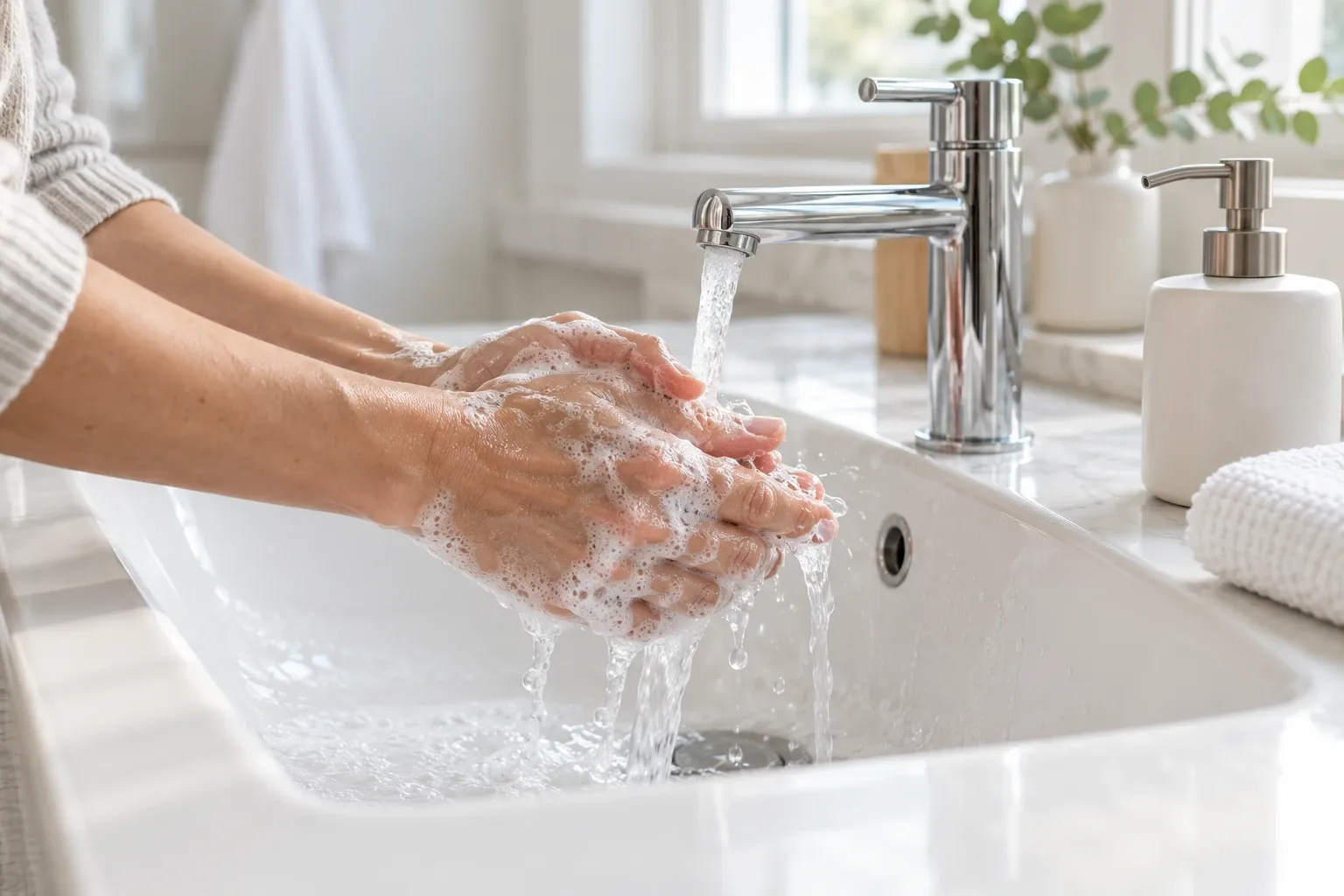
This is the surprise for many visitors. 1177 and Folkhälsomyndigheten both say alcohol hand gel is not enough to stop vinterkräksjukan. Only careful washing with soap and running water works. So the dispenser by the hotel lift is no protection here.
- Wash hands after the toilet, before meals and after touching surfaces that may carry the virus.
- Use liquid soap, and dry on your own towel or paper towels, not a shared cloth towel.
- The sick person cooks for nobody, during the illness and just after it.
- Don’t visit people who have it, and don’t visit others while you do, least of all in hospitals or care homes.
- Tell your host if someone in your room or cabin is ill, so shared bathrooms and kitchens can be cleaned.
You can still shed virus after you feel well, and some people carry it for a long time. Keep up the handwashing for several days after recovery.
How long to stay away
1177’s stay-home periods count in dygn, full 24-hour days, from the last episode of vomiting or diarrhoea:
| Who | Back with others when |
|---|---|
| Adults | At least one full day after the last symptoms |
| Schoolchildren | At least one full day after recovering |
| Preschool and family-daycare children | Eating normally and at least two full days without vomiting or diarrhoea |
| Healthy people in the same household | No need to stay home, but wash hands carefully and go home at once if symptoms start |
For a tour group, ski school or family visit, use the same rule. It’s what Swedish workplaces and schools expect.
Vinterkräksjukan isn’t a notifiable disease under Swedish law, so individual cases aren’t reported to the authorities. Folkhälsomyndigheten tracks the epidemic through voluntary reports from 25 laboratories and through searches on 1177.se, and publishes situation reports every second week once the season starts. In 2025–26 it declared the season under way on 11 December 2025.
Food: frozen berries, oysters and buffets
Norovirus also travels on food, and Livsmedelsverket gives consumer advice that surprises most visitors: boil imported frozen raspberries for one minute before eating them. Other imported frozen berries and berry mixes can carry the virus too, along with the rarer hepatitis A virus. Freezing, freeze-drying and drying don’t kill either virus. A minute of boiling kills both.
Outbreaks traced to berries have fallen sharply. A decade ago several were reported each year; now there is at most an occasional one. Livsmedelsverket still recommends boiling, and that matters for smoothies and desserts served unheated. No outbreak is known to have come from Swedish raspberries, fresh or frozen, though far fewer are sold than imported ones.
The other classic routes are raw oysters and mussels, where norovirus is the most common known cause of illness, and food that isn’t heated before serving, such as buffets and the smörgåsbord, when someone ill has handled it. Water contaminated by sewage can carry it too. If you’re staying at a cabin with its own well, see well water at cabins.
Practical information
| Item | Detail |
|---|---|
| Advice line | 1177; from a foreign phone +46 771 11 77 00. Advice is free; you pay your operator’s ordinary call rate (checked 2026-10-14) |
| Emergency | 112 |
| Rehydration salts | Vätskeersättning, at pharmacies; price varies by product and chain |
| Homemade solution | 1 litre water + 6 level tsp sugar + ½ tsp salt (1177 recipe) |
| Clinic visit | Regional fee or full price depending on entitlement; see the visitor healthcare guide |
| Season reports | Folkhälsomyndigheten, every second week once the season starts |
| Frozen imported berries | Boil one minute before eating |
FAQ
What is vinterkräksjukan?
It is the Swedish name for norovirus infection, sometimes caused by its relative sapovirus: “the winter vomiting disease”. It brings sudden nausea, vomiting, stomach pain and diarrhoea, often with aches, fever and headache, starting 12 to 48 hours after infection. It is Sweden’s most common stomach bug, peaks between January and March, and usually passes within one to three days.
How long should I stay away from other people?
At least one full day after your last vomiting or diarrhoea, according to 1177, and longer for preschool children: they return when they eat normally and have gone two full days without symptoms. You can still shed virus after you feel well, so keep washing your hands carefully with soap and water for several days and don’t cook for others.
When should I see a doctor for norovirus in Sweden?
Most people never need to. Contact a health centre or out-of-hours clinic at once for bloody diarrhoea, high fever with shivering or severe stomach pain that doesn’t ease, and call 1177 if you vomit for over a day, feel very weak or show signs of dehydration. Always phone before going in, so the clinic can stop you infecting others.
Does hand sanitiser kill norovirus?
Not reliably. 1177 and Folkhälsomyndigheten, the Public Health Agency, both say alcohol hand gel is not enough to stop vinterkräksjukan. Wash your hands carefully with soap and running water after the toilet, before eating and after touching shared surfaces, and dry them on your own towel or a paper towel. Keep using gel against other germs, but not instead of soap.
Do I need to boil frozen berries in Sweden?
Livsmedelsverket, the Swedish Food Agency, advises boiling imported frozen raspberries for one minute before eating them, and says other imported frozen berries and berry mixes can carry norovirus too. Boiling for a minute destroys both norovirus and hepatitis A virus; freezing does not. Outbreaks have become rarer, but the advice stands for smoothies, desserts and anything served unheated.
When should I take my child to a doctor in Sweden?
Go to a children’s emergency department straight away for a baby under two months with vomiting and diarrhoea. Seek care the same day if any child drinks almost nothing, pees much less, is listless, has severe worsening stomach pain or blood in vomit or stool. Call 1177 for a baby under six months, or any child not improving within a day.
Where do I get oral rehydration salts in Sweden?
At any pharmacy (apotek): ask for vätskeersättning, sold as powder or effervescent tablets, with and without flavour. Babies under one should have unflavoured salts. If you can’t buy any, 1177’s recipe is one litre of water, six level teaspoons of sugar and half a teaspoon of salt, measured exactly and fully dissolved.
Related guides
- How to call 1177 for medical advice — the foreign-phone number, the English option and what the nurse can do.
- Healthcare for visitors to Sweden — what a clinic visit costs with and without an EU card.
- Pharmacies in Sweden — where to buy rehydration salts and get free advice at the counter.
- Emergency departments in Sweden — when akuten is the right door, and what to expect.
- Travel insurance for Sweden — cover for care you may have to pay for in full.
Facts verified 2026-10-14. Sources: 1177, Folkhälsomyndigheten (Public Health Agency of Sweden), Livsmedelsverket (Swedish Food Agency), SKR — full register in this topic’s source file. Found something outdated? Tell us and we’ll fix it.