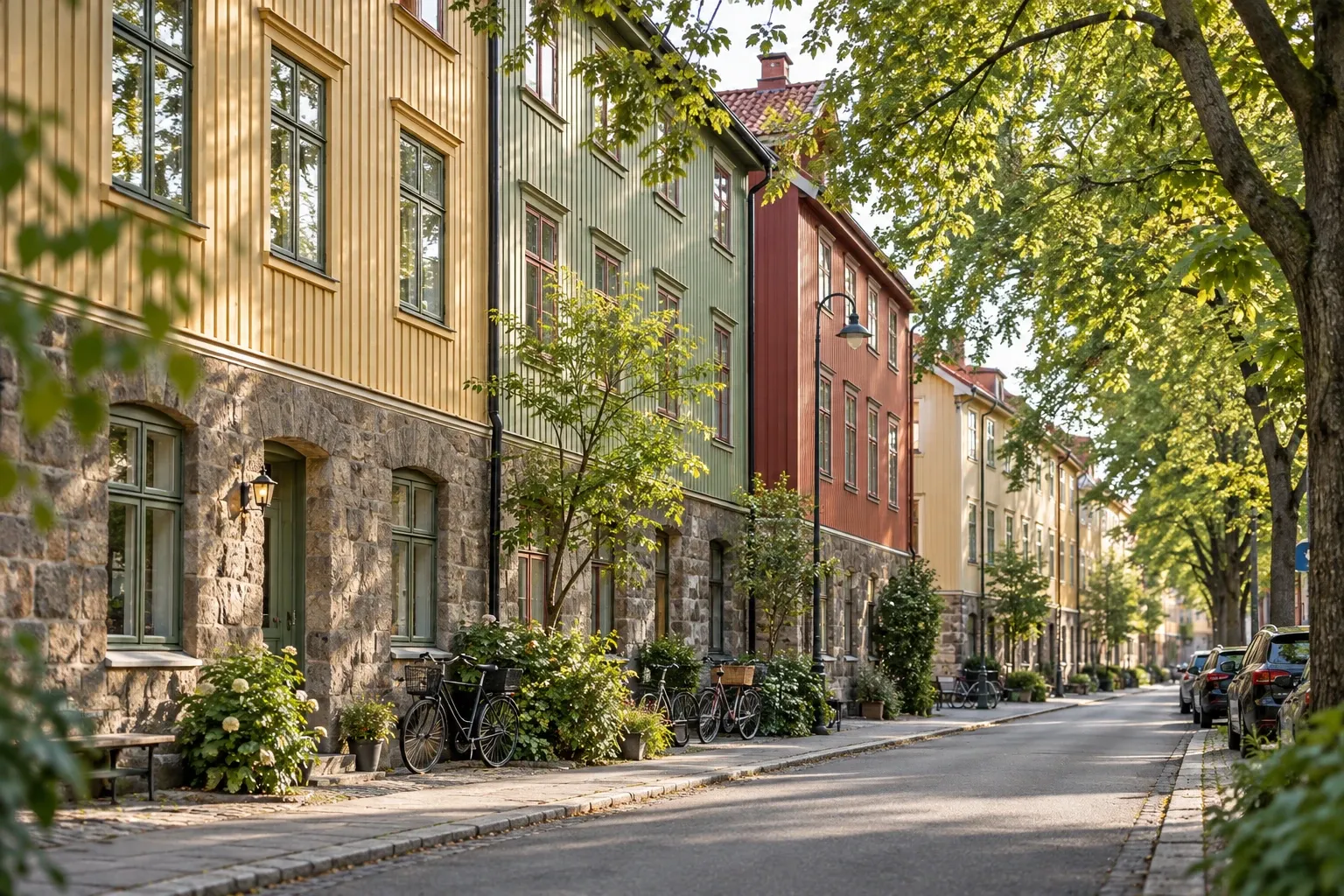
West of Haga, Gothenburg stops performing for visitors and simply lives: a restaurant boulevard, a huge park with free elk and penguins, a hill with a harbor view, and an old East India Company quay under the bridge. Here is how to use it.
When you need this
You have done Haga and the center and want to see where Gothenburgers actually spend their evenings. You are planning dinner and drinks around Järntorget and Linnégatan. You have children and a free day, and Slottsskogen keeps coming up. You are hunting vintage shops, or you want the view from Stigberget and the industrial history of Klippan. Or you are pushing a stroller and wondering how the old streets will treat you. This page covers all of it, without naming a single restaurant or shop.
The two districts at a glance
Linnéstaden, usually just “Linné”, and Majorna sit west and southwest of Haga, between the Göta älv river and Slottsskogen park. Together they form the Majorna-Linné part of the city’s Centrum area. Gothenburg’s official visitor site, goteborg.com, calls Linné a laid-back neighborhood of independent shops and cafés by day and restaurants and bars by night. It describes Majorna as a former working-class district that has become a cultural hot spot, with the city’s largest stock of preserved landshövdingehus.
| Place | What it is |
|---|---|
| Järntorget | Square and transport hub at Linné’s east end; over 20,000 travelers a day |
| Långgatorna | Four parallel streets running west from Järntorget: bars, small stages, restaurants |
| Linnégatan | Tree-lined boulevard from Järntorget to Slottsskogen |
| Skanstorget | Where Linné meets Haga, below Skansen Kronan |
| Slottsskogen | Large city park: free animal park, Plikta playground, Natural History Museum |
| Stigberget | Majorna’s music and food quarter, the Maritime Museum, Masthuggskyrkan |
| Kungsladugård and Mariaplan | Landshövdingehus blocks, vintage shops, the Plaskis paddling pool |
| Klippan | Riverside cultural reserve under Älvsborgsbron: old industry and contemporary art |
Getting there
Take the tram; both districts are threaded with stops. Several lines stop at Järntorget, the gateway to Linné and Långgatorna. Trams 1, 2, 6, 7, 8 and 13 stop at Linnéplatsen and Botaniska trädgården, the two ends of Slottsskogen. In Majorna, use Stigbergstorget, Majvallen, Mariaplan, Ostindiegatan or Chapmans torg.
For Klippan, ride ferry 285 (Älvsnabben), which runs from Stenpiren via Lindholmspiren and Eriksberg to Klippans färjeläge (Klippan ferry stop) on an ordinary ticket. In zone A, tap a contactless Visa or Mastercard, or a phone wallet, on the reader for a 90-minute adult single; one card buys one ticket, so each traveler needs their own. Fares are in our Gothenburg public transport guide.
Linnéstaden: Linnégatan, Järntorget and Långgatorna
Linnégatan is the spine: a tree-lined boulevard from Järntorget to Slottsskogen, and goteborg.com says few streets in Sweden are so packed with restaurants. Walk it end to end, then turn into the side streets, which the city’s visitor site recommends for smaller finds. At the Haga end, the area around Skanstorget has filled with new restaurants in recent years, with Skansen Kronan’s hill next door; see our Haga guide for that side.
Järntorget and Långgatorna are the evening. The four parallel Långgatorna (“long streets”) run west from the square, and goteborg.com calls them the heart of Gothenburg’s alternative, laid-back nightlife: bars, small stages, a theater and concert venues by the square.
Two practical points for the evening:
- Serving hours are set by law. Under the Alcohol Act, bars and restaurants may serve until 01:00 unless the municipality decides otherwise, and the premises must be cleared 30 minutes after serving ends. Some venues hold later licences.
- The square has been rebuilt. New bus stops at Järntorget opened on 14 December 2025, and the trams toward Majorna moved back to their normal stop. Construction of Masthuggskajen, the new district on the quay, continues next door; more under accessibility and construction below.
For a quieter break, Seminarieparken is a small park with gravel paths and cherry blossom.
Slottsskogen
Slottsskogen is the big park on the Linné–Majorna border, and the best free day in this part of the city.
- The animal park is free and open all year. It is one of the oldest zoos in Sweden: elk, Finnish forest reindeer, harbor seals, Humboldt penguins and Gotland ponies.
- The children’s zoo is seasonal. Barnens zoo, with sheep, goats, rabbits, chickens and horses up close, and the pony rides run from April to September. It is closed now and next opens in April 2027.
- Plikta is the city’s first excursion playground: a 15-meter wooden whale, access-adapted play equipment, and staff on site almost every day running activities for children aged 6 to 16. There is also a nature playground and a 300-meter barefoot trail.
- The Natural History Museum (Göteborgs naturhistoriska museum) sits in the park near Linnéplatsen. It is free for under-20s and students, closed on Mondays, and does not allow large bags or pushchairs up to the exhibitions; use the lockers on the entrance level.
- Look for the jättegrytor beside the animal enclosures: giant potholes carved into the rock by the inland ice more than 12,000 years ago.
The history, from the city: in the Middle Ages the land belonged to the Älvsborg castle estate, used for deer hunting, fruit growing and grazing, which gave the park its name, “castle forest”. County governor Albert Ehrenswärd pushed for a green space open to everyone, council member August Kobb took up the cause, and it became a proper park in 1874. Kobb’s portrait is carved into the rock at the bottom of Säldammsbacken.
Pair the park with the Botanical Garden, open every day around the clock for a voluntary fee; the trams stop at both. More free ideas are in free things to do in Gothenburg.
Majorna: Stigberget and Kungsladugård
Majorna is large, and goteborg.com says its character comes from the landshövdingehus, literally “county governor’s houses”. These are a Gothenburg building type: a stone ground floor under two wooden floors, built about 1870–1940 as workers’ housing to get three storeys past a fire rule that capped wooden houses at two.
Stigberget is the music and food quarter around Stigbergstorget, with concert venues and restaurants. Here you find:
- Sjöfartsmuseet Akvariet, the Maritime Museum and Aquarium, at the Stigbergstorget stop. It is free for under-20s and students and closed on Mondays. Pushchairs cannot go inside; there is covered pushchair parking next door, and lifts to all floors.
- Masthuggskyrkan, a church completed in 1914 to designs by Sigfrid Ericson, high on the hill. Goteborg.com calls it one of the city’s best viewpoints, over the harbor entrance, the river and the western rooftops. The parish welcomes visitors inside to light a candle, and Sunday service is at 11:00. The Gathenhielmska cultural reserve is nearby.
Kungsladugård, around the square Mariaplan, is landshövdingehus blocks, restaurants and vintage shops. Its summer landmark is Plaskis, the nickname of Älvsborgsdammen, a public paddling pool built in 1930–1933. It is the city’s only historic paddling pool still in use, and it reopened in June 2026 after a renovation with a new basin, water treatment, pump house and better access around the pool. Entry is free, the water is chlorinated and checked daily by the city, the depth is 20–45 cm, and it is normally filled from 1 June to 31 August.
Vintage and second-hand: shops line the stretch between the Stigbergstorget and Majvallen tram stops and cluster around Mariaplan. Goteborg.com notes that they are small and keep varying hours, so check each one before you set out. For how second-hand shopping works in Sweden, see loppis and second-hand shops.
Klippan
Klippan, on the river under Älvsborgsbron, is part of Majorna and one of Gothenburg’s oldest places. It is mentioned in the 15th century and was the site of the city’s oldest port. The Älvsborg castle stood here from the 14th to the 16th centuries until it was blown up in the 1660s; only a ruin remains.
From the 1760s the East India Company used the harbor, and its warehouses, workshops, forges and homes now form the Klippan cultural reserve (kulturreservat). David Carnegie the younger bought the local sugar mill and porter brewery in 1837, and production ended in 1979. The old sugar mill, Sockerbruket, now holds studios and galleries, and St Birgitta’s chapel, by A. W. Edelsvärd, was completed in 1857.
Under the bridge, Röda Sten konsthall shows contemporary art in a boiler house built in 1940, closed in 1957 and saved from demolition in 1996. Every two years it hosts GIBCA, Gothenburg’s international art biennial; the 2025 edition was held there. Check its site for current exhibitions and hours.
Through the year
| When | What happens |
|---|---|
| April–September | Slottsskogen’s children’s zoo and pony rides (next opening April 2027) |
| May–early June | The Azalea Valley in Slottsskogen in bloom |
| Spring | Art Walk in Majorna, with open studios at Sockerbruket |
| 1 June–31 August | Plaskis normally filled |
| 12–14 August 2027 | Way Out West festival in Slottsskogen, with night shows in venues across central Gothenburg |
| Advent weekends, 28 November–20 December 2026 | The Haga Christmas market stretches about 660 meters, into Tredje Långgatan in Linné |
| Winter | The main animal park stays open; skiers and sledgers in Slottsskogen when there is snow |
The Christmas market and the rest of the season are in Christmas in Gothenburg.
Accessibility and construction
- Old streets, few lifts. Goteborg.com names Linnéstaden and Majorna among the older neighborhoods with cobblestones, stairs and older buildings without lifts. Ask ahead about step-free access.
- Trams. Newer trams are easiest to board at the middle carriage; older trams have high steps.
- The hill. Stigberget and Masthuggskyrkan mean a climb from the river or the tram stops.
- Museums. Sjöfartsmuseet Akvariet has lifts to all floors but no pushchairs inside; the Natural History Museum keeps pushchairs and large bags out of the exhibitions.
- Plaskis was renovated in 2026 with better access around the pool.
- Järntorget works. The city is building Masthuggskajen, a district of homes and offices on the quay beside Järntorget. In December 2025 Trafik Göteborg said the works would keep affecting traffic around the square, with Första Långgatan closed westbound between Järnvågsgatan and Nordhemsgatan. Expect detours at the eastern end of Långgatorna and check Trafik Göteborg before you go.
Mistakes to avoid
- Going for the petting animals in winter. The children’s zoo opens in April 2027; the main animal park is open now.
- Visiting a museum on a Monday. Sjöfartsmuseet Akvariet and the Natural History Museum are closed.
- Expecting water in Plaskis in September. It is filled from 1 June to 31 August.
- Treating Klippan as one sight. It is a whole area; take ferry 285 or walk the riverside.
- Heading for a vintage shop without checking its hours. They vary.
Practical information
| Item | Details (checked 15 October 2026 unless noted) |
|---|---|
| Slottsskogen and its animal park | Free, all year |
| Children’s zoo and pony rides | April–September; next opening April 2027 |
| Plaskis paddling pool | Free; normally filled 1 June–31 August |
| Botanical Garden | Voluntary entry fee, 30 kr; open around the clock |
| Natural History Museum | Adult day ticket 70 kr; free under 20 and students; closed Mondays (checked 25 September 2026) |
| Sjöfartsmuseet Akvariet | Free under 20 and students; closed Mondays (checked 25 September 2026) |
| Tram or ferry 285 | Zone A adult single by card tap, 90 minutes (checked 24 September 2026) |
| Way Out West | 12–14 August 2027, Slottsskogen |
| Alcohol serving | Until 01:00 by default |
FAQ
What is Linnéstaden in Gothenburg known for?
Restaurants, bars and small independent shops. Its main street, Linnégatan, runs from the square Järntorget to Slottsskogen park, and Gothenburg’s visitor site says few streets in Sweden are so packed with restaurants. The four Långgatorna streets off Järntorget are the heart of the city’s laid-back nightlife, with bars and small stages. Slottsskogen, at the far end, is the neighborhood’s back garden.
Is Majorna worth visiting?
Yes, for neighborhood life rather than a single sight. Majorna has Gothenburg’s largest stock of preserved landshövdingehus, music venues and vintage shops around Stigbergstorget and Mariaplan, the Maritime Museum and Aquarium, and the Masthuggskyrkan viewpoint. Riverside Klippan adds 18th-century East India Company buildings and the Röda Sten art hall. Trams and ferry 285 get you there.
Is Slottsskogen zoo free?
Yes. Slottsskogen’s animal park is free and open all year, with elk, Finnish forest reindeer, harbor seals, Humboldt penguins and Gotland ponies. The separate children’s zoo, where you can meet farm animals up close, and the pony rides run from April to September; the children’s zoo next opens in April 2027. The park also has the large Plikta playground.
How do I get to Linnéstaden and Majorna?
By tram. Several lines stop at Järntorget, the gateway to Linné and Långgatorna; Linnéplatsen serves Slottsskogen and the Natural History Museum; Stigbergstorget, Mariaplan and Chapmans torg serve Majorna. Ferry 285 calls at Klippan. In zone A you can tap a contactless card or phone for a 90-minute adult single, one card per traveler.
What is Plaskis in Majorna?
Plaskis is the nickname of Älvsborgsdammen, a shallow public paddling pool at Mariaplan in Kungsladugård, built in 1930–1933. It is the city’s only historic paddling pool still in use, reopened in June 2026 after a full renovation, and is free. It is normally filled from 1 June to 31 August and is 20 to 45 centimeters deep.
Is Linnéstaden good for nightlife?
Yes, for the relaxed kind. Järntorget and the four Långgatorna streets hold bars, small music stages, a theater and concert venues, and Linnégatan is lined with restaurants. Swedish law lets bars serve alcohol until 01:00 unless the municipality allows longer, and venues must be cleared 30 minutes after serving ends.
Are Linnéstaden and Majorna accessible with a wheelchair or stroller?
Partly. Gothenburg’s visitor site warns that older neighborhoods, Linnéstaden and Majorna included, have cobblestones, stairs and older buildings without lifts. Stigberget is on a hill. Newer trams are easiest to board at the middle carriage. Sjöfartsmuseet Akvariet has lifts but no pushchairs inside, and Plaskis was renovated in 2026 with better access around the pool.
Related guides
- Haga: Gothenburg’s cinnamon bun quarter — the old suburb right next to Linné
- Where to stay in Gothenburg — hotels by district, including Linné and Majorna
- Gothenburg museums — the Maritime Museum, the Natural History Museum and the Museum Card
- Gothenburg public transport — trams, ferry 285 and tap tickets
- Södermalm — Stockholm’s neighborhood-life district in the same format
Facts verified 15 October 2026. Sources: Göteborg & Co (goteborg.com), Göteborgs Stad, Trafik Göteborg, Västtrafik, Svenska kyrkan, Sjöfartsmuseet Akvariet, Göteborgs naturhistoriska museum, Göteborgs botaniska trädgård, Way Out West and Sveriges Riksdag — full register in this topic’s source file. Found something outdated? Tell us and we’ll fix it.