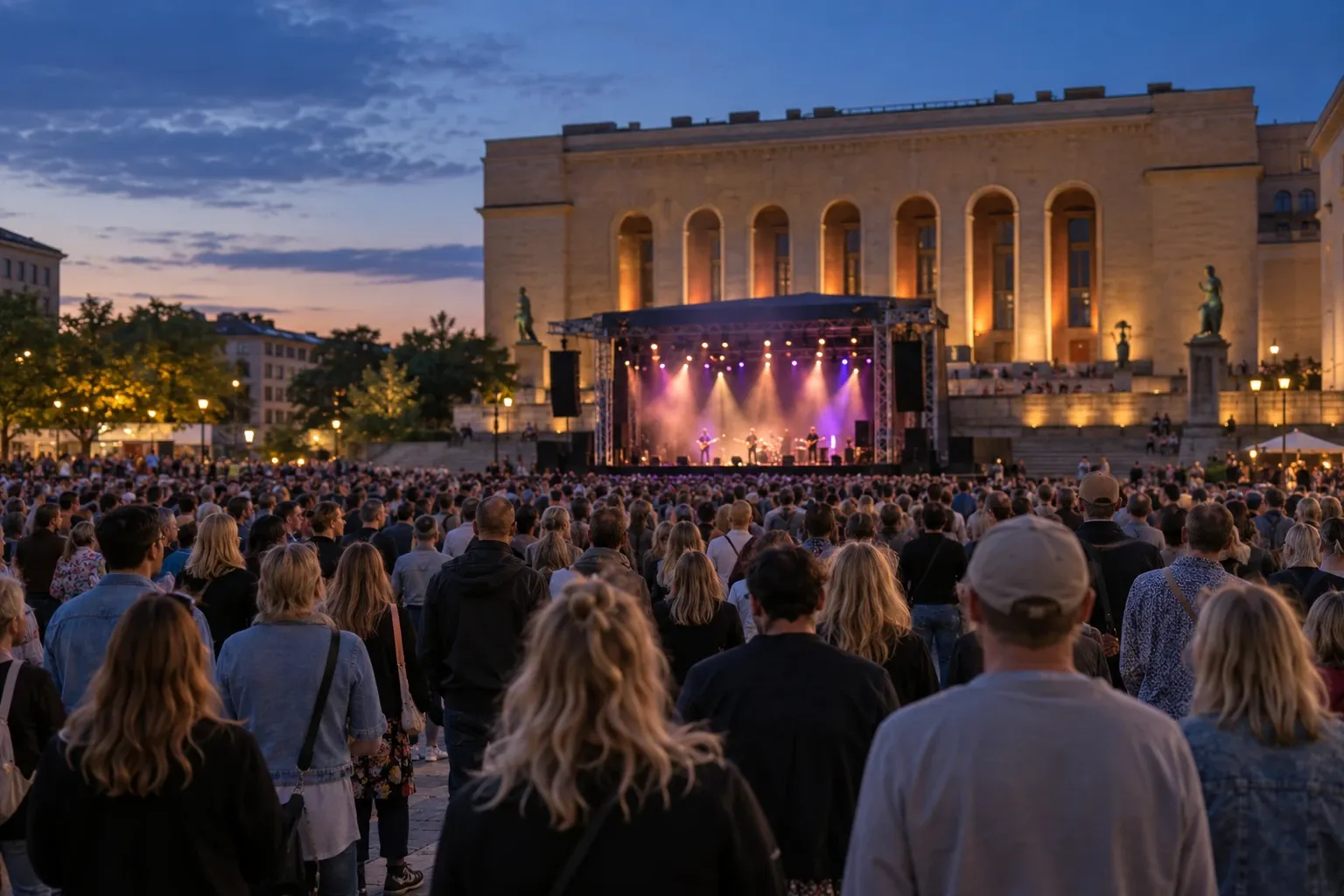
Every late August, central Gothenburg turns into one big free festival: a main stage on Götaplatsen, street food on Kungstorget, a dance floor in a park, circus for children. Here is what changed with the new name, how the six sites work, and the house rules visitors trip over.
When you need this
You are in Gothenburg at the end of August and wondering why the city centre is full of stages and crowds. Or you found “Kulturkalaset” dates online and are not sure they are current. Or you are planning an August trip around a free big-name concert and want to know the rules, the sites and whether it works with children or a wheelchair.
Kulturkalaset is now Göteborgskalaset
The festival you may know as Kulturkalaset (officially Göteborgs Kulturkalas) changed its name in December 2025. It went back to Göteborgskalaset, the name it started with in 1991, after residents sent in more than 2,600 suggestions. Kalas means party, so the name is simply “the Gothenburg party”. The 2026 edition ran under the new name only.
Older pages are still everywhere, and they get more than the name wrong. Here is how the festival has changed:
| Period | Name | Format |
|---|---|---|
| 1991 to about the mid-2000s | Göteborgskalaset | City festival |
| About twenty years to 2025 | Kulturkalaset / Göteborgs Kulturkalas | Six days in mid-August (week 33) |
| 2019 only | Gothenburg Culture Festival | Moved a week earlier, to week 32 |
| 2025 | Göteborgs Kulturkalas | Three days, 28–30 August |
| 2026 onward | Göteborgskalaset | Four days, Thursday 27 to Sunday 30 August in 2026 |
So if a page says “Kulturkalaset, six days in mid-August”, it describes the festival before its current format. Search for Göteborgskalaset, or go straight to the organiser’s site, which has an English version. The 2027 dates had not been announced on 15 October 2026; the city’s tourism board lists the festival only for August 2027.
The six festival sites
The festival has no single ground. In 2026 it was spread over six sites in the city centre, from Götaplatsen at the top of Avenyn down to the old moat around Kungsportsplatsen. The 2026 edition got a bigger budget and brought the biggest concerts back to Götaplatsen, which had not been used since 2018.
| Site (2026) | What happened there | Nearest tram stop |
|---|---|---|
| Götaplatsen | Main stage, biggest names | Berzeliigatan |
| Upper Avenyn | Restaurants and bars move onto the street; long tables with West Coast mussels | Valand |
| Kungstorget / Basargatan | Second stage and the street-food festival | Kungsportsplatsen |
| Bältespännarparken | Dance floor, drop-in classes, local craft beer | Kungsportsplatsen |
| Kungsparken | Children and families: circus, shows, a 1935 carousel | Grönsakstorget |
| Grönsakstorget | New local bands and hip hop | Grönsakstorget |
Opening hours differed by site and day; the main stage ran latest, to 23:30 on Friday and Saturday. Full 2026 hours are in the Practical information table below.
What’s free and what’s on
Everything on the programme is free: every concert and activity, with no ticket or wristband. You pay only for food and drink from the vendors on the sites. In 2026 that free programme included a Swedish House Mafia concert on Götaplatsen on the Saturday afternoon, with no booking needed.
The programme is broad rather than just music. The 2026 categories were music, dance, sport, activities, theatre and circus, family, youth, seniors, talks, art and design, food and drink, and film. A few items need advance booking, and some have an age limit or recommended age; both are stated on the item’s own programme page.
To build your own schedule, tap the heart on any programme item and it is saved to a favourites page on the festival site. Artist announcements come in early summer: in 2026 the first names were released on 12 May and the full programme on 23 June.
Food is part of the draw. In 2026 the street-food festival filled Kungstorget and Basargatan, Bältespännarparken served local craft beer, upper Avenyn had long tables with Bohuslän mussels, and a local-drinks area on Kungstorget also offered alcohol-free options. The festival is kranmärkt, a certification for events that promote tap water over bottled, so bring a bottle to refill.
The scale is large. In 2018, when the festival still ran six days, it counted about 1.7 million visits, including 225,000 at EuroPride. Expect the evening concerts on Götaplatsen to be packed.
House rules
Most rules are the organiser’s own, and they apply on the festival sites. One is also national law.
| Rule | What it means for you | Type |
|---|---|---|
| No own alcohol | Leave the bottle at home; buy at the serving areas | Organiser rule |
| Alcohol at a public event only at permitted serving | Spirits, wine and strong beer may not be drunk or stored on the site outside licensed serving; you can be told to leave | Law (Public Order Act) |
| Serving age 18 | Bar staff must check age | Law (Alcohol Act) |
| No alcohol on trams and buses | Applies on the way to and from the sites | Law (Public Order Act) |
| No umbrellas during concerts | They block other people’s view; bring a poncho | Organiser rule |
| No camping | Not on any festival site | Organiser rule |
| Private photos fine | Professional photographers need accreditation | Organiser rule |
There was no bag ban in 2026: the organiser said it did not expect one, because the police generally no longer impose them. That can change for a given year, so check the festival’s FAQ before you go. The main areas are under camera surveillance for crowd management.
You may queue for a spot near the main stage, but the area in front of the Götaplatsen stage is closed overnight. In 2026 it opened at 15:00 on Thursday, 12:00 on Friday and 11:00 on Saturday and Sunday, subject to change. For where a beer outdoors is legal away from the festival, see our guide to drinking in public in Sweden.
Getting there and around
All six sites are in central Gothenburg, and the organiser recommends walking, cycling or public transport between them rather than driving. Each site page names its nearest tram stop, listed in the table above.
In 2026 the festival offered two free transport deals. Free single-ticket codes for Västtrafik’s trams and buses ran out on the first day, 27 August, so do not count on them. The city bike-share, Styr & Ställ, gave unlimited free 60-minute rides through all four days via the nextbike app. Budget a normal fare; our Gothenburg public transport guide explains which ticket to buy.
Weather and cancellations
The festival is outdoors, and storms do cancel shows. On Friday 28 August 2026 a thunderstorm forced the organiser to cancel the Teddybears concert, putting the safety of the audience, artists and staff first. A Sunday circus show in Kungsparken was also marked cancelled.
Check the festival’s news page on the day, and keep an eye on SMHI’s weather warnings; our guide to SMHI weather warnings explains the levels. A poncho beats an umbrella anyway, since umbrellas are banned during concerts.
With children
Kungsparken is the family site. In 2026 it had circus shows, try-it-yourself circus with tightrope and juggling, and a carousel built in 1935, run together with Gothenburg’s dance and theatre festival. It opened from 16:00 on Friday and from noon at the weekend. Family items appear on other sites too, and the programme can be filtered for them.
Daytime is the easy time with children; the big evening concerts on Götaplatsen are the most crowded part of the festival. Every site has portable toilets. If something gets lost, each vendor or stage operator keeps its own lost property, so ask staff at the site where it went missing.
Accessibility
Götaplatsen has a raised wheelchair platform with a good view of the stage, but places are limited and the organiser says to arrive in time. The surface is asphalt, with cable covers and small level changes. Drop-off for färdtjänst (Sweden’s subsidised transport service for people with disabilities) is on Arkivgatan and Engelbrektsgatan, and parking for people with reduced mobility is on Geijersgatan and Engelbrektsgatan.
Selected programme items are sign-language interpreted or audio described, and the programme can be filtered for both. The disability organisation Passalen runs accompanied visits for people who want company at the festival. For wider planning, see our guide to accessible travel in Sweden.
Practical information
| Item | Detail (2026 edition unless stated) |
|---|---|
| Name | Göteborgskalaset (formerly Kulturkalaset / Göteborgs Kulturkalas) |
| Organiser | Göteborg & Co, for the City of Gothenburg |
| 2026 dates | Thursday 27 – Sunday 30 August |
| 2027 dates | Not announced on 15 October 2026 |
| Entry | Free, no tickets; food and drink paid |
| Götaplatsen and upper Avenyn | Thu 15:00–22:00, Fri 12:00–23:30, Sat 11:00–23:30, Sun 11:00–21:15; last drinks at closing |
| Kungstorget / Basargatan | Thu 15:00–22:00, Fri–Sat 11:00–23:00, Sun 11:00–19:00 |
| Bältespännarparken | Thu 16:00–22:00, Fri–Sat 12:00–23:00, Sun 12:00–19:00 |
| Kungsparken | Fri 16:00–19:00, Sat–Sun 12:00–18:00 |
| Grönsakstorget | Fri 16:00–22:00, Sat 12:00–22:00, Sun 12:00–16:00 |
| Getting there | Walk, cycle or tram; free Västtrafik codes ran out on 27 August; free 60-minute city-bike rides all four days |
| Toilets | Portable toilets on every site |
| Official site | goteborgskalaset.se (Swedish and English) |
FAQ
Is Kulturkalaset the same as Göteborgskalaset?
Yes. Göteborgs Kulturkalas took back its original name, Göteborgskalaset, in December 2025 after residents sent in more than 2,600 name suggestions. The festival began as Göteborgskalaset in 1991, used the Kulturkalaset name for about twenty years and was briefly the Gothenburg Culture Festival in 2019. Search under the new name, or you will land on old dates.
When is Göteborgskalaset 2027?
Not announced as of 15 October 2026. The organiser’s site says only that it returns in 2027, and the city’s tourism board lists it for August 2027. Recent editions ran 28–30 August 2025 and 27–30 August 2026, Thursday to Sunday. In 2026 the first artists were named on 12 May and the full programme on 23 June.
Is Göteborgskalaset free?
Yes. All concerts and activities are free, with no tickets or wristbands, and that included Swedish House Mafia’s concert on Götaplatsen in 2026. You pay only for food and drink from the vendors on the festival sites. A few programme items need advance booking, and the booking details appear on that item’s page in the programme.
Can I bring my own alcohol to Göteborgskalaset?
No. The organiser forbids bringing your own alcohol, and Swedish law allows alcohol at a public event only at permitted serving. Buy drinks at the bars and serving areas on the festival sites, where staff must check that you are 18. Drinking alcohol on Gothenburg’s trams and buses is banned by national law anyway.
Where is Göteborgskalaset held?
In central Gothenburg. In 2026 the main stage stood on Götaplatsen, at the top of Avenyn, with restaurants spilling onto upper Avenyn. The other sites were Kungstorget and Basargatan for street food and a second stage, Bältespännarparken for dance, Kungsparken for children and circus, and Grönsakstorget for new local bands. The organiser recommends walking, cycling or public transport between them.
Is Göteborgskalaset good for children?
Yes. In 2026 Kungsparken was the family site, with circus shows, try-it-yourself circus and a carousel from 1935, run together with Gothenburg’s dance and theatre festival. Family items appear on other sites too, and the programme can be filtered for them. Some items have age limits, shown on each programme page. Daytime is calmer than the big evening concerts on Götaplatsen.
Is Göteborgskalaset accessible for wheelchair users?
Partly, with planning. Götaplatsen has a raised wheelchair platform with a view of the stage, but places are limited, so arrive early. Surfaces are asphalt with cable covers and small level changes. Accessible drop-off and parking are marked on nearby side streets. Selected items are sign-language interpreted or audio described, and the organisation Passalen runs accompanied visits.
Related guides
- Summer festivals in Sweden — the ticketed music festivals and the other free August city festivals.
- Free things to do in Gothenburg — what costs nothing the rest of the year.
- Where to stay in Gothenburg — which area puts you closest to Avenyn and Kungsportsplatsen.
- Gothenburg public transport — the one fare you need for the trams.
- Stockholm’s Culture Festival — the capital’s free August counterpart.
Facts verified 15 October 2026. Sources: Göteborg & Co (Göteborgskalaset’s official site and goteborg.com), Sveriges Riksdag (Public Order Act, Alcohol Act), SVT Nyheter and TT — full register in this topic’s source file. Found something outdated? Tell us and we’ll fix it.