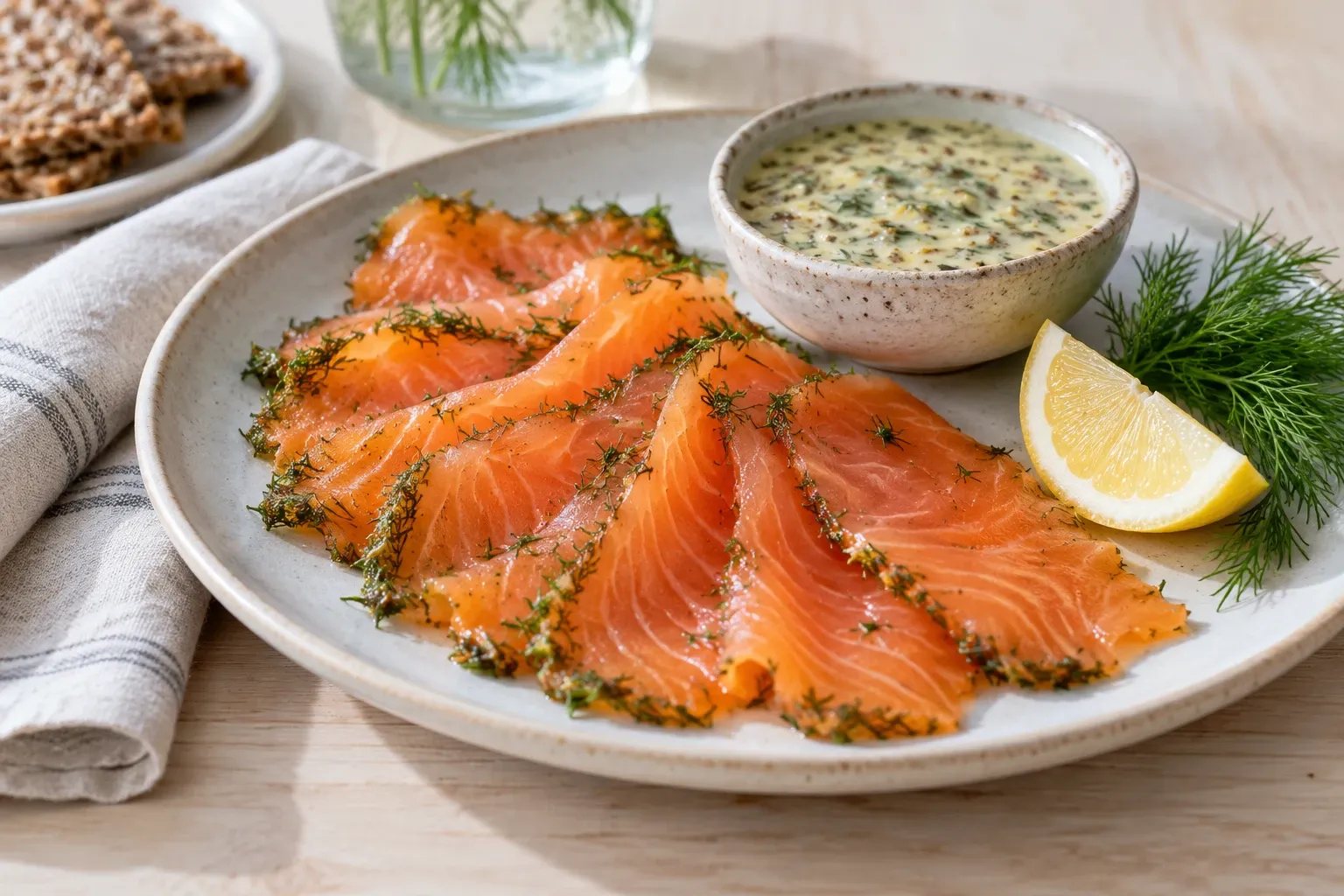
Gravlax is the salmon on every Swedish holiday table. It is also raw fish, and the pack may not even be salmon. Here is what it is, where the name comes from, how Swedes eat it, and the safety rules that recipe pages get wrong.
When you need this
You’re invited to a julbord, the Christmas buffet, or to an Easter or Midsummer lunch, and the cold-fish table has a platter of pink slices with a yellow-green sauce. Or you’re in a Swedish supermarket and the chill cabinet offers gravad lax next to gravad regnbågslax. Or you’ve rented a cabin, bought a fillet, and want to cure it yourself. If you’re pregnant, it’s on the list of foods to check.
What gravlax is
Gravad lax, usually shortened to gravlax, is raw salmon cured under salt and sugar, usually with dill. The fillets are kept cool under light pressure for a few days. The salt draws liquid out of the fish, the cure turns into a brine, and the flesh firms up and matures. It is never cooked and never smoked.
Store norske leksikon, the Norwegian national encyclopaedia, describes the same method for other fatty fish, such as trout, whitefish, herring and mackerel. It puts eating time at one to four days after curing starts. Norway (gravlaks), Denmark and Finland all have the dish. On a Swedish table the cured salmon sits right beside its cousin, smoked salmon (rökt lax).
| On the label | What it is |
|---|---|
| gravad lax | Cured Atlantic salmon |
| gravad regnbågslax | Cured rainbow trout |
| kallrökt lax | Cold-smoked salmon |
| varmrökt lax | Hot-smoked salmon, cooked through |
Why “grave” salmon
Grava comes from the word for digging. Fish was once put in a hole in the ground, where the temperature stayed cool and even while it matured. Leave it long enough and it fermented, ending up closer to Norway’s rakfisk or Sweden’s surströmming than to today’s mild slices. In Sweden, Store norske leksikon notes, both the short-cured and the fermented kind were called gravfisk until the 1800s.
The often-quoted oldest written trace is a man nicknamed after the dish in a Norwegian document from 1348. Sources disagree on when the dish itself appeared, so we won’t give you a century. What matters at the table is that modern gravlax is “buried” only in salt, sugar and dill, in a fridge.
How and when Swedes eat it
Visit Sweden, the official tourism board, says salmon is served at almost all traditional holidays: Christmas, Easter and Midsummer. It may be cured, smoked or grilled, and it often comes with a glass of snaps and a drinking song. Snaps is tradition, not obligation. Beer or a soft drink is just as normal; see snaps and aquavit.
| Occasion | Where gravlax fits |
|---|---|
| Julbord (late November to 24 December) | The cold-fish round, after the pickled herring |
| Easter | Cured, smoked or grilled salmon on the påskbord |
| Midsummer | Cured, smoked or grilled salmon beside the herring |
| Any time | As a starter, or a main course with potatoes |
The sauce is hovmästarsås, literally “head waiter’s sauce”. It is a cold emulsion of mustard, neutral oil, a little vinegar, often a pinch of sugar, and chopped dill. Visit Sweden recommends mixing sweet Swedish mustard with sharper Dijon. When gravlax is a main course, a classic partner is dillstuvad potatis, potatoes stewed in a dill white sauce.
Cut it right. Slice thin, at an angle, away from the skin, and only just before serving. Sliced fish keeps less well than a whole cured fillet.
Reading the pack
Swedish labelling law reserves the trade name lax for Atlantic salmon (Salmo salar). Rainbow trout (Oncorhynchus mykiss) is sold as regnbåge or regnbågslax, “rainbow salmon”. So gravad regnbågslax is cured rainbow trout. That’s a perfectly good product, but it isn’t salmon. Livsmedelsverket, the Swedish Food Agency, even uses farmed rainbow trout for its own model description of cured fish.
The same model description shows two more things about the pack. First, shelf life is set for an unopened pack at +4 °C, at 21 days in the example. Second, fish frozen to kill parasites doesn’t have to say “thawed” on the label. So commercial gravlax may well have been frozen, and you won’t be told.
Freezing: farmed vs wild
Recipes tell you to freeze salmon for 72 hours before curing, Visit Sweden’s included. That is the cautious version. Livsmedelsverket draws the line elsewhere:
- Farmed salmon does not need freezing. The agency judges the risk of worm parasites in it very small.
- Wild-caught fish does. Freeze fresh wild fish that will be eaten raw, cured, lightly marinated or cold-smoked at −18 °C for at least three days. Large whole fish may need a couple of days more.
Freezing farmed salmon anyway does no harm. Skipping it for wild fish does. The roundworm Anisakis occurs in wild sea fish on the west coast and in the southern Baltic. It survives curing and can cause nausea, vomiting and stomach pain within hours, plus allergic reactions in some people. Freshwater and Gulf of Bothnia fish can carry a fish tapeworm, and the same freezing advice applies.
Restaurants and shops work under binding EU rules. Fish sold to be eaten raw, or given a cure too mild to kill parasites, must be frozen to −20 °C for 24 hours or −35 °C for 15 hours. The exception is farmed fish that the business can show is parasite-free. Cooked salmon is a different case: heat also kills the parasites.
Curing at home, in outline: two fillets, flesh to flesh, thin end against thick end. Cover them with salt, sugar, white pepper and dill, then weight them in the fridge for one to two days, turning now and then. Pour off the liquid that forms and scrape off the dill before slicing. Keep the fridge at 4 °C or below.
Pregnancy and listeria
Gravlax is one of the foods Livsmedelsverket flags for pregnant women, because of listeria. The rules are simple:
- Bought cured or smoked fish: eat it within a week of the packing date (förpackningsdag). Listeria can multiply in vacuum-packed cured salmon over weeks in the fridge. The best-before date is often weeks later, but it is not a safe limit in pregnancy.
- Home-cured fish: start from fish packed at most a few days earlier, or from thawed frozen fish. Eat it within a week or freeze it.
- Pickled herring is fine, so on a julbord the herring round is the easy one. Our pregnancy guide has the full list.
There is a second, separate rule. Wild salmon from the Baltic, the Gulf of Bothnia, the lakes Vänern and Vättern and their rivers can contain dioxin and PCB. Children, young people, and anyone pregnant, breastfeeding or hoping to become pregnant should eat it at most two to three times a year. Other adults can eat it once a week. Farmed salmon has lower levels, even when farmed in those waters.
On a buffet, mind the clock as well. Chilled food should stand out no longer than four hours at up to 20 °C, three hours at up to 25 °C, and two hours at 26–30 °C.
Where the salmon comes from
The tradition is Swedish. The fish usually isn’t. Livsmedelsverket says the salmon in ordinary Swedish shops is almost always farmed salmon from Norway, or wild salmon from the Atlantic and Pacific. Wild Baltic salmon is now scarce in shops. For 2026 the EU cut the main-basin salmon catch by 27% and limited it to by-catch, apart from summer coastal fishing in the Åland Sea and the Gulf of Bothnia. Coastal fish shops are where you might still meet wild fish, so ask where it was caught.
The angling tradition is alive, though. At Mörrumsån in Blekinge, salmon fishing was first described in 1231. The season opens each March with a ceremonial premiere, which in 2026 was the 86th, on 21 March. Our guide to salmon fishing at Mörrum covers permits. Remember that a wild salmon you are given there counts toward the dioxin limit, and needs freezing before you cure it.
Practical information
| Item | Detail |
|---|---|
| Freezing wild fish at home | −18 °C for at least 3 days (longer for large whole fish) |
| Freezing farmed salmon | Not needed |
| Business freezing rule | −20 °C for 24 h or −35 °C for 15 h |
| Pregnancy: bought cured fish | Within a week of the packing date |
| Wild Baltic/lake salmon, at-risk groups | At most 2–3 times a year |
| Fridge temperature | 4 °C or below |
| Buffet time out of the fridge | 4 h up to 20 °C · 3 h up to 25 °C · 2 h at 26–30 °C |
| Model shelf life, unopened pack | 21 days at +4 °C (example, not a rule) |
| Price of a pack or a julbord | Varies by shop, species and restaurant; not published here (checked 2026-10-15) |
FAQ
What is gravlax?
Gravlax, or gravad lax, is raw salmon cured under salt and sugar, usually with dill, for a day or a few days in the cold. It is not cooked or smoked. Swedes slice it thin and eat it cold, typically with hovmästarsås, a sweet mustard and dill sauce, on a buffet or as a starter. Norway, Denmark and Finland have the same dish.
Why is it called gravlax?
Grava comes from the word for digging. Fish was once put in a hole in the ground to keep a cool, even temperature while it matured, and left long enough it fermented, closer to surströmming or Norwegian rakfisk. In Sweden both kinds were called gravfisk until the 1800s. Today the salmon is “buried” only in salt, sugar and dill.
Is gravlax raw?
Yes. The salt and sugar draw liquid out of the fish and change its texture, but it is never heated. That is why parasites matter: businesses must freeze fish sold for raw eating, or show farmed fish is parasite-free, and Livsmedelsverket tells home cooks to freeze wild fish at −18 °C for at least three days. Farmed salmon needs no freezing.
Do you have to freeze salmon before making gravlax?
Only if it is wild. Livsmedelsverket says fresh wild-caught fish to be cured should be frozen at −18 °C for at least three days, longer for large whole fish, to kill parasites. Farmed salmon does not need freezing because the risk of worm parasites is very small. Many recipes freeze all salmon for 72 hours anyway, which does no harm.
Can I eat gravlax when pregnant?
With care. Livsmedelsverket says bought cured and smoked fish can occasionally carry listeria, so pregnant women should eat it within a week of the packing date, even though the best-before date is often later. Home-cured fish should start from freshly packed or thawed frozen fish and be eaten within a week. Wild Baltic salmon also carries a dioxin limit.
What sauce is served with gravlax?
Hovmästarsås, literally the “head waiter’s sauce”: a cold emulsion of mustard, neutral oil, a little vinegar, often a pinch of sugar, and chopped dill. Visit Sweden recommends mixing sweet Swedish mustard with sharper Dijon. Potatoes stewed in a dill white sauce, dillstuvad potatis, are a classic partner when gravlax is served as a main course.
Is the salmon in Sweden Swedish?
Rarely. Livsmedelsverket says the salmon in ordinary shops is almost always farmed salmon from Norway or wild salmon from the Atlantic and Pacific. Wild Baltic salmon is scarce: for 2026 the EU cut the main-basin catch by 27% and limited it to by-catch outside summer coastal fishing in the north. Check the catch or farming area on the pack.
Related guides
- The julbord: Sweden’s Christmas buffet — where gravlax sits in the five rounds, and how to take a clean plate.
- Pickled herring explained — the other cold fish on the same table, and why it is the pregnancy-safe one.
- Påskbord: the Swedish Easter smorgasbord — salmon, eggs and herring at Easter.
- Pregnant in Sweden — the full Swedish food advice in one place.
- Swedish groceries worth trying — what else is in the chill cabinet next to the gravlax.
Facts verified 2026-10-15. Sources: Livsmedelsverket (Swedish Food Agency), Regulation (EC) No 853/2004, LIVSFS 2024:8, European Commission (DG MARE), Visit Sweden, Store norske leksikon, Sveaskog — full register in this topic’s source file. Found something outdated? Tell us and we’ll fix it.