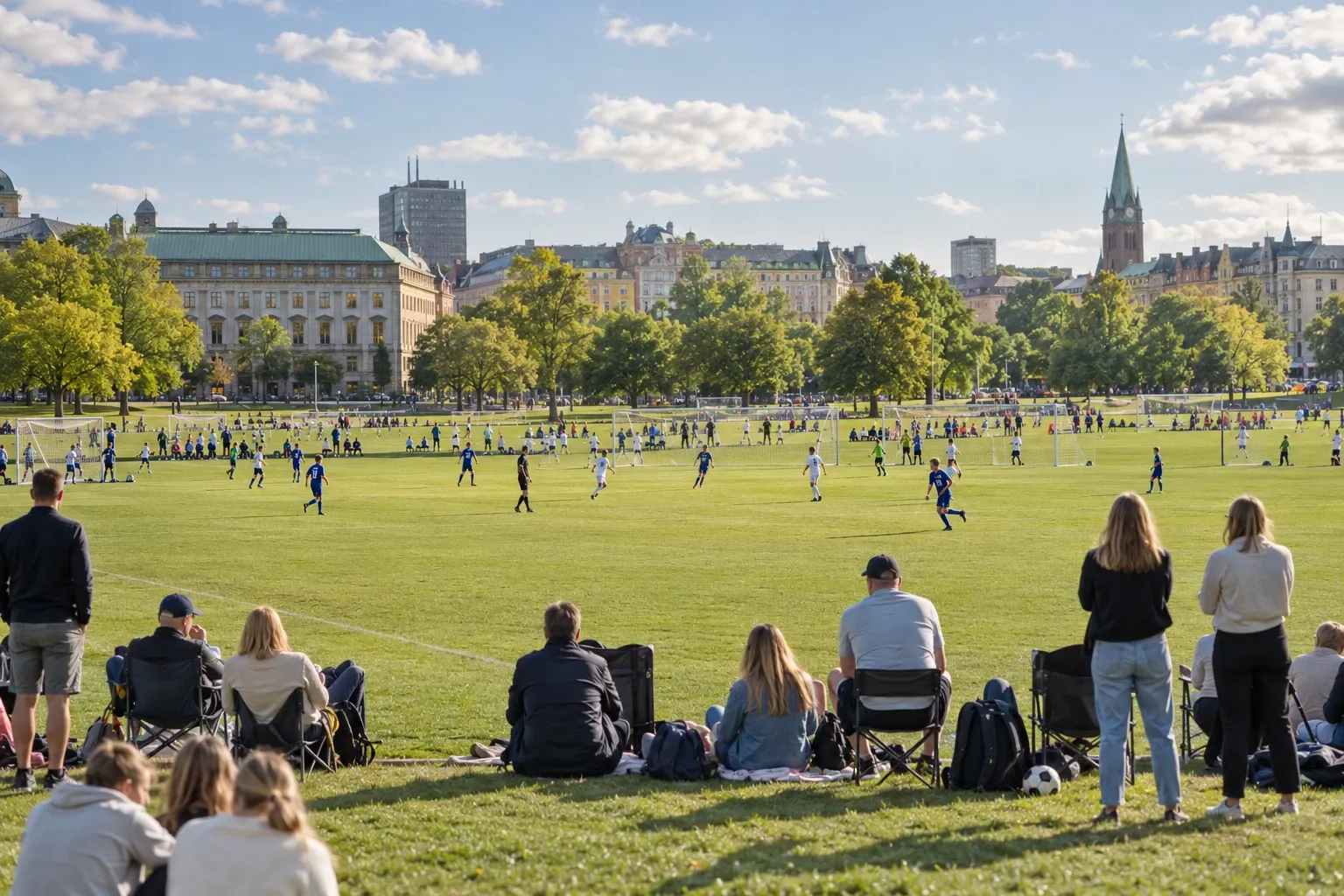
Every July nearly two thousand youth teams from around 77 nations take over Gothenburg for a week. This guide covers the 2027 dates, what spectators get for free, the Gothia Card, how a team gets in and what it costs, and the rules that catch first-time teams.
When you need this
You coach a youth team and are wondering whether Gothenburg in July is realistic, and by when you’d have to commit. Or your child’s team is going and you’re working out what parents pay for and what’s free. Or you’re planning a mid-July trip to Gothenburg for other reasons and want to know why the city is suddenly full of teenagers in tracksuits, and whether you can watch.
Gothia Cup 2027 at a glance
Gothia Cup started in 1975, founded by the Gothenburg clubs BK Häcken and GAIS together with a local newspaper. BK Häcken has run it alone since the early 1980s. Its organiser bills it as “the world’s largest and most international youth football tournament”, and the city’s visitor company, Göteborg & Co, uses the same words.
| Gothia Cup 2027 | |
|---|---|
| Arrival day (no matches) | Sunday 18 July |
| Matches begin | Monday 19 July |
| Opening ceremony | Monday 19 July, 20:00, Ullevi stadium (gates 18:30) |
| Leaders Party (adults 18+) | Tuesday 20 July, 19:00–24:00, Scandinavium |
| Special Olympics Trophy | 18–22 July, Kviberg and Heden |
| Finals and departure | Saturday 24 July, Gamla Ullevi and SKF Arena |
| Last edition | 2026: 1,964 teams, 77 nations, 4,947 matches, 124 pitches |
Watch out for old numbers. Tour-operator pages still give at least five different sets of 2027 dates. The organiser’s own pages agree on 18–24 July, and the 2026 tournament began on 12 July. Also, 2025 wasn’t the “50th Gothia Cup”, whatever you may read. It was the 49th edition, celebrating 50 years since 1975. The 50th edition was 2026, because the 2020 and 2021 tournaments were cancelled.
Watching as a visitor
Ordinary matches are free. Göteborg & Co says entry is free to all matches during the tournament week. You need a ticket only for the opening ceremony and for the finals at Gamla Ullevi.
The hub is Heden, an open space of pitches in central Gothenburg near Ullevi. Heden and Kviberg, north-east of the centre, are the largest pitch areas and draw the biggest crowds. The rest of the matches are spread across Centrum, Öster, Hisingen, Frölunda, Mölndal, Lerum, Kungsbacka and Härryda. The schedule, live results and a pitch map are on the organiser’s results site and app.
The opening ceremony is an hour of music, dancing, fireworks and a parade of every nation, in an Ullevi stadium that holds around 51,000 for the show. Tickets come with a pre-ordered Gothia Card for anyone in the tournament’s accommodation or paying the participation fee. Other visitors can buy a Gothia Card at the information desk at Heden during the week. It then includes a ceremony ticket only while tickets last. Two details turn people away at the gate:
- The Gothia Card alone isn’t a ticket. You need the separate physical ticket.
- No bags of any kind are allowed into the ceremony, and all bags are inspected.
Children under 4 can sit on a parent’s lap, and a companion of a person with a disability gets in free.
Finals day is Saturday 24 July. At Gamla Ullevi a Gothia Card lets you in once; without one, you buy a ticket. Again, no bags. In 2025 the finals at SKF Arena were free, and all B-finals were played at Heden. The organiser hadn’t published 2027 finals ticket prices when we checked.
Can’t be there? Matches are filmed by automated cameras. In 2026 more than 3,300 matches from almost 80 pitches were streamed live, with passes for the whole tournament or a single match.
The Gothia Card
The Gothia Card is the tournament pass. It gives you:
- free public transport in Gothenburg for the week,
- your opening ceremony ticket, if pre-ordered or while tickets last,
- one free entry to the Gamla Ullevi finals,
- selected events and partner offers around the city.
It’s included for every player and leader in the three team categories and for supporters who book a hotel through the organiser. Supporters in their own accommodation can buy one. Order it through your team leader and you’ll sit with the team at the ceremony; buy it at Heden and seating is random. It costs the same at any age. Note that children ride Gothenburg’s trams and buses free until they turn 7 anyway, so for a small child the card’s value is the ceremony seat.
Taking a team: how to get in
Gothia Cup accepts clubs and academies registered with a FIFA-affiliated national association, and school teams where schools play in the national FA’s competitions. Players must be registered with the club they play for and can’t belong to a club in a country where they don’t live.
Register in the autumn, not by the deadline. The formal deadline is 10 March. But when a category fills, teams that paid the registration fee first get in, and the date the money arrives counts. All 2026 categories were full by November 2025, and 2025 registration closed in November 2024. For 2027, registration opened on 21 September 2026.
| Category | Where the team sleeps | What’s included |
|---|---|---|
| A — school | A classroom or shared sports hall, on your own or rented mattresses | 18 meals (dinner 18 July to lunch 24 July), Gothia Card, one airport/station/ferry transfer |
| B — hotel | A hotel booked through the organiser | Breakfast, Gothia Card, one transfer |
| C — own | Wherever you arrange | Gothia Card only |
Hotel and own-accommodation teams buy lunch and dinner vouchers for nearby school canteens separately. The included transfer is for the team only, one round trip, booked in advance for at least ten people. Parents make their own way. In 2026 the tournament used 68 schools in six municipalities and 35 hotels.
The team year runs like this:
| When | What |
|---|---|
| Within 10 days of registering | Pay the registration fee (never refunded) |
| 10 January | School deposit, category A (never refunded) |
| 10 April | Accommodation and participation fees |
| 10 May | Extra orders and player cancellations; later refunds need a doctor’s note |
| 12 July | Player list complete: name, birth date and photo for everyone |
| 8–17 July | Online check-in |
If fees are more than five days late, the organiser may cancel the registration and keep the registration fee.
Age classes 2027
| Class | Born 1 January … or later | Format |
|---|---|---|
| B18 / G18 | 2009 | 11-a-side |
| B17 / G17 | 2010 | 11-a-side |
| B16 / G16 | 2011 | 11-a-side |
| B15 / G15 | 2012 | 11-a-side |
| B14 / G14 | 2013 | 11-a-side |
| B14B / G14B | 2013 | 9-a-side |
| B13 / G13 | 2014 | 9-a-side |
| B12 / G12 | 2015 | 7-a-side |
| B11 / G11 Friendly | 2016 | 7-a-side, no results, at least five matches |
Groups of four or five play each other once. The top two go to play-off A, the rest to play-off B, both knockout. Eleven-a-side teams may field two players at most one year over age, nine-a-side teams one, seven-a-side teams none. Girls may play in boys’ classes within the age rules. There’s also an invitation-only tournament for elite 17-year-olds, and the Special Olympics Trophy for young people with intellectual disabilities, run since 2011.
Rules that catch first-time teams
- The player list locks. Everyone must be in the team’s online account by 12 July with full name, eight-digit birth date and a clear photo. No names can be added during the week, and teams are photographed before matches for comparison.
- Every player carries ID. A passport, or for players from countries that need no passport to travel to Sweden, a driving licence or national ID card with a photo. Documents that expired after 30 June 2026 are accepted; copies are not.
- School house rules. Two to four leaders stay per team, and at least one responsible adult from the club must always be present. There’s no alcohol on school premises, silence from 23:00 to 06:00, and no smoking, cooking or coffee-making in classrooms. Breaking them can get a team thrown out of the school and the tournament.
- Don’t leave valuables lying around in a shared hall or classroom. The organiser itself warns against it.
- Protests cost money. A written protest is due within 90 minutes of the final whistle, with a fee refunded only if you win, and the jury’s decision is final.
- Food: allergies can be catered for, no dishes contain nuts (peanuts, almonds and sesame included), and there’s a pork-free option whenever pork is served.
Visas and insurance
Players and leaders of a registered team can get an invitation letter for a Schengen visa from the organiser. That happens once the registration fee and accommodation are paid and a name list with passport numbers has been validated. Accompanying parents don’t get one. A Schengen visa covers visits of up to 90 days. Teams can apply up to six months before travel. The organiser advises applying as early as possible, and the embassy alone decides. See passport rules for visiting Sweden and, for children travelling with coaches rather than parents, consent letters for children travelling without both parents.
Insure everyone. The organiser has no group insurance for injury, illness, theft or damage. The team manager must make sure players are insured on the pitch, and each person is responsible for their own cover off it. Participants from countries without a medical insurance agreement with Sweden must have personal medical insurance. EU, EEA and Swiss visitors with a European Health Insurance Card pay what Swedes pay, while most other visitors pay the full cost of care.
Getting around and finding a bed
Use trams and buses first: the organiser’s own Gothia Line buses run only where schools and pitches are hard to reach by public transport. River ferries are part of the same network, and the city bikes help in the centre. See Gothenburg public transport for how tickets and children’s fares work if you don’t have a card. The rail operator SJ has offered teams and supporters a discount on train travel to the tournament; check the organiser’s travel page for the current offer.
Göteborg & Co puts the crowd at about 35,000 players and almost as many accompanying guests, so beds go early. Supporters can book a hotel through the organiser for the six nights from 18 to 24 July (five nights minimum), with a Gothia Card included. Late cancellations are expensive: the deposit is non-refundable, and rooms cancelled after 10 April are charged in full. To compare neighborhoods yourself, see where to stay in Gothenburg.
July can bring both heat and downpours. In 2022 a heatwave led to the tournament’s first cooling breaks. In 2024 rain forced 1,086 matches onto other pitches. Pack for both, and see heatwaves in Sweden.
Practical information
| Item | Detail (2027 unless noted; checked 14 October 2026) |
|---|---|
| Dates | 18–24 July 2027; matches 19–24 July |
| Team registration fee | €260 / $340 (categories A and B); €760 / $900 (category C); never refunded |
| Participation fee | €80 / $90 per player or leader |
| School accommodation (A) | €280 / $360 per person with 18 meals; €1,000 / $1,000 deposit, never refunded |
| Hotel accommodation (B) | About €650 / $740 per person on average, with breakfast; 25% deposit |
| Mattress rental / extra school night | €60 / $70 per person / €25 / $30 per person and night, no meals |
| Gothia Card | SEK 500, any age |
| Watching ordinary matches | Free |
| Gamla Ullevi finals without a card | Ticket price not yet published |
| Livestream (2026 prices) | SEK 349 for all matches; SEK 89 per match |
| Protest fee | SEK 2,000, refunded if upheld |
| Official sources | gothiacup.se; results.gothiacup.se; goteborg.com |
FAQ
When is Gothia Cup 2027?
Gothia Cup 2027 runs from Sunday 18 July to Saturday 24 July in Gothenburg. Teams arrive on the 18th, when no matches are played. Group matches start on Monday 19 July, the evening of the opening ceremony at Ullevi stadium. The finals are played on Saturday 24 July at Gamla Ullevi and SKF Arena, which is also departure day.
Can anyone watch Gothia Cup matches for free?
Yes. Entry is free to all matches during the tournament week, at Heden, Kviberg and the other pitch areas around Gothenburg. You need a ticket only for the opening ceremony at Ullevi and the finals at Gamla Ullevi, where a Gothia Card lets you in once. The schedule and pitch map are on the organiser’s results site and app.
How do you get tickets for the Gothia Cup opening ceremony?
Players, leaders and supporters who booked accommodation through Gothia Cup or paid the participation fee get a physical ticket with their pre-ordered Gothia Card. Other visitors can buy a Gothia Card at the Heden information desk during the week, which includes a ceremony ticket while tickets last. The card alone is not a ticket, and bags are not allowed.
What is the Gothia Card and is it worth it for parents?
It is the tournament pass: free public transport in Gothenburg for the week, entry to the opening ceremony, free entry once to the Gamla Ullevi finals, plus selected events and offers. It costs SEK 500 regardless of age and is included in accommodation booked through the organiser. Ordered through the team, it seats you with the team at the ceremony.
How much does it cost to take a team to Gothia Cup?
For 2027 a team pays a registration fee of €260 per team, or €760 if it arranges its own accommodation. Each player and leader then pays an €80 participation fee, plus €280 for school accommodation with meals or about €650 on average for a hotel. Travel, extra meals and extras come on top. The registration fee is never refunded.
What ages can play in Gothia Cup?
In 2027 boys’ and girls’ classes run from 11 to 18: B18 and G18 are for players born on 1 January 2009 or later, down to the 11-year-old Friendly classes for those born in 2016 or later. Eleven-a-side starts at 14, nine-a-side is for 13-year-olds, seven-a-side for 11 and 12. Limited over-age dispensations apply.
Where do Gothia Cup teams sleep?
Teams choose one of three categories. In category A they sleep in a school classroom or shared sports hall with 18 meals included, on their own or rented mattresses. Category B is a hotel booked through the organiser, with breakfast. Category C teams arrange their own beds. In 2026 the tournament used 68 schools across six municipalities and 35 hotels.
How early should a team register for Gothia Cup?
As soon as registration opens in September. When a category fills, teams that paid the registration fee first get priority. All 2026 categories were fully booked by November 2025, and registration for 2025 closed in November 2024. The formal deadline is 10 March, but recent editions filled long before it.
Related guides
- Where to stay in Gothenburg — which neighborhoods work in a full event week.
- Gothenburg public transport — trams, tickets and children’s fares beyond the Gothia Card.
- Gothenburg travel guide — the city around the pitches on a rest day.
- Watching sports in Sweden — league football, hockey and bandy for the rest of the year.
- Day trips from Gothenburg — where to go once the final whistle has blown.
Facts verified 14 October 2026. Sources: Gothia Cup (organised by BK Häcken), Göteborg & Co, Migrationsverket, 1177 Vårdguiden — full register in this topic’s source file. Found something outdated? Tell us and we’ll fix it.