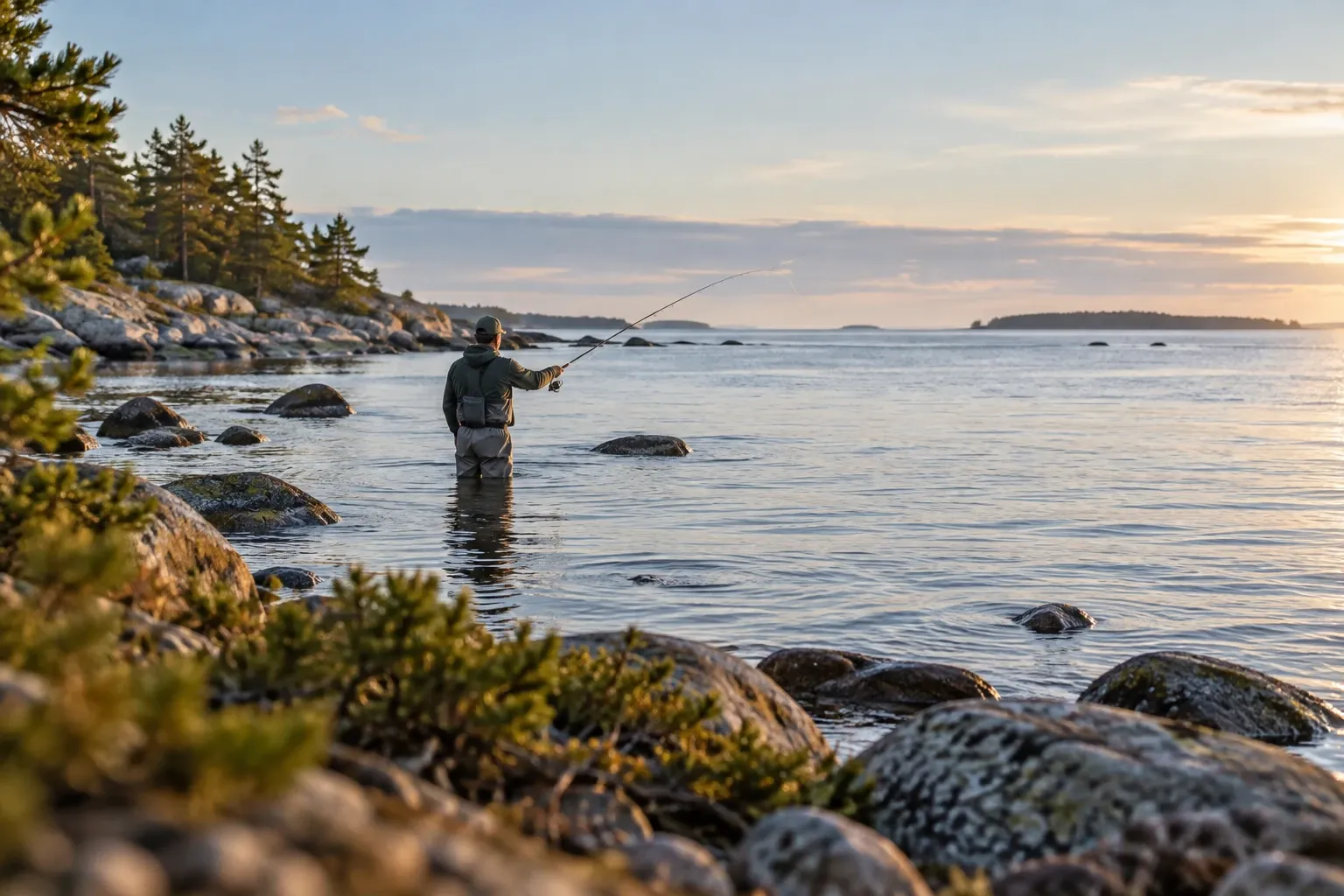
Sweden’s coast has four different sea-trout calendars, not one. Here is which stretch is open when, what you may keep, where the stream-mouth closures bite, and what changes for Baltic salmon in 2027.
When you need this
You’re planning a spring or winter trip to Skåne, Blekinge, Gotland or the west coast with a spinning or fly rod. You’re on an Öresund beach in late September and not sure the season is still open. You’ve just landed a silver trout on Gotland and want to know if you can keep it, or you’re trolling in the Stockholm archipelago and a salmon hits instead.
Free to fish, not free of rules
Havsöring — sea trout, the sea-run form of brown trout — needs no permit on the coast. The Fishing Act opens the whole Swedish coastline to handredskap (hand tackle: a rod or similar gear with a line and at most ten hooks), and foreign visitors have the same right as Swedes. Our guide to free fishing in Sweden explains that right stretch by stretch.
What the free right does not settle is when, where and what you may keep. That sits in one regulation from the Swedish Agency for Marine and Water Management (HaV): FIFS 2004:36. It sets the sizes, the daily limits and the closed seasons, and it lists the fredningsområden (closed areas) at stream mouths. The closures apply in the kustvattenområdet, the coastal water area that runs four nautical miles out from the baselines.
Two definitions in that regulation trip people up:
- Öresund is Baltic. The Baltic legally begins at Kullens fyr, the lighthouse at the tip of the Kullaberg peninsula in northwest Skåne. South of it, the 50 cm Baltic size applies, not the west coast’s 45 cm.
- The rules are for “salmon and trout” together. Closed seasons cover both species, and the west-coast bag limit counts them as one.
The four sea-trout coasts
Find your stretch first. Everything else follows from it.
| Coast stretch | Closed season | Minimum size | Daily limit |
|---|---|---|---|
| West coast — Bohuslän, Halland, Skåne north of Kullens fyr | 1 October–31 March (beyond 4 nm: all year) | 45 cm (40 cm Svinesund, Idefjorden) | Two salmon and sea trout combined |
| Kullens fyr to Torhamns udde — Öresund, Skåne’s south and east coasts, most of Blekinge | 15 September–31 December | 50 cm | None set nationally |
| Kalmar border to Västernorrland — Kalmar, Öland, Gotland, east coast, Stockholm, Gävleborg | No general closure; local closed areas | 50 cm, farmed fish too | One wild (fin intact) trout |
| Bothnian Bay — Västerbotten from Nordmaling, Norrbotten | 1 October–31 December | 50 cm | None set nationally |
“None set nationally” means the national regulation has no sea-trout daily limit for that stretch; the size, the closures and every local closed area still apply. A short piece of easternmost Blekinge, between Torhamns udde and the Kalmar county border, sits outside both the southern closure and the one-fish limit.
Measure from the tip of the snout to the tip of the tail fin. An undersized fish goes back at once.
The southern closure: 15 September to 31 December
The stretch from Kullens fyr round to Torhamns udde in eastern Blekinge closes to salmon and sea-trout fishing every year from 15 September to 31 December. That’s two weeks before the west coast closes, and it catches visitors who assume one autumn date for all of Sweden.
The wording matters. The regulation bans fishing for salmon and trout, so casting for sea trout with the plan to release them is not allowed either. A trout caught while you fish for something else goes straight back.
Some pages describe this as a new ban “from 15 September 2026”. It isn’t new, and it doesn’t run on indefinitely. It’s a recurring annual closure in the regulation, last reworded in 2021, and the county boards’ September 2026 notice gives the same 31 December end date. From 1 January the stretch reopens.
Stream mouths and closed areas
Sea trout gather off the streams they spawn in, which is exactly where closed areas sit. There are closed areas along the whole coast, each with its own boundary and dates, drawn in coordinates in the regulation and shown on the official map at svenskafiskeregler.se. Signs on the shore are not a reliable substitute.
A few patterns are worth knowing before you look:
- West coast: where a closed area’s rules say so, all fishing is banned 1 October–31 March. From 1 April to 30 September only hand tackle is allowed, and only if the method doesn’t need a boat.
- Gulf of Bothnia: at streams not listed in the regulation, all fishing is banned within 200 m of the mouth from 1 September to 31 December.
- Earlier than the coast: at the mouth of the Mörrumsån in Blekinge, salmon and sea-trout fishing with hand tackle closes on 1 September, two weeks before the coast around it.
Gotland
Gotland is the classic sea-trout island, and it has its own layer of rules. Twenty-five closed areas around 34 sea-trout streams are shut to all fishing from 1 September to 31 January. Since 2025 the ban covers the streams themselves, not just the mouths.
The open coast between them stays open all year. You may keep one wild sea trout per day, minimum 50 cm. A farmed trout — recognisable by its missing adipose fin, the small fleshy fin between the dorsal fin and the tail — doesn’t count toward that limit but must still be 50 cm. Getting there is covered in our Gotland and Visby guide.
Trolling and boats
Shore fishing never runs into a boat rule. From a boat it depends where you are:
| Where | Trolling in private water under the free right? |
|---|---|
| West coast, Skåne, northern coast | Yes — no boat condition |
| Östhammar to Blekinge, and Gotland | No — towed tackle needs a local permit |
| Anywhere | Casting or jigging from an anchored or drifting boat is fine |
Our free fishing guide explains where private water ends, and how to buy a fiskekort covers trolling permits.
Salmon on the line
Trolling or casting for sea trout in the Baltic sometimes brings in a salmon, and salmon has rules of its own. In 2026 you may keep one fin-clipped salmon per person per day, at least 60 cm, and then stop fishing for salmon. When trolling, any wild salmon — adipose fin intact — must be released at once, all year.
That may tighten. On 24 August 2026 the European Commission proposed ending recreational fishing for farmed salmon from 2027 in most of the Baltic, keeping it only in the northern coastal summer fishery. EU fisheries ministers are due to decide on 26–27 October 2026, and the new rules would apply from January.
Releasing a sea trout
Plenty of sea trout go back — undersized, out of season, or by choice. Research on Gotland’s sea-trout fishery gives simple advice: keep the fish in the water and limit its total time in the air to under 10 seconds. Fish that have recently spawned — a besa, or kelt — or that are caught in warm water are more stressed and need extra care.
The county boards of Skåne, Blekinge, Gotland and Kalmar have made a short film series on releasing sea trout, linked from the county fishing pages.
Mistakes to avoid
- Using 45 cm in Öresund. South of Kullens fyr is Baltic: 50 cm.
- Fishing Skåne or Blekinge in late September. The south closes on 15 September, not 1 October.
- Treating “the Baltic” as one rulebook. Skåne and Blekinge close in autumn; from Kalmar north there’s no general closure but a one-wild-fish limit.
- Fishing a stream mouth in autumn without the map. That’s where the closed areas are.
- Trolling inshore off Gotland without a permit. The free right excludes methods that need a boat there.
- Keeping a fin-clipped trout under 50 cm in the Baltic. The size covers farmed fish too.
Practical information
| Item | Detail |
|---|---|
| Permit for coastal rod fishing | None — free for everyone, visitors included |
| Gear under the free right | Hand tackle: rod or similar, line, max 10 hooks |
| Minimum size | 45 cm west coast (40 cm Svinesund, Idefjorden); 50 cm Baltic incl. Öresund |
| Daily limit | West coast: two salmon and trout combined; Kalmar border to Västernorrland incl. Gotland: one wild trout |
| Closed seasons | West coast 1 Oct–31 Mar; Kullens fyr–Torhamns udde 15 Sep–31 Dec; Nordmaling north 1 Oct–31 Dec |
| Gotland stream closed areas | 1 Sep–31 Jan, 25 areas at 34 streams |
| Baltic salmon by-catch, 2026 | One fin-clipped salmon per person per day, min. 60 cm; 2027 change proposed, decision due 26–27 Oct 2026 |
| Live closed areas | svenskafiskeregler.se |
| Penalty | Fines or prison; catch and gear forfeited |
FAQ
Do I need a license to fish for sea trout in Sweden?
Not on the coast. The whole Swedish coastline is free water for rod fishing, and foreign visitors have the same right as Swedes to fish there with hand tackle. You need a local fiskekort only in rivers and streams, and for trolling in private water from Östhammar to Blekinge and around Gotland. Size limits, closed seasons and closed areas still apply.
What is the minimum size for sea trout in Sweden?
It depends on the sea. On the west coast, in Skagerrak and Kattegatt, the minimum is 45 cm, or 40 cm in Svinesund and Idefjorden. In the Baltic, which legally starts at Kullens fyr and so includes Öresund, it is 50 cm, and that applies to farmed fin-clipped trout too. Measure from snout tip to tail tip.
When is sea trout season on the Swedish west coast?
From 1 April to 30 September. Salmon and sea trout are closed in the west-coast coastal water from 1 October to 31 March, and beyond the four-mile coastal zone all year. Any trout caught in the closed season must go back at once. Local closed areas at stream mouths can be stricter, so check the official map.
Can I fish for sea trout in Skåne in the autumn?
Not from 15 September to 31 December on the coast between Kullens fyr and Torhamns udde in eastern Blekinge, which covers Öresund, Skåne’s south and east coasts and most of Blekinge. The ban covers fishing for salmon and sea trout, so catch and release is not allowed either. North of Kullen, the west-coast season runs to 30 September.
How many sea trout can I keep in Sweden?
On the west coast, two salmon and sea trout combined per angler per day. On the Baltic coast from the Blekinge–Kalmar border to the Västernorrland–Västerbotten border, including Gotland, one wild trout a day; fin-clipped farmed trout do not count but must still be 50 cm. Elsewhere the national rules set no daily trout limit.
Is sea trout fishing on Gotland closed in autumn?
Partly. Gotland’s 25 closed areas around 34 sea-trout streams are shut to all fishing from 1 September to 31 January, and since 2025 that includes the streams themselves. The open coast between them stays open, with a 50 cm minimum and one wild sea trout per angler per day. Trolling in private water needs a permit.
Can I troll for sea trout from a boat?
On the west coast, in Skåne and on the northern coast, the free right sets no boat condition. From Östhammar to Blekinge and around Gotland, towed tackle in private water needs a permit, though casting from an anchored or drifting boat is free. In the Baltic, any wild salmon hooked while trolling must be released.
Related guides
- Free fishing in Sweden — where the free right applies, stretch by stretch, and where private water ends
- Swedish fishing rules — sizes and limits for the other fish you’ll hook on the coast
- Salmon fishing at Mörrum — sea trout and salmon in Blekinge’s famous river, on a permit
- How to buy a fiskekort — for trolling permits and river fishing
- Boating in Sweden — before you take a boat out to fish
Facts verified 2026-10-15. Sources: Sveriges Riksdag (Fiskelagen), Havs- och vattenmyndigheten (FIFS 2004:36 and species pages), Länsstyrelsen (Gotland, Södermanland, Västra Götaland, Svenska fiskeregler), European Commission — full register in this topic’s source file. Baltic salmon rules change each January, and a 2027 change is pending; re-check after the October 2026 Council. Found something outdated? Tell us and we’ll fix it.